
The numbers tell one story. The ownership structure tells another. Afrobeats generated an estimated $100 million globally in 2023, with streams on Spotify topping 14 billion — a figure that rose another 114 percent in 2024. Nigerian artists alone earned roughly $37.5 million in Spotify royalties that year, more than double their 2023 earnings. By surface metrics, the genre is thriving. But the structural question — who captures that value, and on what terms — remains largely unresolved.
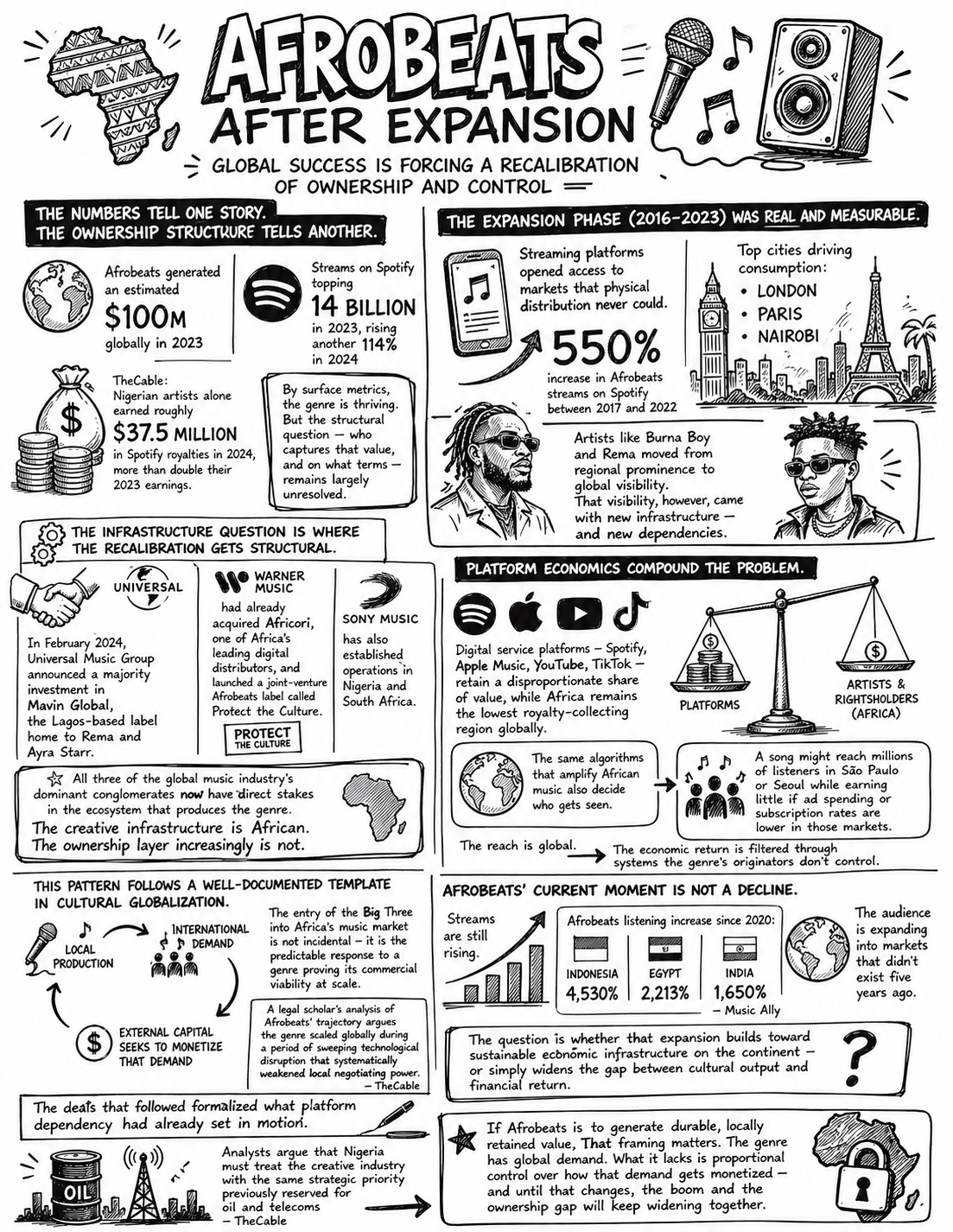
The expansion phase, roughly 2016 to 2023, was real and measurable. Streaming platforms opened access to markets that physical distribution never could. Between 2017 and 2022, Afrobeats streams on Spotify increased 550 percent, with London, Paris, and Nairobi ranking among the top cities driving consumption. Artists like Burna Boy and Rema moved from regional prominence to global visibility. That visibility, however, came with new infrastructure — and new dependencies.
The infrastructure question is where the recalibration gets structural. In February 2024, Universal Music Group announced a majority investment in Mavin Global, the Lagos-based label home to Rema and Ayra Starr. Warner Music had already acquired Africori, one of Africa’s leading digital distributors, and launched a joint-venture Afrobeats label called Protect the Culture. Sony has also established operations in Nigeria and South Africa. All three of the global music industry’s dominant conglomerates now have direct stakes in the ecosystem that produces the genre. The creative infrastructure is African. The ownership layer increasingly is not.
Platform economics compound the problem. Digital service platforms — Spotify, Apple Music, YouTube, TikTok — retain a disproportionate share of value, while Africa remains the lowest royalty-collecting region globally. The same algorithms that amplify African music also decide who gets seen, and a song might reach millions of listeners in São Paulo or Seoul while earning little if ad spending or subscription rates are lower in those markets. The reach is global. The economic return is filtered through systems the genre’s originators don’t control.
This pattern follows a well-documented template in cultural globalization. Local production generates international demand, which then attracts external capital seeking to monetize that demand. The entry of the Big Three into Africa’s music market is not incidental — it is the predictable response to a genre proving its commercial viability at scale. A legal scholar’s analysis of Afrobeats’ trajectory argues the genre scaled globally during a period of sweeping technological disruption that systematically weakened local negotiating power. The deals that followed formalized what platform dependency had already set in motion.
Afrobeats’ current moment is not a decline. Streams are still rising. Indonesia has seen Afrobeats listening increase 4,530 percent since 2020, followed by Egypt at 2,213 percent and India at 1,650 percent. The audience is expanding into markets that didn’t exist five years ago. The question is whether that expansion builds toward sustainable economic infrastructure on the continent — or simply widens the gap between cultural output and financial return.
Analysts argue that Nigeria must treat the creative industry with the same strategic priority previously reserved for oil and telecoms if Afrobeats is to generate durable, locally retained value. That framing matters. The genre has global demand. What it lacks is proportional control over how that demand gets monetized — and until that changes, the boom and the ownership gap will keep widening together.