
The platform that was supposed to make connection easier has made commitment harder. People are building exits — but not everyone can afford them.
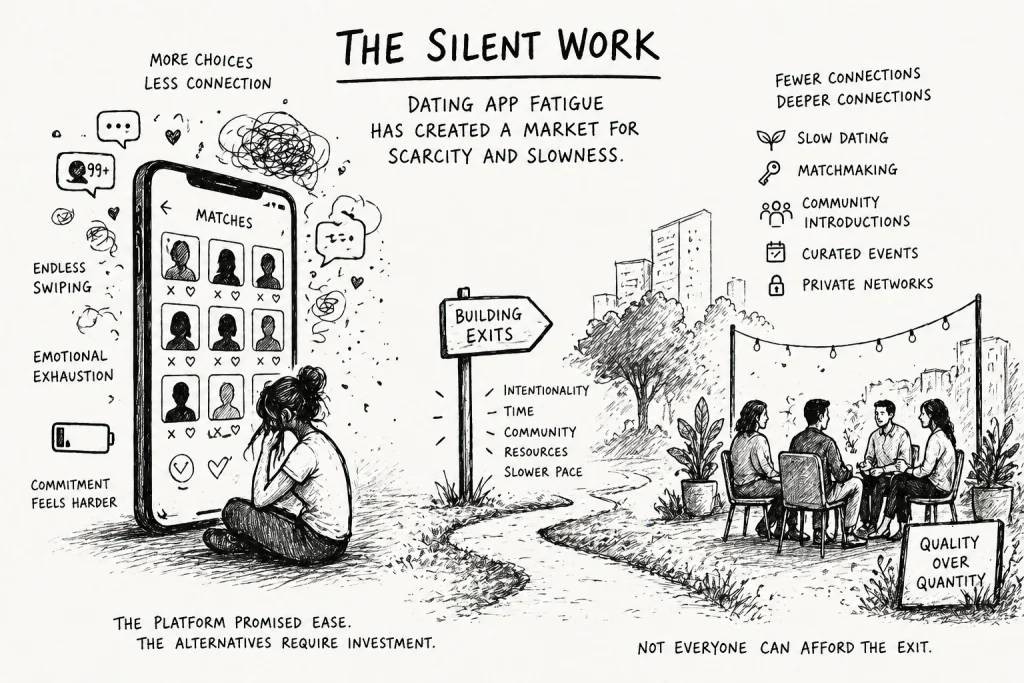
A growing disconnect exists between how people are currently dating and how they want to be dating — more people than ever are using dating apps while simultaneously experiencing emotional exhaustion tied specifically to app-based dating. That gap is not a technical problem. It is the predictable outcome of applying platform economics to intimate connection. Dating apps were built on the same logic as every other attention economy product — more volume, more engagement, more data. The fatigue being documented now is what happens when that logic runs long enough inside a domain where the human cost of optimization is felt personally and immediately.
68% of single Americans say dating apps and online platforms have made commitment more difficult — a finding that comes from the same population that continues using those platforms at record rates. That combination is the clearest evidence of how thoroughly the dependency has been established. People know the system isn’t working for them. They keep using it because the alternatives require resources — time, money, social infrastructure — that the platform was supposed to make unnecessary. Exiting a broken system is easier when you can afford to build something in its place.
What is being built in response is a market for the opposite of what apps optimized for. Slow dating — focusing on fewer connections and allowing relationships to develop more naturally — is rising as a deliberate counter to swipe culture. Matchmaking services are growing among demographics that previously considered them unnecessary. Community-based introductions, curated events, and private social networks are attracting people who have calculated that the emotional cost of the app experience exceeds its return. Singles are becoming more intentional, more selective, and far less interested in the endless swiping culture that defined the last decade. The correction is real. So is the access question — curated alternatives are consistently more expensive than the apps they replace, which means the exit from platform dating is easier for people with more financial flexibility.
I spent enough time in communications strategy to recognize what is happening here. The app companies built a dependency and are now watching a segment of their most burned-out users build alternatives around the edges of the system. That is not disruption. It is what happens when a platform optimizes so aggressively for engagement that it degrades the experience it was supposed to deliver. The people leaving are not rejecting connection. They are rejecting the infrastructure that was supposed to facilitate it and finding that the most durable alternatives look a lot like what existed before the apps arrived — community, slowness, intentionality, and the willingness to invest time before swiping.
The broader signal is structural. Only about 30% of young adults are actively dating in an environment where the primary infrastructure for meeting people is a platform most of them find emotionally exhausting. That is not a generation that doesn’t want connection. It is a generation navigating a connection system that was not designed around their actual needs — and building alternatives with whatever resources they have available.
Slowness isn’t a trend. It’s a correction. And like most corrections, it asks for something the system trained people to avoid: patience, presence, and the willingness to risk less volume for something that might actually last.