
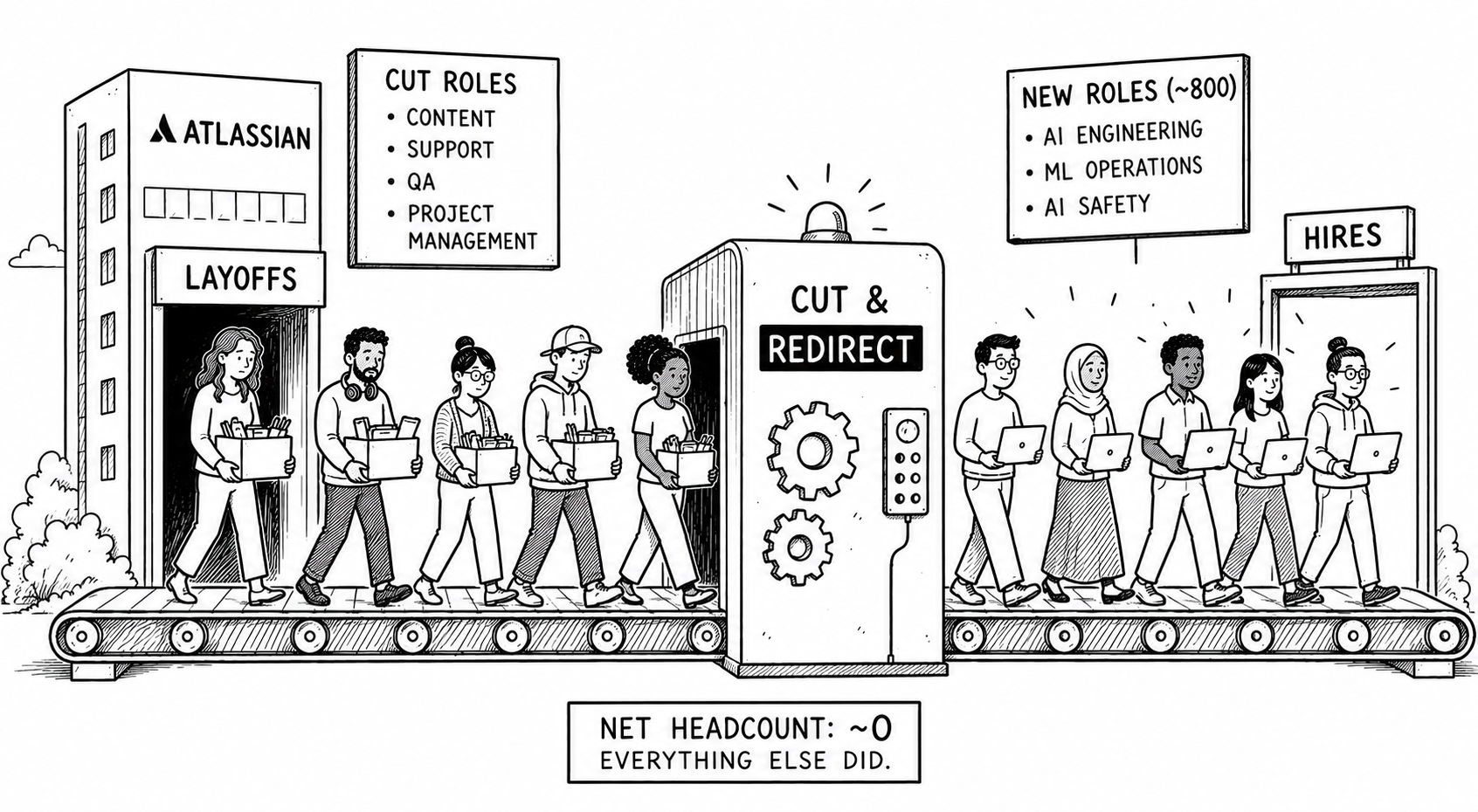
Atlassian laid off workers this year concentrated in four functions: content creation, customer support, quality assurance, and project management — the roles where AI tools have made the fastest documented progress. At the same time, the company announced plans to hire approximately 800 new positions in AI engineering, machine learning operations, and AI safety. The net change in headcount: roughly zero. The New York Times described the shift as a watershed moment in corporate America’s relationship with artificial intelligence.
The label “layoffs” undersells what happened. A traditional layoff shrinks a company. This didn’t — it re-staffed one, swapping out an entire category of work for a different one, on a roughly one-for-one basis. Atlassian‘s operating margin is projected to improve by 8 to 12 percentage points as a result, which is the kind of number that gets a restructuring rewarded by investors rather than questioned by them.
The pattern has a name inside the industry now: “cut and redirect.” A company spends 12 to 18 months building out AI infrastructure and tooling. Then it runs an internal assessment of which roles that tooling can now partially or fully cover. The roles that can be covered get cut. New roles — building, maintaining, and governing the AI systems themselves — get opened in their place. Tech-sector layoffs in 2026 have already passed 183,000 across 247 events, an average of over 1,100 jobs lost per day, and roughly 48% of tracked layoffs this year have been explicitly attributed to AI by the companies making them.
What “cut and redirect” doesn’t address is who fills the new roles. A content writer, a QA tester, and a customer support specialist are not, by default, qualified for AI engineering or ML operations — those are different skill sets requiring different training, often different degrees entirely. The math at the company level can look neutral: same number of jobs, different jobs. The math at the individual level is not neutral at all. The person whose role got cut and the person hired into the new AI-safety role are very often not the same person — and the company’s headcount chart doesn’t capture that gap.
Atlassian isn’t unusual in this. It’s notable mainly for how cleanly it illustrates a pattern other companies are running with less transparency — bundling AI-driven reductions into broader restructuring language that makes the “cut and redirect” ratio harder to see. The aggregate jobs numbers may end up looking stable. The people inside those numbers are being asked to become different people, on a timeline largely set by the companies doing the cutting.