
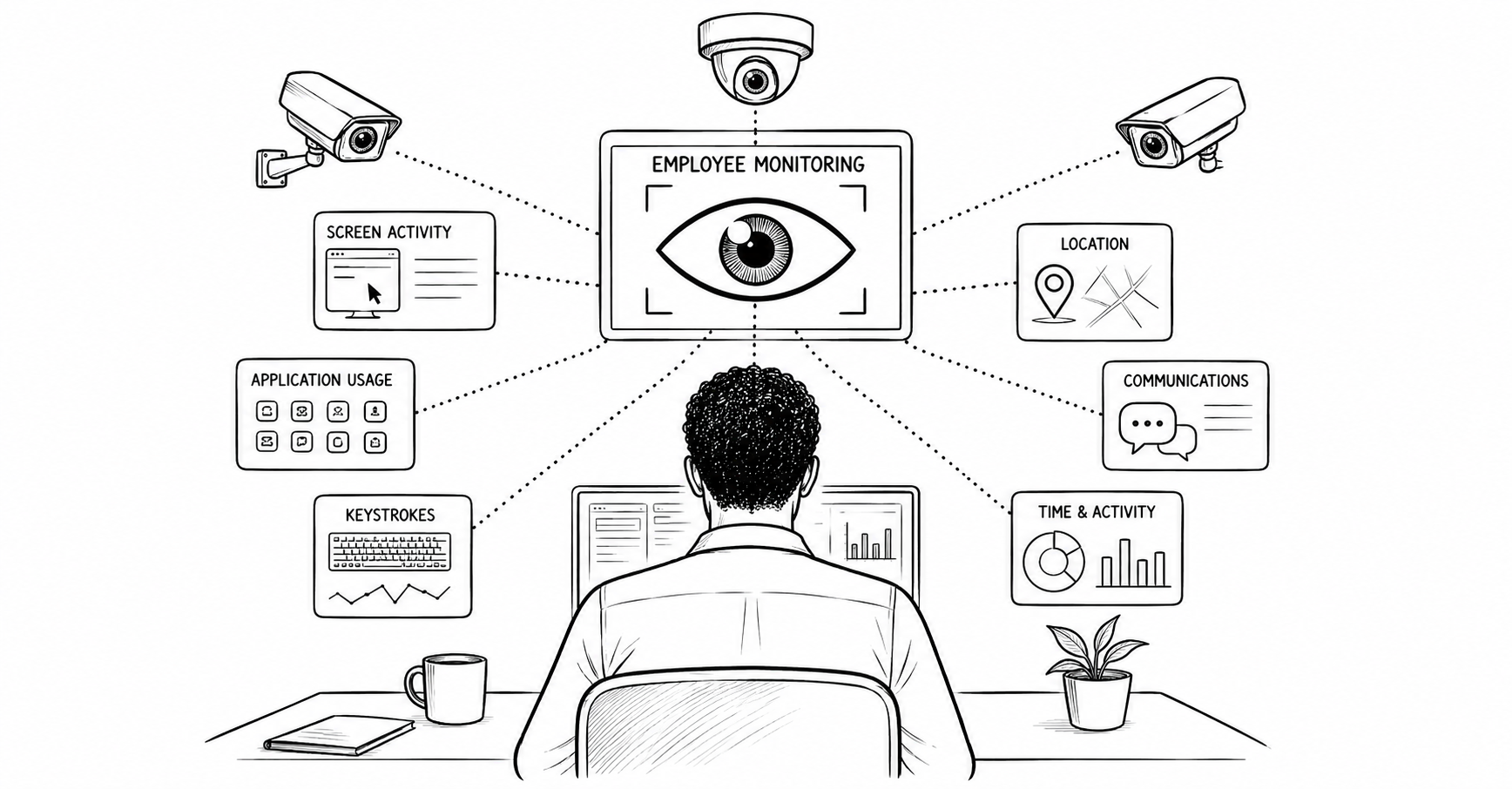
The market for employee monitoring software is projected to reach $12.3 billion by 2033, according to industry research compiled by WorkTime. That number is not a prediction about a distant future. Adoption grew from 30% before the pandemic to 60% by 2022, driven primarily by employer anxiety about remote work visibility. By 2026, an MIT study found that 80% of companies are already monitoring remote or hybrid workers. The surveillance infrastructure is already in place. The legal framework governing what employers can do with what they collect has not kept pace.
The tools themselves have expanded well beyond the security camera. Modern workplace monitoring systems track application usage, website visits, keystrokes, screen content, GPS location, communication patterns, idle time versus active time, and in some configurations, audio and video through workplace devices. Kickidler, one platform currently on the market, offers live screen monitoring, video and audio recording, remote access, violation detection, and keylogging as standard features. The vendor describes this as operational visibility. Workers describe it differently. Research shows that 59% of employees feel stress and anxiety about workplace surveillance, and 54% say they would be willing to quit over excessive monitoring.
The stress response is not irrational. It reflects a structural asymmetry that the productivity framing obscures: the data collected through monitoring systems belongs to the employer, not the worker. The worker generates it through their labor. The employer owns it, analyzes it, and uses it to make decisions about performance, compensation, scheduling, and termination. The worker typically has no legal right to see the full picture of what has been collected, no right to correct inaccurate inferences, and in most states, no right to be meaningfully notified before the monitoring begins.
That legal gap is starting to close — unevenly and slowly. New York Labor Law requires written notice upon hiring and conspicuous workplace postings. California’s CCPA amendments expanded employee rights to access personal data collected through monitoring systems. The Texas Privacy Protection Act became fully effective in January 2025, requiring comprehensive disclosure of monitoring activities. California’s AB 1331, introduced in the 2025–2026 legislative session by Assemblymember Elhawary, would require employers to provide at least 30 days notice before implementing any new surveillance tool and to disclose the type of data being collected, the purpose, and the justification. Most states have none of these requirements. Federal legislation remains proposals rather than law.
The NLRA adds a separate layer. The National Labor Relations Board has warned that surveillance used to monitor, intimidate, or retaliate against workers organizing for collective action is illegal. That protection exists on paper. Enforcement depends on workers knowing their rights, having the resources to file complaints, and operating in an environment where the NLRB has the staffing and political backing to act. In the current federal environment, none of those conditions are guaranteed.
What the legal patchwork produces is a surveillance system whose reach depends on geography. A worker in New York has different rights than a worker in Texas, who has different rights than a worker in a state with no monitoring disclosure requirements at all. The monitoring tools themselves operate nationally. The legal protections do not. Employers deploy the same software across their entire workforce. Workers’ ability to understand, challenge, or limit that monitoring varies entirely by which state they work in.
The productivity argument that employers use to justify surveillance deserves examination. Research on the effects of intensive monitoring found that productivity declined by 8–19% despite longer work hours, with output per hour dropping and collaboration decreasing as employees interacted with fewer colleagues. The tools designed to increase productivity are, in at least some documented cases, producing the opposite effect — not because workers are less motivated, but because surveillance changes the nature of the work itself. Workers optimize for what is being measured rather than for what actually produces results. The measurement system becomes the work.
The structural consequence is not what monitoring does to individual productivity scores. It is what it does to the balance of power inside the employment relationship. Every behavioral data point collected about a worker strengthens the employer’s ability to make decisions that the worker cannot fully see, challenge, or contextualize. Performance reviews, terminations, and scheduling decisions are increasingly shaped by algorithmic analysis of monitoring data. The worker experiences the outcome. The reasoning behind it remains inside the system.
The next phase of workplace surveillance is AI-driven inference — not just tracking what workers do, but predicting what they are likely to do, flagging behavioral patterns before any defined violation occurs, and scoring workers against productivity models that no single worker helped design. Federal AI monitoring proposals under consideration would require disclosure when artificial intelligence analyzes employee behavior or performance. Those proposals have not yet become law. Until they do, the most consequential decisions being made about workers’ professional futures may be made by systems workers never agreed to, cannot inspect, and have no legal mechanism to contest.
The workplace surveillance story is not primarily about software. It is about who holds the data, who sets the definitions, and who absorbs the consequences when the system gets it wrong.