
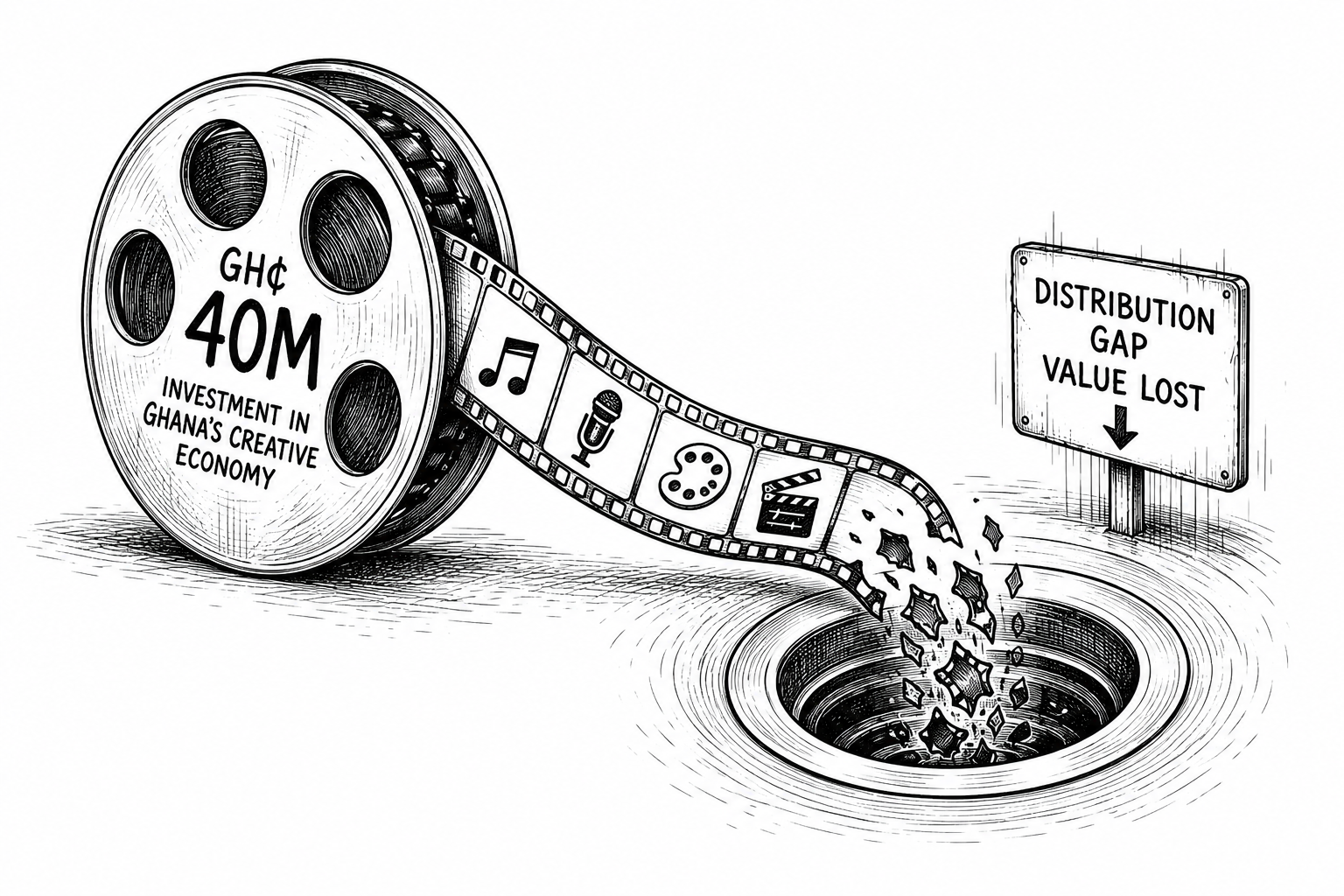
Ghana’s Finance Minister Dr. Cassiel Ato Forson presented the 2026 Budget Statement with a commitment that the country’s creative sector had been waiting years to hear: GH₵40 million in seed funding for the creative economy, with GH₵20 million directed specifically at the film industry. President John Mahama confirmed the allocation during his State of the Nation Address in February 2026. Converted to U.S. dollars, the total investment sits at approximately $48 million. Ghana’s Graphic Online called it the first major coordinated public investment plan for the country’s creative sector in years.
The investment addresses production. The constraint is distribution.
Ghana’s creative sector currently contributes an estimated 1.5% of GDP—below Rwanda at 5.3%, below South Africa at 3%, below Kenya’s trajectory toward 10% by 2025, and far below Nigeria, where Nollywood alone contributes 2.3%. The country has not struggled to produce artists. It produced Afrobeats pioneer Sarkodie, international crossover artist Stonebwoy, and Black Sherif, whose debut album reached listeners in more than 100 countries. Its Year of Return campaign generated nearly $1.9 billion through cultural tourism in 2019. Ghana can create cultural products that travel the world. It has struggled to build the machinery that keeps more of the economic value at home.
One place that machinery breaks down is copyright enforcement. Ghana’s copyright collection society, COSGA, operates with limited capacity to track, collect, and distribute royalties from streaming, radio, and sync licensing. Music can circulate globally while the institutions responsible for collecting revenue lag behind it. The $48 million investment does not directly strengthen enforcement capacity, modernize royalty collection, or reform the legal frameworks that determine how money flows back to Ghanaian creators.
Even if those royalties were collected perfectly, streaming economics create another obstacle. Sub-Saharan Africa’s recorded music revenue reached $110 million in 2025, and the market continues to grow. But global streaming platforms pay standardized royalty rates into vastly different economies. A Ghanaian artist and a U.S. artist may generate the same number of streams and receive the same nominal payment, yet that payment circulates inside markets with dramatically different purchasing power and investment capacity. Growth in consumption does not automatically translate into growth in local wealth.
Ownership may be the biggest constraint of all. Many of Africa’s most commercially successful artists are signed to or distributed through Universal Music Group, Sony, and Warner—international conglomerates that often control master recording rights and capture much of the revenue before it reaches either the artist or the country where the work originated. When Universal Music Group acquired a majority stake in Nigerian record company Mavin Global, it invested in one of Africa’s fastest-growing music markets. It also acquired the rights to a catalog that had generated more than 6 billion streams.
The $48 million commitment is an important policy signal, but signals and structures are different things. Seed funding creates lasting returns when it strengthens the systems that determine who captures value. For Ghana’s creative sector, those systems include copyright enforcement, collection capacity, streaming economics, and ownership of intellectual property. Build those systems and today’s investment can compound over time. Fund production alone, and Ghana may create even more global cultural successes while watching much of their economic value leave the country.
Get SSC analysis delivered to your inbox every day. Subscribe free on Beehiiv: socialstorytellerscollective.beehiiv.com