
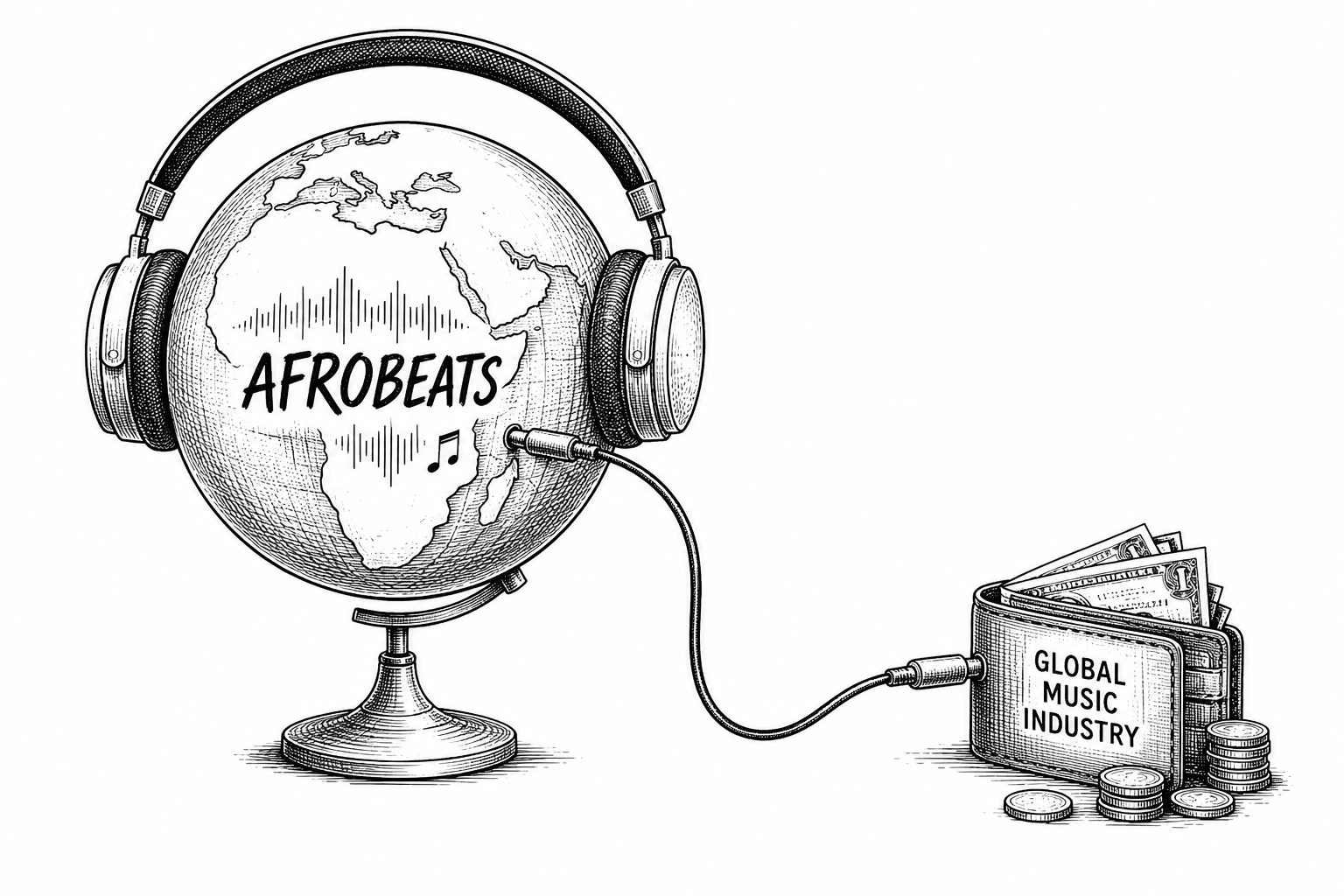
The numbers are not in dispute. Afrobeats streams on Spotify grew 34% globally in 2024. Amapiano clocked over 1.4 billion streams the year before, 61% of them from outside the continent. U.S. Afrobeats concert bookings are up 400% year over year, according to Live Nation. Burna Boy’s Love, Damini world tour brought in $40 million across 12 countries. Wizkid’s Made in Lagos tour grossed over $25 million. Rema’s “Calm Down” became the first African-led track to enter Spotify’s Billions Club. Twelve African artists from four countries received Grammy nominations in 2025. The genre has arrived.
The receipts tell a different story about where the money goes.
Global recorded music revenues hit $29.6 billion in 2024. Sub-Saharan Africa’s recorded music revenue reached $110 million in 2025 — its first crossing of the $100 million threshold, representing 22.6% growth and ranking the region joint-second globally in growth rate. That sounds like momentum. CISAC’s 2025 report puts the figure in context: despite Africa being the fastest-growing music region on earth, total royalty collections across the continent reached only €90 million — 0.7% of global music collections. Africa is producing the culture. It is not capturing the return.
The mechanism producing this gap is not new — it is the same extractive architecture that has governed African cultural exports for decades, now operating at streaming scale. A Harvard Law School report authored by Nigerian-born legal scholar Olufunmilayo Arewa documented the structure precisely: Afrobeats scaled globally during a period of sweeping technological disruption — from MP3 downloads to modern-day streaming — and those shifts weakened local negotiating power at exactly the moment global reach was expanding. The genre grew faster than the infrastructure protecting its value.
The royalty system is the primary transfer mechanism. Streaming platforms pay per stream at rates that disadvantage African artists in two compounding ways. First, the payout per stream is the same regardless of where the stream originates — meaning a Nigerian artist whose song streams primarily in Nigeria, where per-capita income is a fraction of the U.S. equivalent, collects the same nominal rate as an artist whose audience is concentrated in high-income markets. Second, the master recording rights for many of the genre’s most commercially successful artists are held by major international labels — Universal Music Group, Sony, Warner — meaning the royalty revenue generated by African cultural production flows to corporate structures headquartered outside the continent before any distribution reaches the artist.
Copyright infrastructure compounds the problem. Weak enforcement mechanisms across many African markets mean that local streaming, radio play, and sync licensing generate royalties that are collected inconsistently or not at all. CISAC’s 0.7% figure reflects not only what Africa receives from global music collections but what the continent’s collection societies are able to capture from within its own borders.
The institutional response is arriving, but at a different speed than the cultural moment. Afreximbank signed a $1 billion initiative to support Africa’s creative industries. The IFC and Sony Group have established a fund to invest in Africa’s creative sector. Ghana’s government committed $48 million to creative economy development. These are investments in the infrastructure that should have existed before the genre went global — building what the culture needed before it needed it, not after the value has already been extracted.
Afrobeats is not a story about an industry that failed. It is a story about a culture that succeeded faster than the systems protecting its economic value could keep pace. The genre won the world. The question the receipts are asking is whether winning the world produces sustainable return for the communities that built the sound — or whether it produces another generation of cultural exports that enrich the distribution infrastructure more than the artists who fill it.
Get SSC analysis delivered to your inbox every day. Subscribe free on Beehiiv: socialstorytellerscollective.beehiiv.com