
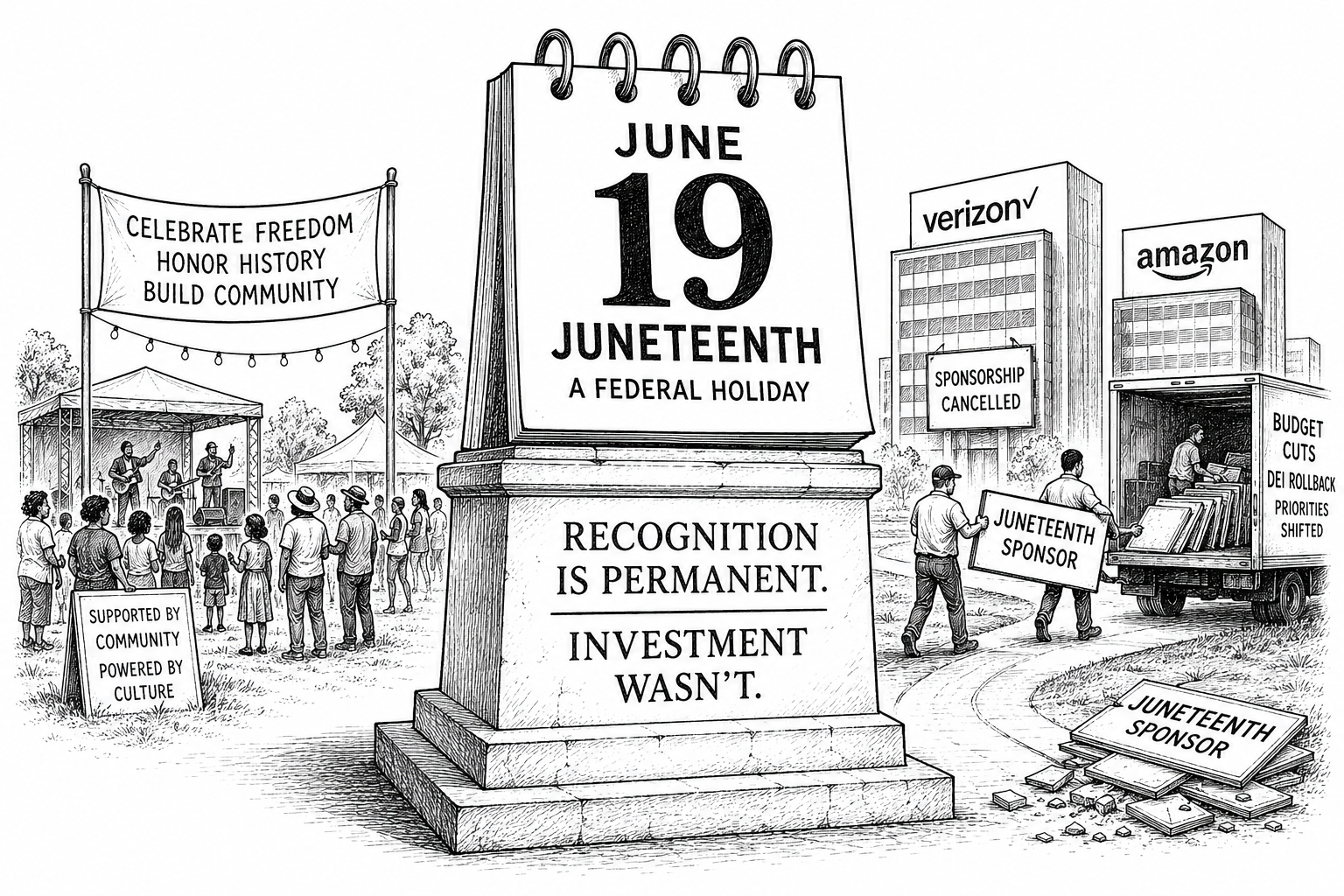
Juneteenth became a federal holiday in 2021. Congress passed the legislation. President Biden signed it. For the next two years, corporations issued statements, launched campaigns, and attached their logos to celebrations across the country. The investment looked like commitment. It was timed to a cultural moment — and the moment passed.
The AP reported in June 2025 that Juneteenth celebrations across the country were being scaled back as corporate sponsors withdrew financial support. In Denver, more than a dozen companies backed out of the Juneteenth Music Festival in the historically Black Five Points neighborhood, forcing organizers to cut the event from two days to one and launch an emergency $80,000 fundraising campaign. Norman Harris, executive director of JMF Corporation, which produces the festival, said companies “pulled back their investments or let us know they couldn’t or wouldn’t be in a position to support this year.” Grassroots donors and small businesses stepped in when the larger backers stepped aside.
In Colorado Springs, the local celebration relocated to a mall parking lot after corporate support dropped from dozens of sponsors to five. Jennifer Smith, a planner for the Southern Colorado Juneteenth Festival, named the reason directly: “They have said their budgets have been cut because of DEI, and that they can no longer afford it.” In Scottsdale, Arizona, the city council dissolved its DEI office in February 2025 and the city’s annual Juneteenth observance was canceled entirely. West Virginia announced it would not host events for the first time since 2017, citing budget deficits — the same week its governor signed legislation eliminating DEI from state government.
The National Endowment for the Arts rescinded grants to dozens of Juneteenth organizers in May 2025. The Cooper Family Foundation, which produces one of the largest Juneteenth celebrations in San Diego, received an email informing them their $25,000 grant was being pulled. The reason given: the event no longer aligned with the agency’s priorities. Maliya Jones of the foundation said organizers had to personally finance key elements — cultural exhibits, performances, and youth programming — that the grant had previously covered.
In Plano, Illinois — which designated Juneteenth as a local holiday before the state or federal government did — the fifth annual celebration was canceled because local businesses feared losing customers if they were listed as sponsors. In Bend, Oregon, planners cited “an increasingly volatile political climate” as the reason for cancellation.
The mechanism is not complicated. A study found that 15% of organizations said they would stop recognizing identity and heritage events amid the wider backlash against DEI programs. Corporate Juneteenth sponsorships boomed after George Floyd’s murder in 2020 — driven by brand activism calculations, not infrastructure commitments. When the political environment shifted, the calculation shifted with it. Many companies that sponsored Juneteenth events have contracts directly with the federal government or receive indirect federal funding through nonprofits, and Trump’s executive orders required federal contractors to certify they do not promote DEI programs. The sponsorship was always conditional. The condition changed.
What did not change is the federal holiday itself. Juneteenth remains a U.S. federal holiday in 2026. Federal offices, banks, and the stock markets close for it. The recognition is permanent. The investment was not. Verizon and Amazon are among the companies that have pulled back from Juneteenth sponsorships. The holiday they are no longer funding still commemorates the same event it always did.
Juneteenth 2026 arrives on June 19 — ten days from today — in a DEI environment that has contracted further since 2025. The corporate infrastructure built around the holiday between 2020 and 2023 has been systematically dismantled. The community organizations that were told their events had a corporate partner now know that partner’s commitment was calibrated to a political climate, not to the history the holiday represents.
Recognition becomes infrastructure when institutions build sustainable support systems around it. When those systems depend on brand activism cycles that reverse with the next executive order, recognition is not infrastructure. It is a press release with a shelf life.
The federal holiday is still on the calendar. The money that was supposed to support what happens on that day is somewhere else now.
Get SSC analysis delivered to your inbox every day. Subscribe free on Beehiiv: socialstorytellerscollective.beehiiv.com