
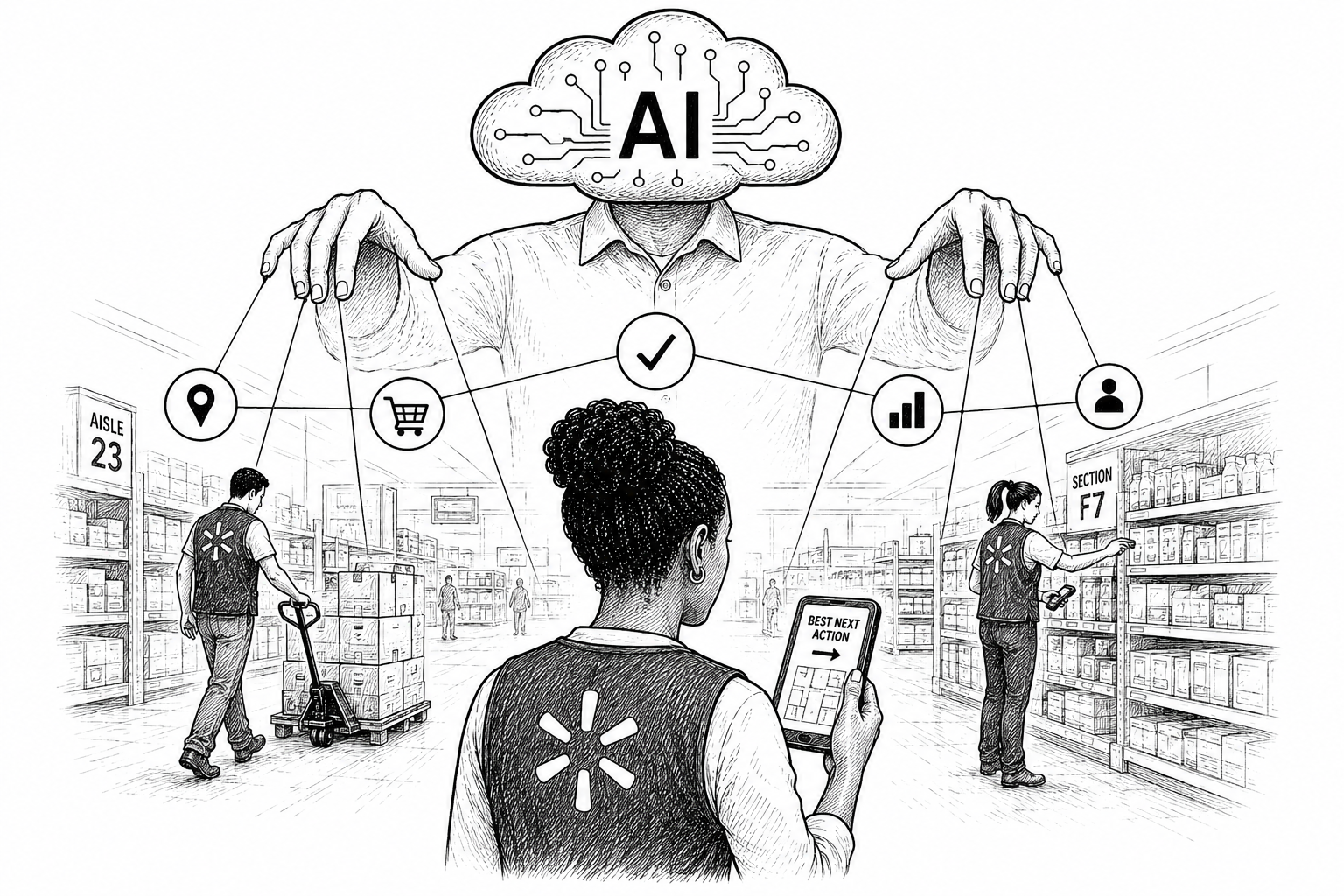
At its 2026 Associates Week in Bentonville, Arkansas, Walmart executives repeatedly described the company’s strategy as “people-led, powered by technology.” The message was designed to reassure employees that artificial intelligence is a tool rather than a replacement. One announcement made the reassurance harder to accept at face value: approximately 1.3 million U.S. Walmart associates now carry AI-powered devices that surface the best next action, display store layouts, and help workers locate products more efficiently. The technology is designed to make employees better at their jobs. It is also reorganizing who — or what — is doing the managing.
The public debate around AI has centered on whether machines will replace human workers. The transformation underway across the economy is more precise than that. In many industries, AI is not eliminating employees first — it is reorganizing them. The algorithm decides what should happen next. The worker executes the recommendation. Management becomes software.
Walmart‘s own strategy maps that evolution directly. The retailer has expanded its use of AI agents that work alongside employees, supply chain partners, and developers to streamline operations and consolidate workflows. It has developed an internal coding assistant called Code Puppy that helps employees assemble information previously requiring emails and coordination across multiple teams. Executives describe these tools as freeing workers from repetitive tasks so they can focus on higher-value work.
That framing is accurate as far as it goes. What it does not describe is the structural shift in authority embedded in the design. Warehouse workers follow optimized picking routes generated by software. Delivery drivers receive routes determined by algorithms. Gig workers are assigned jobs and evaluated by automated systems. Walmart is now placing AI guidance directly into the hands of 1.3 million front-line retail employees. The workplace is becoming an operating system — and the worker is running processes determined elsewhere.
The customer side of the equation makes the architecture visible. Walmart executives noted that 85% of shopping still occurs in physical stores, yet customers who use the Walmart app while shopping spend 25% more than those who do not. The store is being enhanced by software that shapes navigation, recommendations, and purchasing behavior simultaneously. Employees are guided by algorithms. Shoppers are influenced by them. Both become participants in the same digital system — one that was designed, maintained, and optimized by a layer of the organization neither group directly interacts with.
Walmart President and CEO John Furner acknowledged that the company is still learning what works — that agentic commerce and operations remain in their early stages and some experiments will fail. That admission is more significant than it sounds. It means 1.3 million workers are already inside a management system whose long-term design is still being determined.
The automation economy is not arriving through one dramatic announcement. It is arriving through 1.3 million small recommendations that quietly reshape how people work every day. The supervisor of the future may still wear a name badge. Increasingly, the instructions will come from software — and the worker’s relationship to decision-making will have changed long before any job title does.
Get SSC analysis delivered to your inbox every day. Subscribe free on Beehiiv: socialstorytellerscollective.beehiiv.com