
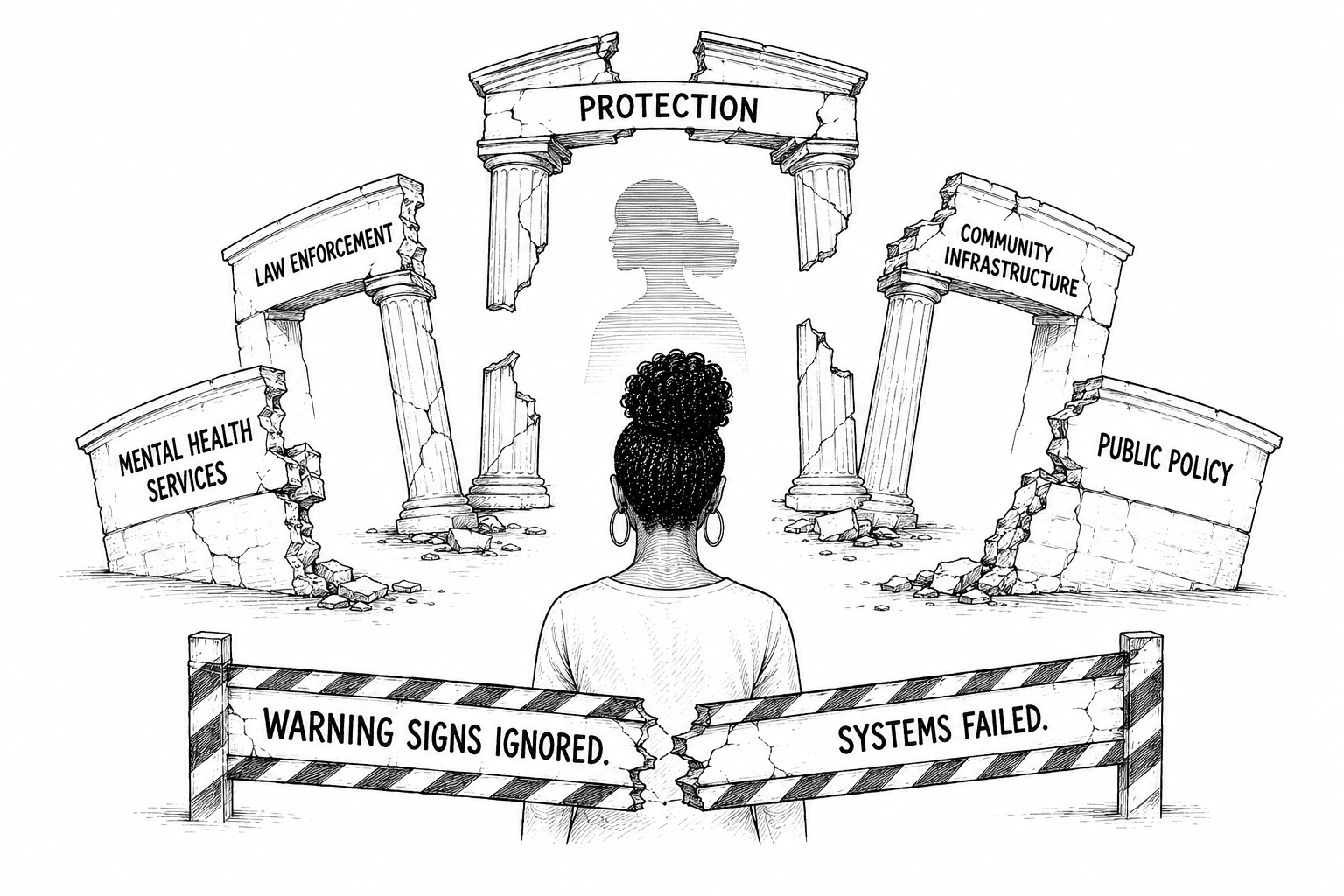
In a recent opinion essay for The Guardian, columnist Tayo Bero argued that the killings of several Black women by current or former partners — including Cerina Fairfax in Virginia and Coral Springs Vice Mayor Nancy Metayer Bowen in Florida — should not be understood as isolated tragedies. They are part of a documented public health crisis that reflects failures across multiple systems simultaneously: law enforcement, mental health services, community infrastructure, and public policy.
The data makes the pattern visible. A 2025 study found that Black women are approximately 2.5 times more likely to be murdered by men than white women. A 2024 CDC report found that although Black women comprise roughly 13% of the U.S. female population, they account for nearly 30% of intimate partner homicide victims. In most cases, the perpetrator is someone they knew. Firearms are the most common weapon used.
The instinct after these deaths is to search for a single explanation: mental illness, access to firearms, a difficult divorce, a relationship dispute that escalated. That instinct is the problem. Violence rarely emerges without warning. Reports of previous threats, prior police calls, controlling behavior, and escalating conflict frequently precede these deaths. The question is not simply why one man became violent. It is why repeated warning signs so often fail to produce meaningful intervention — and who absorbs the consequences when they don’t.
The barriers are compounded for Black women specifically. Research has documented persistent distrust between Black communities and institutions including law enforcement and child welfare systems — distrust built through documented histories of over-policing, racial bias, and surveillance rather than protection. At the same time, cultural expectations can place Black women in the role of protector — of family, community, and the public image of Black men. Reporting abuse may feel not only dangerous but socially costly. The systems designed to intervene are the same systems that have historically produced harm. That is not irrational distrust. It is institutional memory.
What happens after these deaths compounds the structural failure. Public conversation shifts quickly toward the biography of the perpetrator — his mental health history, his professional struggles, his circumstances. The victim’s vulnerability becomes a footnote to his story. The policy failures affecting thousands of women become invisible behind the personal narrative of one man. A pattern is flattened into an incident.
Intimate partner violence operates at the intersection of economic dependence, access to services, institutional trust, gender norms, and public policy. When those systems fail simultaneously — when the victim doesn’t call because she doesn’t trust the response, when she does call and the response is inadequate, when she leaves and the infrastructure to keep her safe doesn’t exist — the consequences compound. The warning signs were present. The intervention was not. That gap is not a coincidence. It is a design failure.
The deeper story is not that another Black woman has been killed by an intimate partner. It is that the nation continues to treat these deaths as disconnected incidents despite mounting evidence that they represent a persistent and measurable inequality in who can reliably access protection before violence becomes irreversible. Thirty percent of intimate partner homicide victims. Thirteen percent of the female population. The gap between those two numbers is a policy question that keeps being answered with a eulogy.
— SSC News Desk | Social Storytellers Collective
Get SSC analysis delivered to your inbox every day. Subscribe free on Beehiiv: socialstorytellerscollective.beehiiv.com