
The World Inequality Lab released the Global Justice Report on June 4, 2026, with a conclusion its authors describe as simple: inequality is not inevitable. It is shaped by choices, institutions, and power. The report, launched at the World Inequality Conference at the Paris School of Economics, documents that the top 10% of the global population captures more than half of all income and is responsible for roughly half of all carbon emissions. The bottom 50% earns approximately 8% of global income while absorbing a disproportionate share of what that concentration produces.
The report argues that a different path is possible. It is also possible to look at Atlanta and ask whether that argument has any domestic precedent — and come away with a complicated answer.
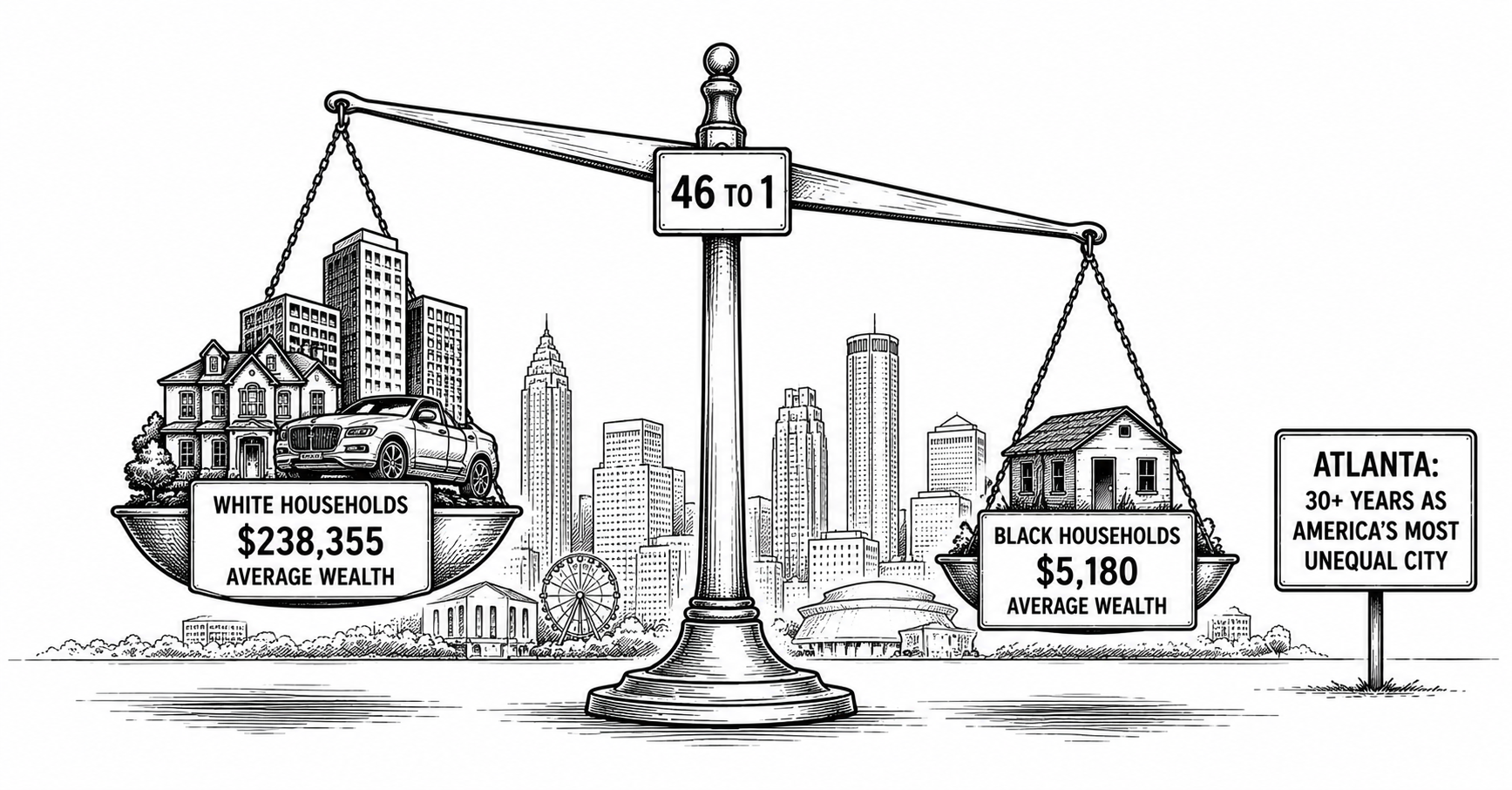
Atlanta is the city most frequently cited as a counter-example to the argument that inequality is structurally inevitable. It has Black political leadership, a large and visible Black professional class, a cluster of HBCUs that produce graduates and civic infrastructure, and a reputation as the city where Black America goes to build wealth. The data tells a different story. Atlanta has held the title of the most unequal city in the United States for more than 30 years. In the City of Atlanta, the wealth of white households averages $238,355. The wealth of Black households averages $5,180 — a ratio of 46 to 1. More than a third of Black Atlanta households have zero or negative net worth. Children born to families in the bottom fifth of Atlanta’s income distribution have a 4% chance of reaching the top fifth.
The gap between Atlanta’s reputation and its data is the structural argument the Global Justice Report is making at global scale, applied locally. The city has not lacked Black political representation. It has not lacked Black business formation, cultural production, or institutional infrastructure. What it has consistently lacked is the redistribution mechanism — the policy architecture — that would translate economic growth into shared wealth rather than widening the distance between the top and the bottom.
The median income for Black Atlantans has grown over the past decade. So has the income gap between Black and white households — from $56,291 to $73,563 in ten years. Growth without redistribution does not close the gap. It compounds it. That is the mechanism the Global Justice Report names at global scale: the top 10% benefits from economic expansion while the structural conditions maintaining the bottom’s position remain intact. Atlanta has been running this experiment for three decades.
What would choosing differently look like? The Global Justice Report proposes a Global Justice Fund financed through a common global wealth tax, spending 10.3% of world GDP annually on redistribution and investment between 2026 and 2060. Atlanta’s Kindred Futures initiative — formerly the Atlanta Wealth Building Initiative — has proposed reparations, an Office of Community Wealth Building, and committed infrastructure spending through Black-owned businesses. The scale is different. The mechanism is the same: redistribution through institutional commitment, not through market outcomes alone.
If inequality is a political choice at global scale, Atlanta is the domestic case study for what happens when that choice is consistently made in the wrong direction — and for what it would take to make a different one. The Global Justice Report offers a blueprint for the world. Atlanta offers a 30-year record of what the alternative produces when the blueprint stays on the shelf.
— SSC News Desk | Social Storytellers Collective
Get SSC analysis delivered to your inbox every day. Subscribe free on Beehiiv: socialstorytellerscollective.beehiiv.com