
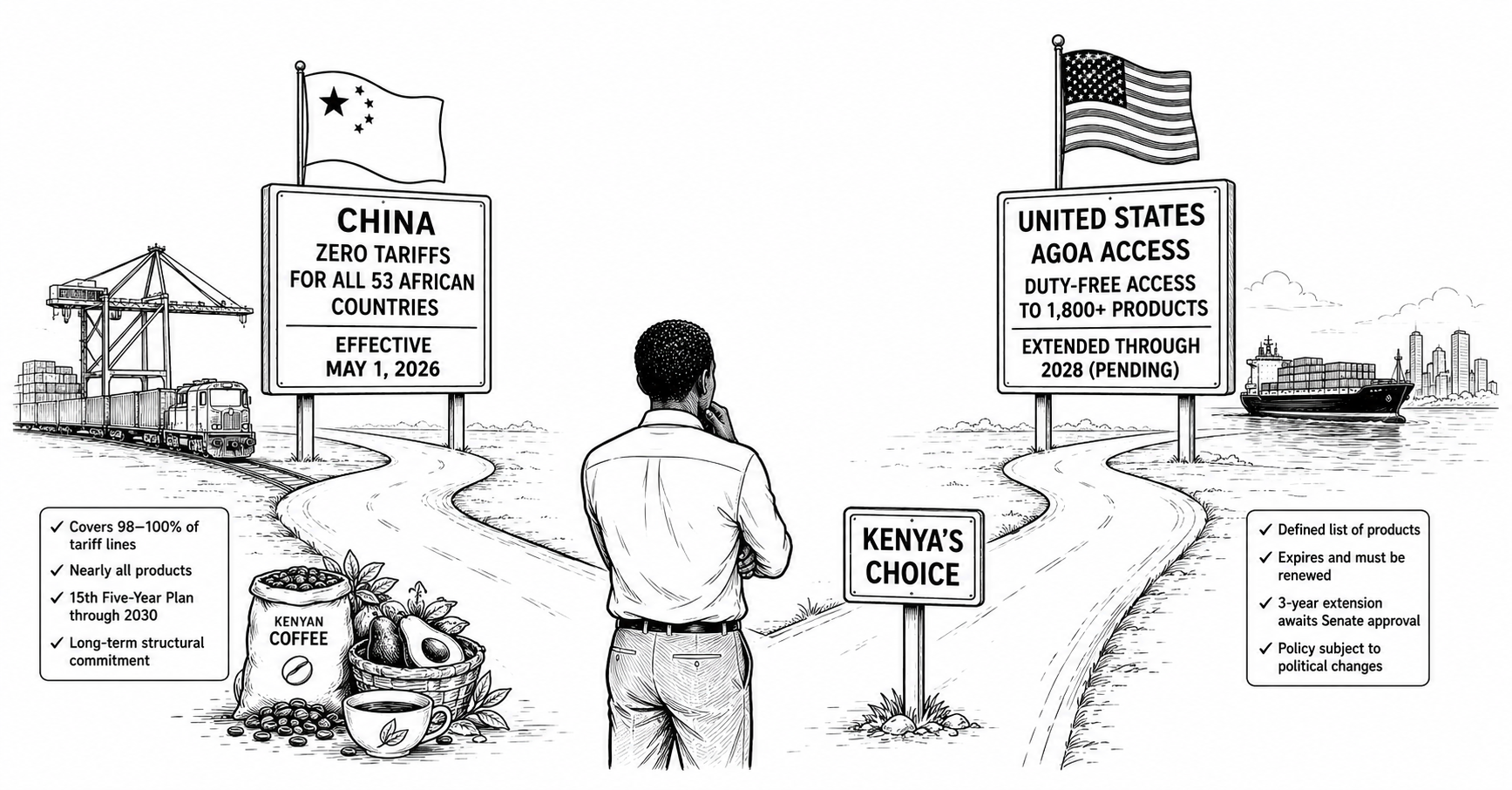
On February 14, 2026, Chinese President Xi Jinping announced to the 39th African Union Summit in Addis Ababa that China would implement zero-tariff treatment for all 53 African countries with which it has diplomatic relations, effective May 1, 2026. The policy covers between 98 and 100 percent of tariff lines — eliminating duties on nearly every product category. For middle-income African economies including Kenya, Egypt, Nigeria, and South Africa, which had not previously received full zero-tariff access, the expansion represents a fundamental shift in the terms of trade between China and the continent.
Kenya imports $4.3 billion from China annually. It exports $200 million in return. The zero-tariff policy is designed, at least in part, to address that imbalance by making Kenyan agricultural products — coffee, avocados, purple tea — cheaper to sell into the Chinese market. A Chinese trade official flagged off the first shipment of Kenyan agricultural products under the new deal in late March, calling it a “major benefit.” Hunan Rift Valley Purple, a Chinese company operating a tea processing factory in Kenya, announced plans to import more processed tea as the policy cut its tax costs significantly.
In the same period, Kenya has been negotiating with the United States for continued access to the U.S. market through the African Growth and Opportunity Act. AGOA, first enacted in 2000, provides eligible African countries with duty-free access to more than 1,800 U.S. product categories. On January 12, 2026, the U.S. House of Representatives voted to extend AGOA for three additional years, through 2028. The bill awaits Senate approval and a signature from the Trump administration. Its passage is not guaranteed.
The arithmetic of the two relationships is not comparable. AGOA provides duty-free access to a defined list of products that the U.S. Congress must periodically choose to renew. China’s zero-tariff policy covers nearly all tariff lines, was announced to a continental audience, and took effect on a specific date. One is a legislative preference that expires and must be renegotiated. The other is a structural commitment — built into China’s 15th Five-Year Plan through 2030 — that signals a long-term economic relationship with Africa regardless of global trade disruptions.
James Shikwati, a Kenyan economist cited in regional trade coverage, argued that Africa should not be forced to choose: “If both AGOA and the China deal are beneficial, then Africa should have both. What matters is fair trade and market access, not the geography of the partner.” That framing is correct on the economics. It understates the political reality, which is that the U.S. and China are competing for economic alignment with Africa — and the terms of that competition are increasingly asymmetric.
China extended zero-tariff treatment to Africa’s least developed countries starting in 2005 and expanded it to all diplomatic partners by 2026 — a 20-year progression of stated commitments met on the stated timelines. The U.S. is renewing a 26-year-old trade preference program in three-year increments while the Trump administration simultaneously imposes broad tariffs on other trading partners. The signal each approach sends about long-term economic partnership is not subtle.
The power building the stronger economic relationship in Africa is the one that made a structural commitment and followed through on it. The trade arithmetic and the geopolitical arithmetic are pointing in the same direction — and Kenya, sitting at the center of both negotiations, is watching both of them closely.
— SSC News Desk | Social Storytellers Collective
Get SSC analysis delivered to your inbox every day. Subscribe free on Beehiiv: socialstorytellerscollective.beehiiv.com