
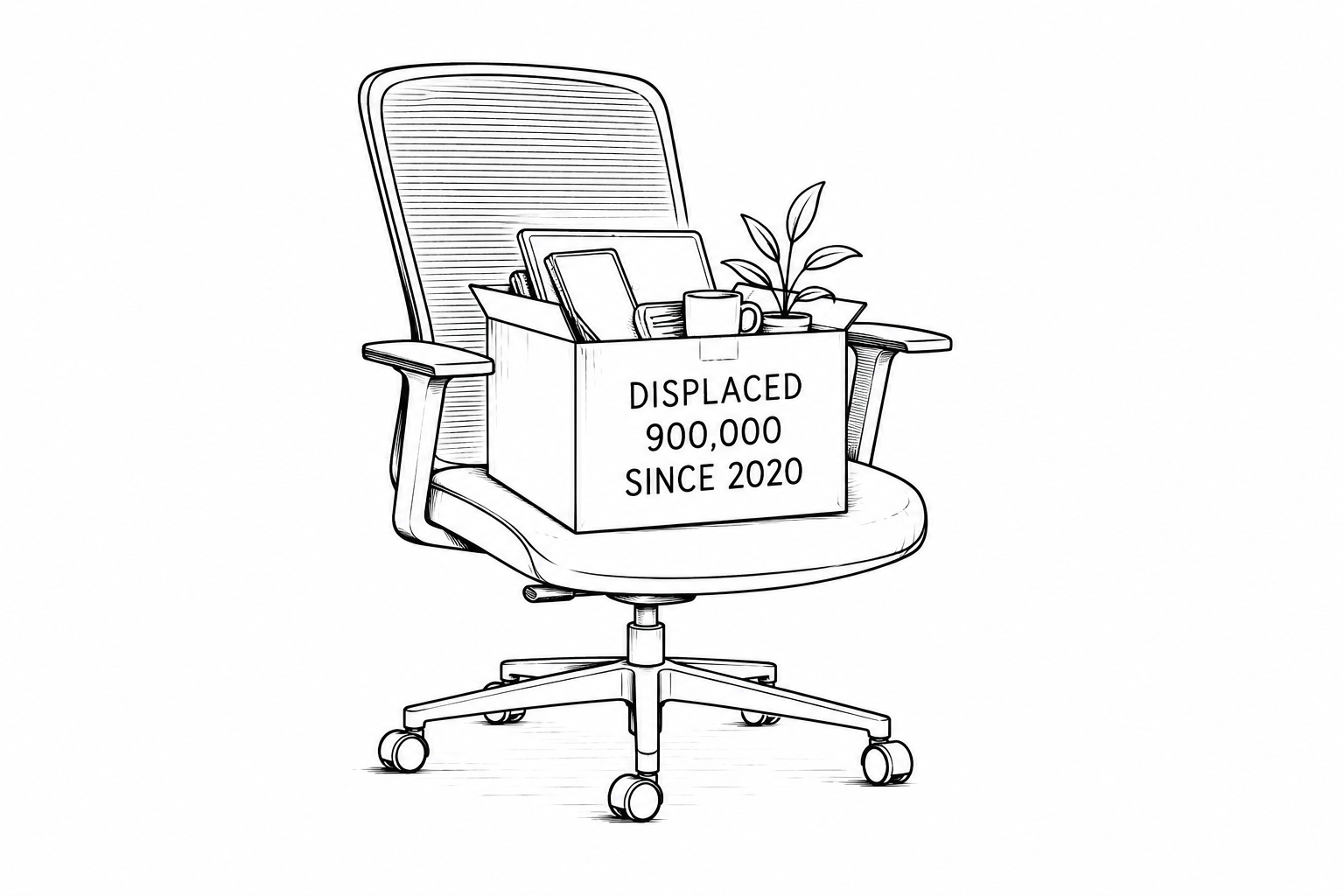
CNBC reporter Kif Leswing reported in April 2026 that more than 92,000 tech workers had been laid off in the first four months of the year alone, citing data from Layoffs.fyi. The six-year total since 2020 now sits at nearly 900,000 displaced workers — a figure that spans boom, bust, and recovery cycles across the sector. Anthony Tuggle, an executive coach and former AI industry insider cited in the piece, described the pattern directly: “This represents a fundamental structural shift rather than a temporary market correction.”
The number is not a byproduct of a struggling industry. It is a byproduct of a thriving one. The companies executing the largest cuts — Meta, Microsoft, Google, Amazon, LinkedIn, Cisco — are simultaneously posting record revenue, record AI investment, and record valuations. The mechanism is not financial distress. It is margin optimization: AI reduces the human labor required to generate a unit of revenue, and companies whose shareholders reward efficiency over headcount are making the rational choice inside the system they operate in. The displacement is not a side effect of growth. It is the product of it.
The workers absorbing the cuts are not distributed randomly across the workforce. Entry-level roles — the positions that historically served as the on-ramp to professional careers in technology — are disappearing fastest. A 2026 LinkedIn Economic Graph review found that roughly 25% of entry-level consulting and finance postings now require AI skills, up from near zero three years ago. The job did not disappear. It transformed into something that fewer people are positioned to walk into. The credential pipeline — four-year degrees, bootcamps, internships — was built for a job market that is being rebuilt around different requirements faster than any training program can track.
The 900,000 figure also does not capture what it replaced. Between 2020 and 2025, the technology sector added enormous headcount during the pandemic hiring surge, then removed it systematically beginning in late 2022. What the net number obscures is the quality of what was lost: stable, benefits-bearing, professionally mobile jobs that represented upward economic access for first-generation college graduates, workers of color, and immigrants who broke into the sector during its expansion. The rollback has not been demographically neutral. It has followed existing inequalities with the precision of a system that never had to account for them.
The 1,200 jobs lost per working day across the sector since 2020 — the arithmetic of Layoffs.fyi‘s data — will not resolve when the market stabilizes. The jobs are not on pause. Many of them are gone. The companies that eliminated them are not waiting to rehire. They are investing the savings into AI infrastructure designed to ensure they never have to.
The next labor shortage in technology will not be a shortage of workers. It will be a shortage of the kinds of jobs that made the sector worth entering in the first place.