
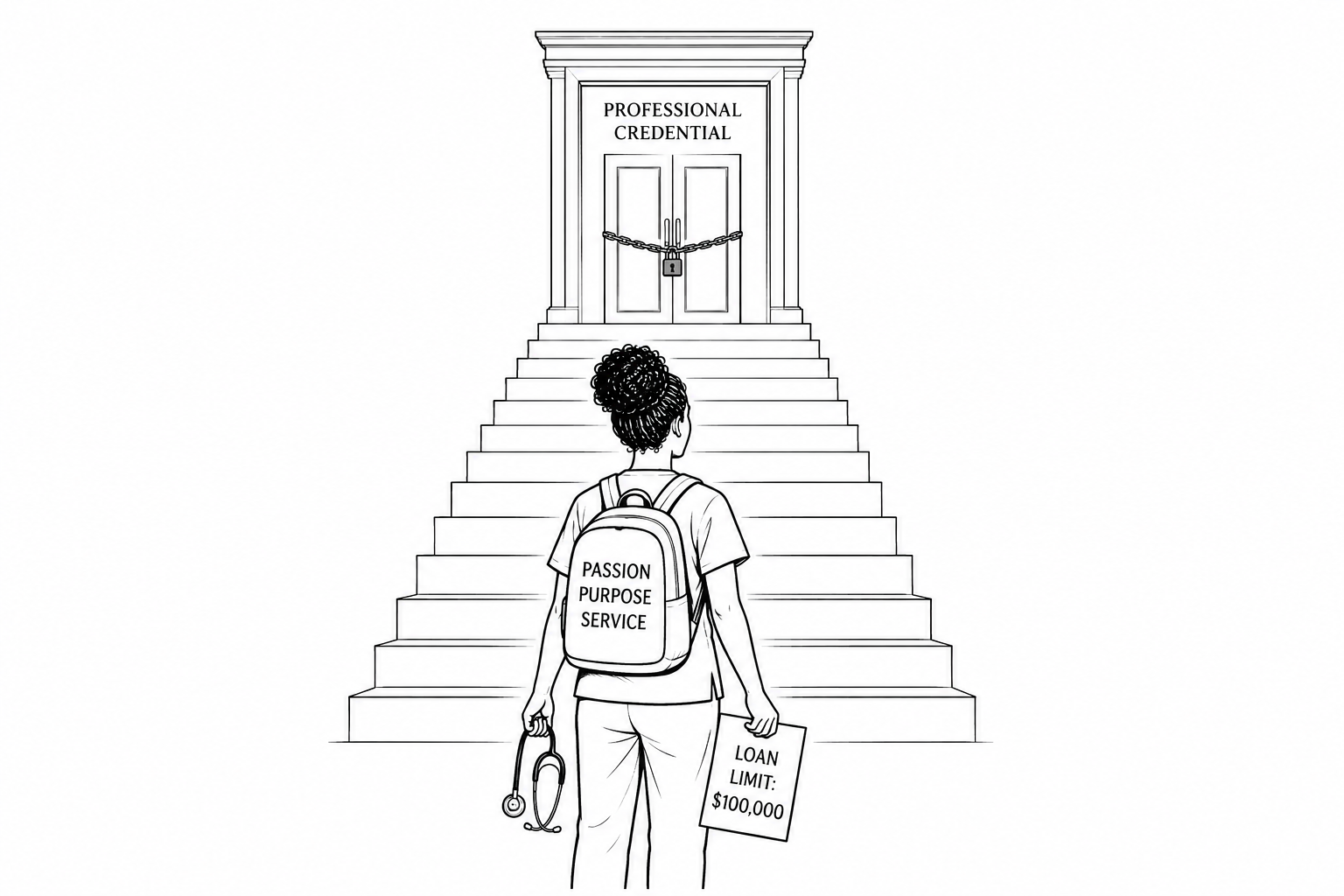
The Department of Education finalized its rule implementing the One Big Beautiful Bill Act’s graduate borrowing limits on April 30, 2026, with most provisions taking effect July 1. Beginning that date, Grad PLUS loans — which have existed for 20 years and allowed graduate students to borrow up to the full cost of attendance — are eliminated for new borrowers. Graduate students are capped at $20,500 per year and a $100,000 lifetime limit. Students whose programs qualify as “professional” can borrow up to $50,000 per year and $200,000 lifetime. The difference between those two numbers is not administrative. It is the difference between being able to afford the degree and not being able to afford it.
More than 440,000 students per year relied on Grad PLUS to cover costs above the standard loan limits. Starting July 1, they will need private loans, personal savings, or employer reimbursement — or they will not enroll.
The Department’s rationale is structural: graduate students hold over a third of all federal student loan debt, and 40% of master’s degree programs have earnings outcomes that do not justify the borrowing required to complete them. Eliminating uncapped borrowing, the argument goes, forces institutions to price their programs against the value they actually deliver. That mechanism is real. The problem is which programs absorb the pressure.
The definition of “professional student” — the category that determines access to the higher $200,000 cap — excludes nursing (MSN/DNP), physical therapy (DPT), physician assistant (MSPAS), occupational therapy (OTD), public health (MPH), social work (MSW), business (MBA), and education (Ed.D.). All of these fields require licensure. All of them have documented workforce shortages. All of them are now capped at $100,000 lifetime — regardless of what the program costs or what the credential requires.
Eleven fields made the professional cut: medicine, dentistry, law, pharmacy, optometry, podiatry, veterinary medicine, chiropractic medicine, osteopathic medicine, and a narrow set of licensed clinical programs. The workers left outside that definition are not peripheral to the American healthcare system. They are the infrastructure of it.
A coalition of 23 states filed suit against the Department of Education this week, arguing the final rule unlawfully strips nurses, physician assistants, and physical therapists of the higher borrowing limits Congress intended for professional students. The lawsuit, reported by The College Investor, targets two specific mechanisms. First, the classification itself — the states argue the Department drew the professional definition contrary to the statutory text. Second, the grandfathering provision — the OBBBA protected students already enrolled as of June 30, 2026 from the new caps, but the final rule strips that protection if a student transfers institutions or withdraws and re-enrolls, even in the same program of study. A student who takes medical leave and returns to the same program loses the protection they were promised. The states call that limitation arbitrary.
The legal deadline and the academic calendar are now running against each other. The court must move before July 1 or the rule takes effect with the lawsuit pending.
The American Hospital Association projects a shortage of more than 3.2 million healthcare workers by 2030. The shortage is most acute in nursing, physical therapy, and allied health — the exact fields the Department of Education classified as non-professional. The rule designed to address unsustainable graduate borrowing imposes its hardest constraints on the workers the country most urgently needs to train.
The workers most likely to be deterred are not the ones with the most options. First-generation students, students of color, and working adults returning to school mid-career relied on Grad PLUS because they did not have family wealth or employer support to fill the gap. The $100,000 lifetime cap sounds large until the actual cost of a three-year nursing program at a private institution — tuition, living expenses, foregone income, accruing interest — is laid against it. The math often doesn’t close. When the math doesn’t close, people don’t enroll.
The next healthcare labor shortage is not a 2030 projection. It is being legislated into existence three weeks from today.