
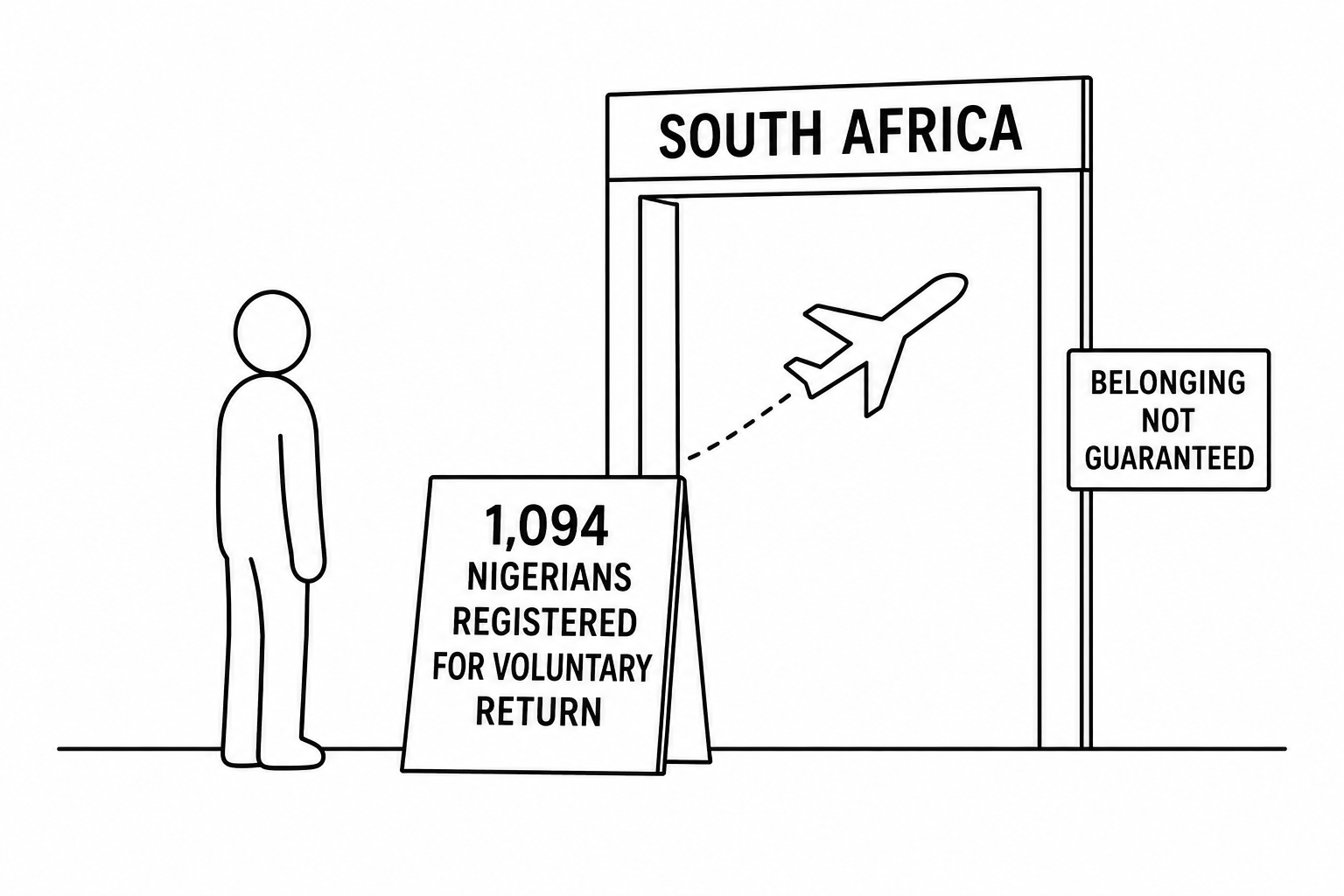
At least 1,094 Nigerians have registered for voluntary repatriation from South Africa following a series of xenophobic attacks — up from 130 seeking return just weeks earlier — with a joint screening process currently underway to determine eligibility, Nigerian foreign ministry spokesperson Kimiebi Ebienfa told Reuters reporter Camillus Eboh on Friday. South African authorities have agreed to waive penalties for visa violations including overstays, though individuals facing criminal charges will not be eligible to leave. Nigeria has condemned the violence, including the deaths of two Nigerian nationals allegedly assaulted by South African security officials. The development represents one of the clearest signs yet that migration decisions are being shaped not only by economic opportunity, but by the social risks migrants face after arrival.
For years, South Africa has served as a destination for migrants from across the continent seeking employment, education, and economic mobility. As the continent’s most industrialized economy, it has attracted workers from Nigeria, Zimbabwe, Mozambique, and elsewhere. Yet the violence is not new and it is not spontaneous. The 2008 xenophobic attacks killed more than 60 people. The 2019 wave prompted multiple African countries to recall ambassadors and Nigerian Airlines to temporarily suspend South African routes. Operation Dudula, the organized anti-immigrant movement that gained prominence in 2022, represents the infrastructure behind what is often framed as spontaneous public frustration. What is happening now is the latest chapter of a documented pattern — not a rupture, but a recurrence.
The timing reflects broader economic pressures facing South Africa. The country continues to struggle with high unemployment, persistent inequality, and slow economic growth. In periods of economic strain, migrants often become visible targets for frustrations that originate in structural conditions. Competition for jobs, housing, and public services is reframed as competition between communities — even when the underlying causes have nothing to do with migration. Migrants frequently absorb public anger directed at conditions they did not create.
Legal access can create mobility. It cannot guarantee belonging. As SSC reported in Ghana Criminalizes LGBTQ Advocacy. The Pattern Is Bigger Than One Country., the conditions that determine whether people can safely build lives after arrival are being reshaped by policy as much as by violence. The Nigerian repatriation numbers and Ghana’s criminalization law are different mechanisms producing the same outcome: migration pathways that remain technically open while belonging becomes structurally impossible. And as SSC reported today in Visa Access Is Becoming a Geography Problem, the U.S. embassy consolidation across Africa is restructuring who can realistically participate in international mobility before they even arrive. The architecture of exclusion is operating simultaneously at the border, in policy, and in the street.
The Nigeria-South Africa relationship adds a diplomatic dimension the migration data alone does not capture. The two countries have one of the most complicated bilateral relationships on the continent — competing claims to regional leadership, trade disputes, and a history of violence against Nigerian nationals that has repeatedly tested diplomatic ties. The 1,094 registrations are not simply a humanitarian statistic. They are a signal about the state of that relationship and about South Africa’s ability to guarantee the safety of African migrants within its own borders.
A migrant’s experience is determined not simply by whether entry is permitted, but by whether daily life remains safe after arrival. People evaluate destinations based on social conditions as much as economic prospects. A higher-paying job loses value when obtaining it requires living under constant threat. Mobility works only when opportunity and security travel together.
Governments measure migration through border crossings, visa approvals, and labor participation. Those metrics reveal who arrives. They reveal far less about who feels compelled to leave — and nothing about who never came because the conditions on arrival were already known. As migration pressures continue to grow worldwide, the more consequential policy challenge is not attracting people. It is building the conditions that make staying possible.