
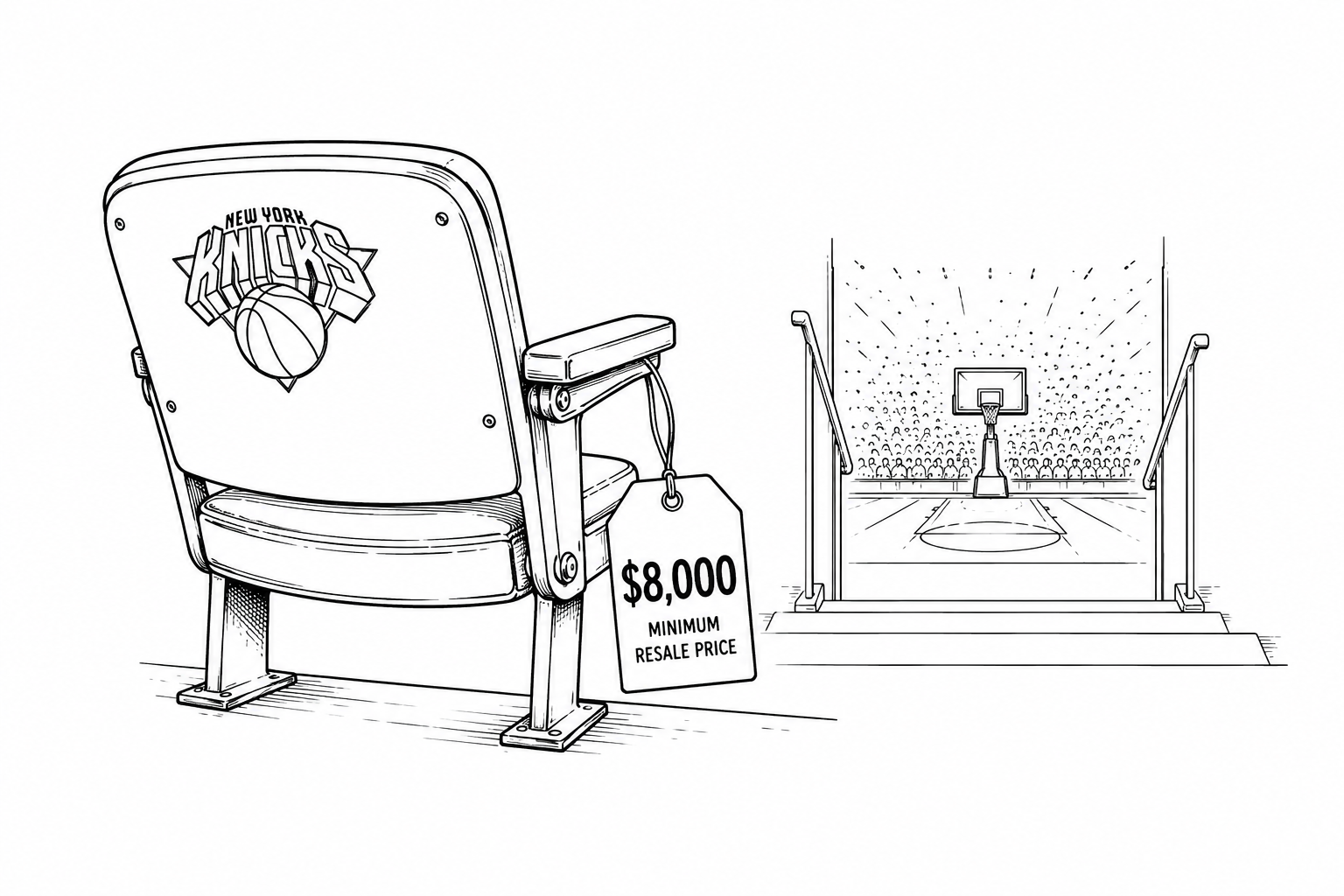
Knicks fans waited 25 years for this. The last time New York hosted an NBA Finals game at Madison Square Garden, Patrick Ewing was still suiting up and the internet was still loading on dial-up. This week, that wait ended — and the market responded accordingly. Tickets for Games 3, 4, and 6 at MSG are starting at $8,000 on resale platforms, according to Front Office Sports. Nosebleed seats to a potential Game 4 clincher are opening at roughly $8,500. That floor price is higher than February’s Super Bowl.
The fans who kept the faith through 25 years of disappointment are not the ones in those seats.
The financialization of live sports did not happen overnight. Over the past two decades, the primary ticket market, the secondary resale market, and the private equity infrastructure underneath both have systematically repriced the live sports experience away from the working and middle-class fans who built the cultural foundation those experiences are now monetizing. Dynamic pricing algorithms adjust ticket costs in real time based on demand signals — a team’s playoff run, a historic matchup, a potential clinching game. The technology is neutral. The outcome is not. Every upward price adjustment is a transfer of access from one income bracket to another.
The MSG context makes the mechanism visible in a way that abstract pricing data cannot. Madison Square Garden sits in Midtown Manhattan — one of the most economically stratified cities in the country. The Knicks fanbase has historically been one of the most diverse in professional sports, drawing from every borough, every income level, every neighborhood that has a relationship with New York City basketball. The $8,000 floor price does not just exclude working-class fans from this series. It excludes the cultural community that kept this franchise relevant through two and a half decades of losing. The loyalty was free. The access is not.
The number lands differently this week. SSC documented this morning that 1.8 million Americans have been out of work for 27 weeks or more. The May jobs report showed small businesses accounting for 67,000 of the 122,000 private sector jobs added — positions that disproportionately carry lower wages and fewer benefits. Household budgets are increasingly being bridged by credit cards as purchasing power stagnates against rising costs. The $8,000 Knicks ticket and the $6.70 pound of ground beef are both real prices in the same economy. The people absorbing one are not the people attending the other.
As SSC documented in Live Nation Didn’t Just Dominate Ticketing. It Designed the System Around Itself., the pricing architecture fans are navigating was not produced by open market competition. It was designed by a company a jury found operated as a monopoly. As SSC reported in Blue Dot Fever Is Exposing the Real Concert Economy, the issue is not the artists setting prices — it is the resale infrastructure and demand algorithms producing them. The illusion of endless consumer appetite is already cracking at the concert level. The NBA Finals is the same system operating at a higher cultural stakes moment. And I documented in The World Cup Is Rewriting City Rules , cities are increasingly reorganizing themselves around experiences while the people who built those cultures get priced out of them. The hospitality workers, transit operators, and security personnel who make those experiences possible are not in the premium seats. Neither are the fans who spent 25 years making Madison Square Garden one of the most electric buildings in professional sports.
The experience economy captured the cultural value those communities created and repriced it beyond their reach. A lifelong Knicks fan watching this series from their couch is not a personal financial failure. It is the designed outcome of a market that has decided the right price for a historic moment is whatever the highest bidder will pay — regardless of who built the history being sold.
The Knicks are in the Finals. Twenty-five years of loyalty earned this moment. Who gets to be inside the building for it is not sentimental. It is structural — and the answer the market has produced says more about who the experience economy is built for than any ticket price alone.