
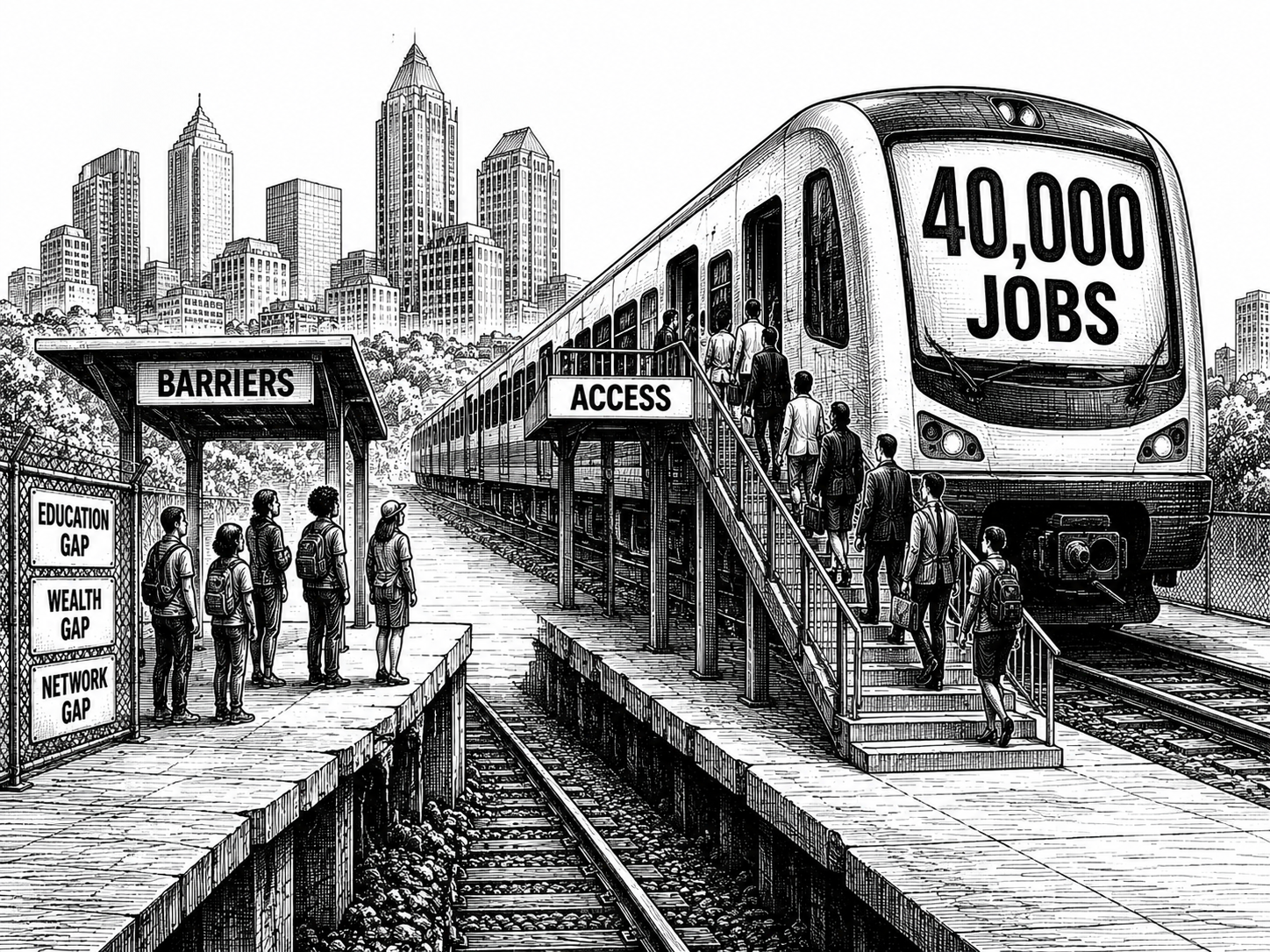
Charlotte’s nonfarm employment rose 2.9 percent over the past 12 months, adding nearly 40,000 net new jobs — outperforming every comparable Sun Belt metro including Raleigh, Nashville, Tampa, Austin, Atlanta, Dallas, and Miami, according to analysis by economist Mark Vitner delivered at the Charlotte Tech Leaders Forum and reported by the Charlotte Business Journal. The numbers position Charlotte as one of the fastest-growing large metropolitan economies in the country at a moment when national labor market data is showing signs of cooling. The headline is real. So is what it leaves out.
Charlotte is a majority-minority city. Its Black population — approximately 35 percent of the metro area — built much of the infrastructure the city’s financial, technology, and professional services sectors now depend on. The industries driving Charlotte’s current job growth are disproportionately concentrated in those same financial and professional services sectors — Bank of America, Wells Fargo, Truist, and a growing constellation of fintech and technology companies that have made Charlotte one of the largest banking centers in the United States. Those sectors skew heavily toward credentialed, higher-wage workers. The 40,000 jobs added over the past year are not distributed evenly across the city’s workforce. They are concentrated in the sectors, salary bands, and credential requirements that most systematically exclude the workers with the longest roots in the community.
Harvard’s Opportunity Insights research, led by economist Raj Chetty, has documented Charlotte’s racial mobility gap with specificity that the aggregate job number obscures. Charlotte ranks among the lowest of any major U.S. city for economic mobility for children from low-income families — and the racial dimension of that finding is stark. Black children born into low-income households in Charlotte face some of the worst odds of upward mobility of any major metro in the country, including cities with significantly weaker overall job growth. A 2.9 percent employment growth rate in that context is not evidence that the system is working for everyone. It is evidence that the system is working well for some people in the same city where it is not working for others.
The sectors absorbing Charlotte’s growth are also the sectors least accessible to workers without four-year degrees or professional credentials — a barrier that compounds existing racial wealth and education gaps. Charlotte’s public school system, which serves a student population that is majority Black and Latino, has faced persistent resource and achievement gaps that the city’s headline economic success has not closed. Workers graduating from those schools into a labor market dominated by financial services and technology are not competing for the same 40,000 jobs that made Charlotte’s growth numbers look strong this quarter.
This is the pattern SSC has documented across the City Signals series — from Houston’s energy economy to Austin’s tech corridor to Miami’s real estate boom. Aggregate job growth is a measure of economic activity. It is not a measure of economic access. The cities posting the strongest headline numbers are often the cities with the sharpest internal divides between the sectors generating that growth and the communities whose labor built the infrastructure those sectors depend on. Charlotte’s 40,000 jobs are real. The question of which Charlotte they belong to is the one the headline number was never designed to answer.