
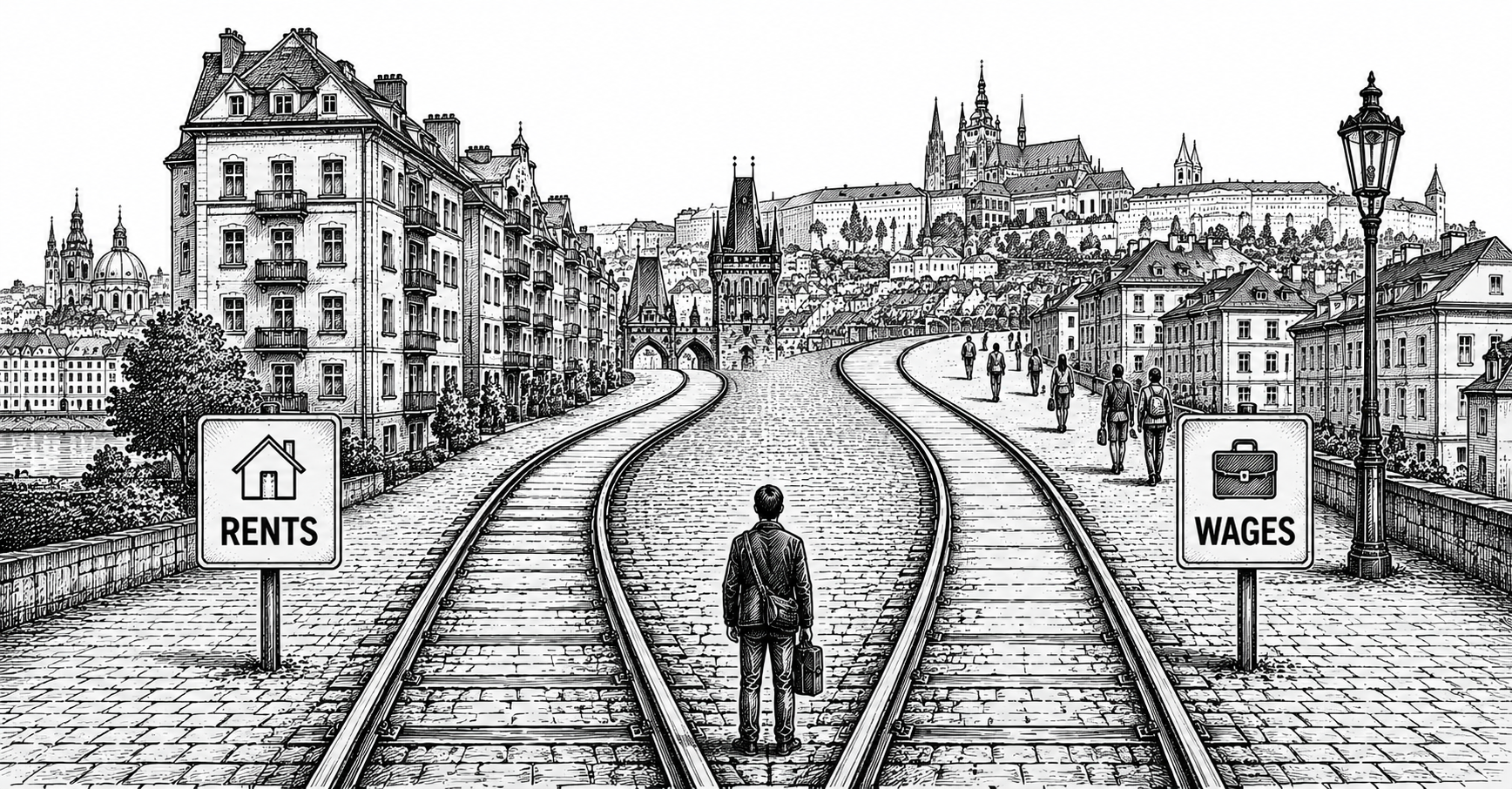
Prague rents hit new highs across all apartment sizes in the first quarter of 2026, according to data published by Expats.cz. The publication framed the numbers not just as what housing costs but as what workers would need to earn to afford them — a framing that shifts the question from real estate to labor. A standard one-bedroom apartment in Prague now requires a monthly salary that exceeds what the majority of Czech workers take home. Czech wages remain the seventh lowest in the European Union despite years of steady growth, according to Eurostat data. The city’s rental market and its wage market are running at different speeds, and the gap between them is widening faster than any policy response has moved to close it.
Prague was, for most of the past two decades, the counterexample to the Western European housing crisis. Central European cities — affordable, livable, historically rich, and culturally dense — represented an alternative for workers, artists, students, and young professionals priced out of London, Paris, Amsterdam, and Berlin. That alternative is closing. Foreign investment, short-term rental platforms, and the concentration of international capital in Central European urban real estate have driven Prague’s housing costs toward the same trajectory that made Western European cities inaccessible a generation earlier. The mechanism is not new. The geography is.
The investment pressure driving Prague’s rental market is not primarily domestic. International buyers and investment funds have increasingly targeted Central and Eastern European cities as Western European markets have saturated. Airbnb and short-term rental platforms have converted long-term housing stock into tourism infrastructure, reducing the supply available to residents while increasing returns for property owners. The Czech government has been slower than some EU counterparts to implement short-term rental regulations, leaving the market to absorb the supply reduction without a policy offset. The result is a city where the workers who staff its restaurants, schools, transit systems, and cultural institutions are being priced progressively further from its center.
The contrast with Austin is instructive. Austin’s median rent fell 16 percent from its 2021 peak after the city made a deliberate series of policy decisions — reducing minimum lot sizes, loosening land use restrictions, and approving large-scale housing development at a pace that meaningfully increased supply. As SSC documented in the City Signals series, the benefits of that supply expansion were most visible in older, lower-cost buildings where rents fell 11 percent — the units most likely to be occupied by lower-income renters. Austin’s experience is the clearest recent evidence that supply-side housing reform produces real results for real people. Prague’s experience is the clearest recent evidence of what happens when it doesn’t.
The housing affordability collapse is not a story about individual cities making individual policy errors. It is a story about a global mechanism operating consistently across geographies — capital concentrating in urban markets faster than wages rise, housing supply failing to keep pace with demand, and the communities with the least political power absorbing the cost of that gap first and hardest. Prague joins a list that includes London, Sydney, Toronto, San Francisco, Miami, and now Austin’s neighbors in Texas. The places that were supposed to be different are running out of time to stay that way — and the workers who made those cities worth living in are the first ones the market pushes out.