
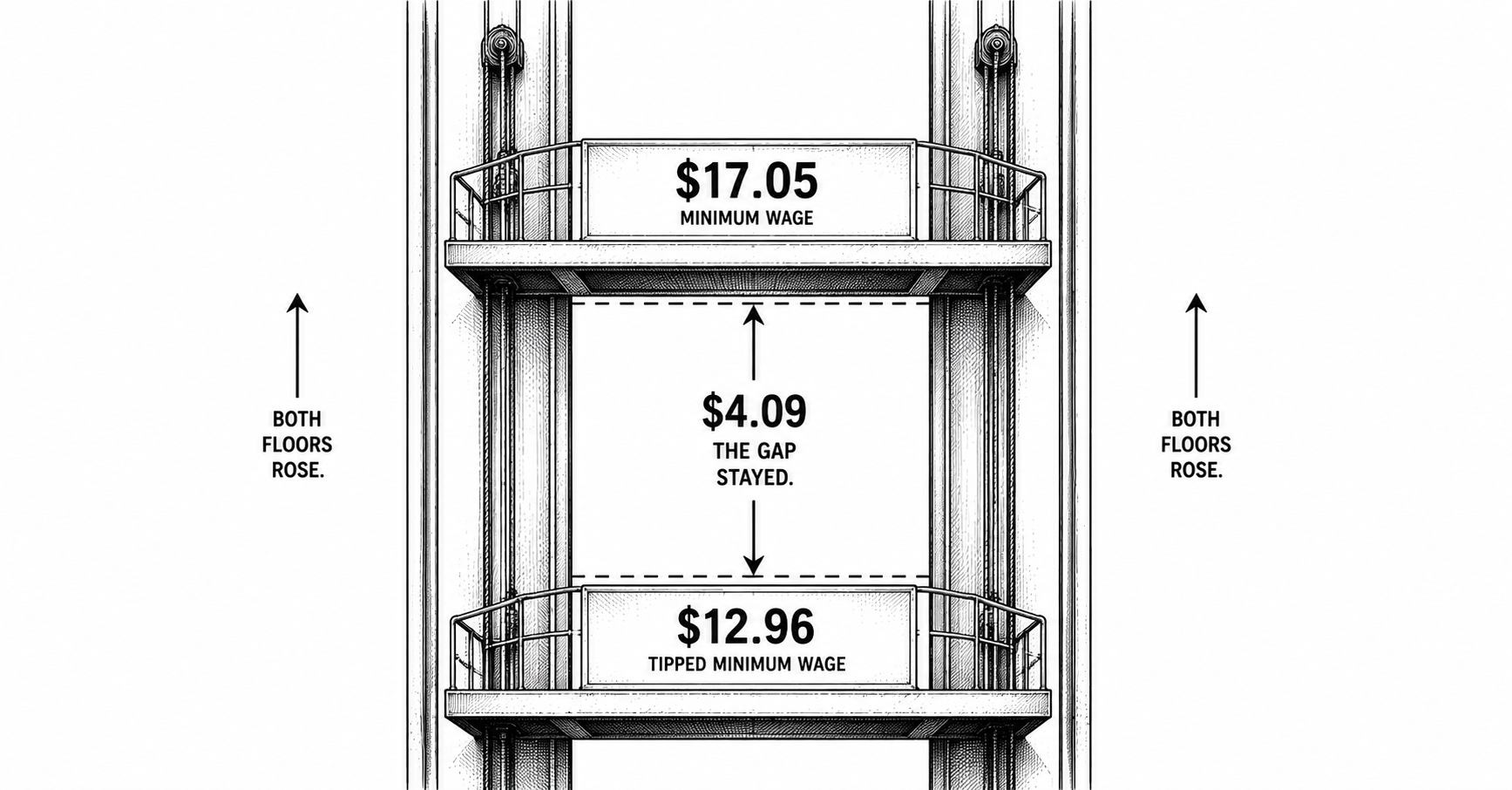
The City of Chicago Office of Labor Standards announced that the minimum wage for employers with four or more employees will increase to $17.05 per hour on July 1, 2026. The tipped worker minimum wage will increase simultaneously to $12.96 per hour. The gap between those two numbers — $4.09 — is not an oversight. It is a policy choice, and it is a choice that lands disproportionately on a specific workforce.
Restaurant and hospitality workers, who make up the majority of tipped workers in Chicago, are disproportionately women and workers of color. The two-tier wage system operates on the assumption that tips will close the gap between what employers are legally required to pay and what workers actually need to live. In practice, tip income is variable, subject to customer discretion, concentrated in higher-end establishments, and entirely absent during slow shifts, bad weather, or economic downturns. A tipped worker earning the legal minimum during a slow Tuesday lunch is not earning $17.05. They are earning $12.96 and hoping the math works out by the end of the week.
The lobbying infrastructure behind the tipped wage differential is not accidental. The National Restaurant Association has spent decades opposing the elimination of the subminimum tipped wage at both the state and federal level, arguing that tip income adequately compensates workers and that eliminating the differential would force restaurants to raise prices or reduce staff. That argument has been tested in states that have already moved to a single wage floor. California, Washington, Oregon, Minnesota, and several other states have eliminated the tipped wage differential entirely. Restaurant industries in those states did not collapse. In California, which has the largest restaurant industry in the country, employment in the sector has continued to grow alongside a unified minimum wage. The argument that tips make the differential unnecessary is not supported by the evidence from states that have actually tested it.
Chicago is the third largest city in the United States, and its labor standards set a benchmark for comparable cities watching how the tipped wage debate resolves at scale. The Fair Workweek and Paid Leave rule updates that also took effect June 1 add scheduling protections and sick leave guarantees that address some of the instability built into hospitality work. A worker who cannot be sent home mid-shift without pay and who can accrue sick days has more stability than one who cannot. Those protections matter. They do not close the wage floor gap, and they do not change the fundamental architecture of a system that allows employers to pay one category of workers less because customers might make up the difference.
The tipped wage differential is one of the most persistent structural inequities in urban labor policy precisely because it is invisible in the headline number. When Chicago announces a $17.05 minimum wage, that is the number that travels in press releases, political speeches, and labor advocacy celebrations. The $12.96 floor — and the predominantly female, predominantly Black and Brown workforce living on it — does not make the announcement. As SSC documented this week in Stable Jobs. Unstable Workers., the official economic indicators and the lived experience of workers are increasingly telling different stories. The minimum wage headline and the tipped wage reality are two versions of the same gap — and the workers absorbing the difference are the ones with the least power to close it.