

From a $3 trillion AI IPO wave to a global matcha shortage, a credentialing system that keeps moving the finish line, and a prostate cancer screening gap that was never accidental — Thursday’s full briefing.
End of Day Closing Note | June 4, 2026
Goldman Sachs CEO David Solomon said something out loud at the Economic Club of New York on Tuesday that the financial industry usually keeps in the subtext: “We are definitely in a moment where there’s more greed than there is fear.” He was talking about AI — specifically the unprecedented IPO wave building around OpenAI, Anthropic, and SpaceX, three companies preparing to enter public markets at combined valuations approaching $3 trillion. Anthropicfiled its confidential IPO prospectus with the SEC on Monday at a valuation of $965 billion, following a $65 billionfundraising round completed last week. Goldman Sachs, whose CEO is publicly declaring greed mode, is playing a lead role in several of these deals simultaneously.
Solomon pointed to Alphabet’s $80 billion equity raise — the largest follow-on equity offering ever recorded — as evidence that markets can absorb what is coming. “Greed can turn into fear very quickly,” he acknowledged, “but that doesn’t mean it will.”
The companies preparing to go public at trillion-dollar valuations are the same companies whose tools are restructuring white-collar work, eliminating junior roles, and producing the displacement that University of Florida researchers formally named as a clinical crisis earlier this year. The greed cycle and the displacement cycle are not running separately. They are the same cycle — distributing their benefits and their costs to entirely different populations. David Solomonsaid markets are in greed mode. He did not mention who is not in the market.

Russell Wilson retired from the NFL on Wednesday after 14 seasons, announcing he will join CBS Sports as an analyst on The NFL Today. Wilson’s next role puts him alongside James Brown, Nate Burleson, and Bill Cowher on CBS’NFL pregame coverage. The quarterback who won a Super Bowl with Seattle, endured one of the most publicly dissected career declines in recent memory across Denver, Pittsburgh, and New York, and rebuilt quietly will now sit on the other side of the microphone. Wilson is only the second Black starting quarterback to win a Super Bowl, joining Doug Williams. Whatever the assignment, he has spent enough time as a subject of the sports media machine to understand exactly how it works — and what it tends to leave out.

That question — what the media machine tends to leave out — runs directly into what CBS News is doing to one of its own institutions. The Gutting of 60 Minutes Is a Structural Story, Not a Personnel One. The firing of Scott Pelley on Tuesday — the fourth major exit from 60 Minutes since February — is being covered as a clash of personalities. The more accurate frame is institutional dismantling. In less than four months, CBS News has removed an executive producer, two senior correspondents, an executive editor, and now its most decorated on-air journalist, replacing decades of accumulated editorial knowledge with leadership whose primary qualification appears to be alignment with new ownership priorities.
SSC Featured Series | The Credentialing Class — Series Conclusion
A 4-part series examining what happens when the platform economy absorbs the credential economy — and who gets left holding a certificate the market hasn’t agreed to honor.
Part I · Not All Credentials Are Created Equal · June 1 Part II · The Platform Promise · June 2 Part III · The Short Runway That Actually Works · June 3 Part IV · The Treadmill Problem · June 4

The series ends where the system keeps sending workers: back to the beginning. 90 percent of employers say they are willing to offer higher starting salaries to candidates with micro-credentials. Among professionals who completed a program, 28 percent received a pay raise — which means 72 percent did not. That number does not appear in the platform marketing. It does not appear in the workforce development reports. It appears in the experience of the worker who did the work, earned the certificate, updated the resume, and is still running in place. The Treadmill Problem — Part IV of The Credentialing Class — is where the series lands its closing argument: the credential economy profits from issuance regardless of outcome, and the workers with the least margin to absorb a credential that does not deliver are the ones taking the most risk on a market that keeps moving the finish line one level ahead of wherever they are standing.
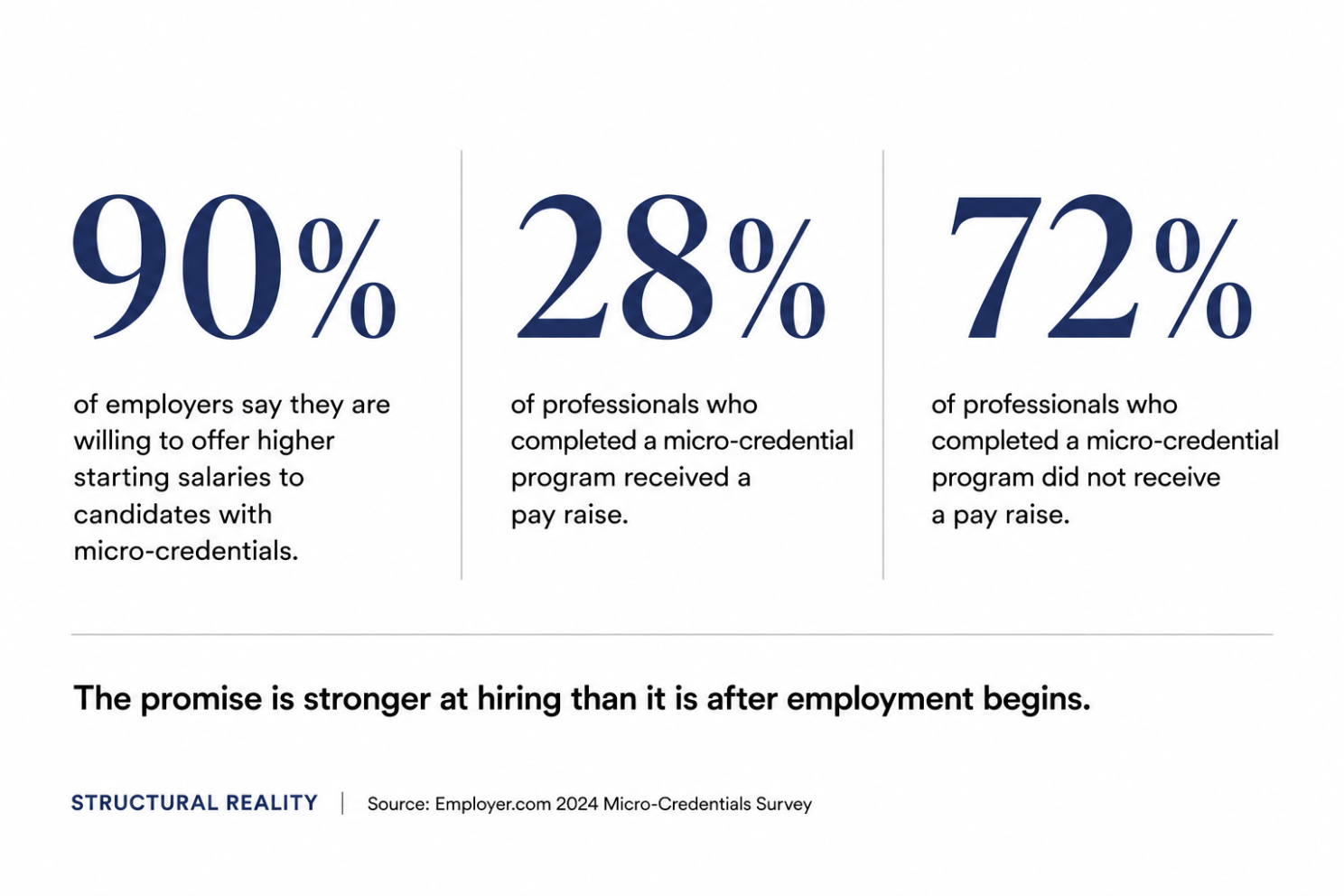
The greed cycle Solomon described at the Economic Club of New York and the treadmill the credentialing series has been documenting are not separate stories. They are the same story at different scales. $3 trillion in AI valuations preparing to hit public markets. 72 percent of micro-credential holders whose wages didn’t move. The capital is abundant. The distribution is not.
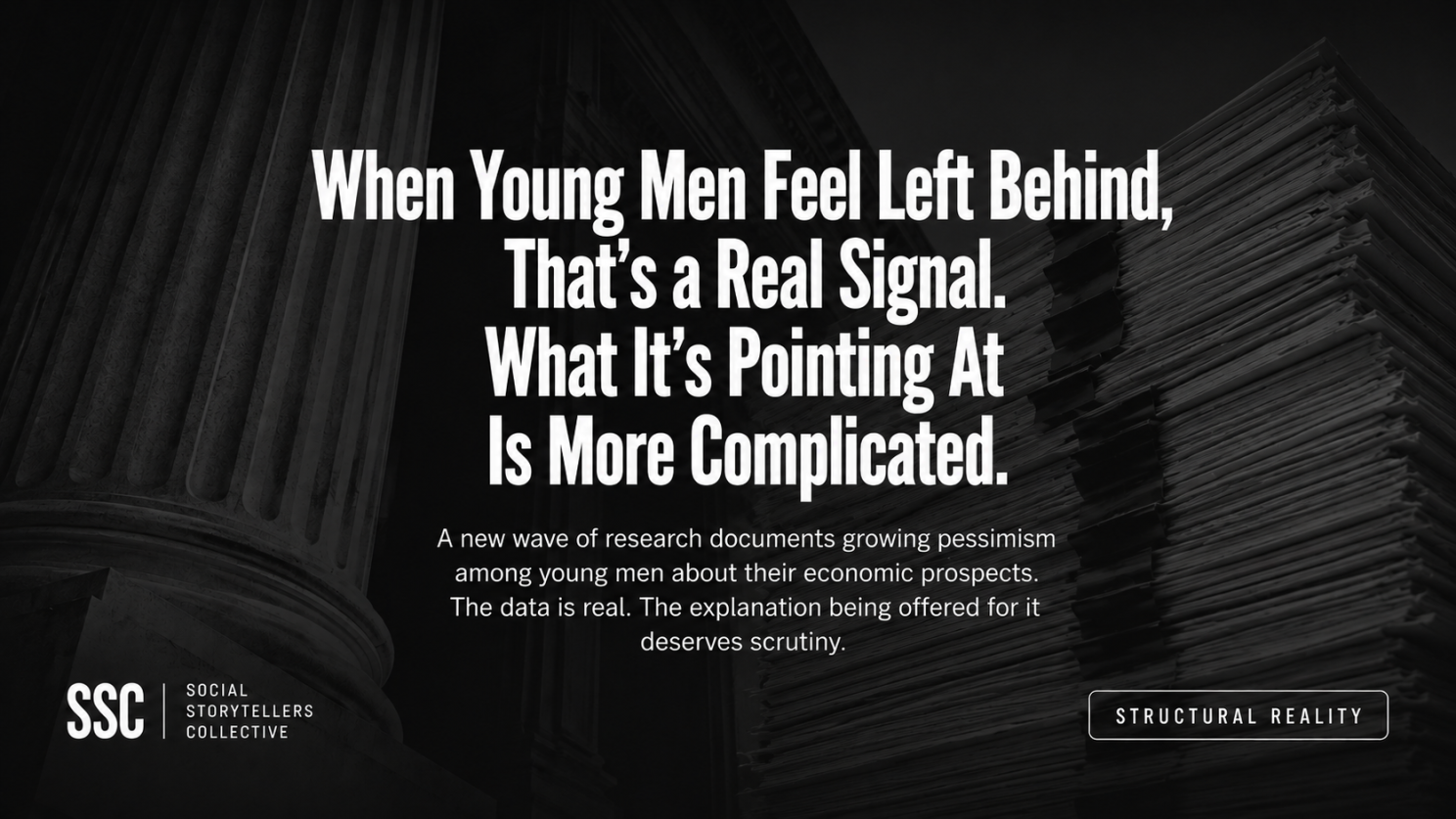
That gap runs through everything SSC published today. A 2025 Pew poll found that 51 percent of young men now believe men face discrimination in American society — up from fewer than one in three in 2019, producing a 22-point gender gap between young men and young women that did not exist a decade ago. When Young Men Feel Left Behind, That’s a Real Signal. What It’s Pointing At Is More Complicated. The pessimism is real. The attribution of it to diversity hiring is where the argument loses precision. The workers whose economic anxiety is rising are navigating a labor market reshaped by remote work, credential inflation, and an economy that has spent a decade consolidating opportunity at the top — not primarily a hiring market that gave their jobs to someone else.
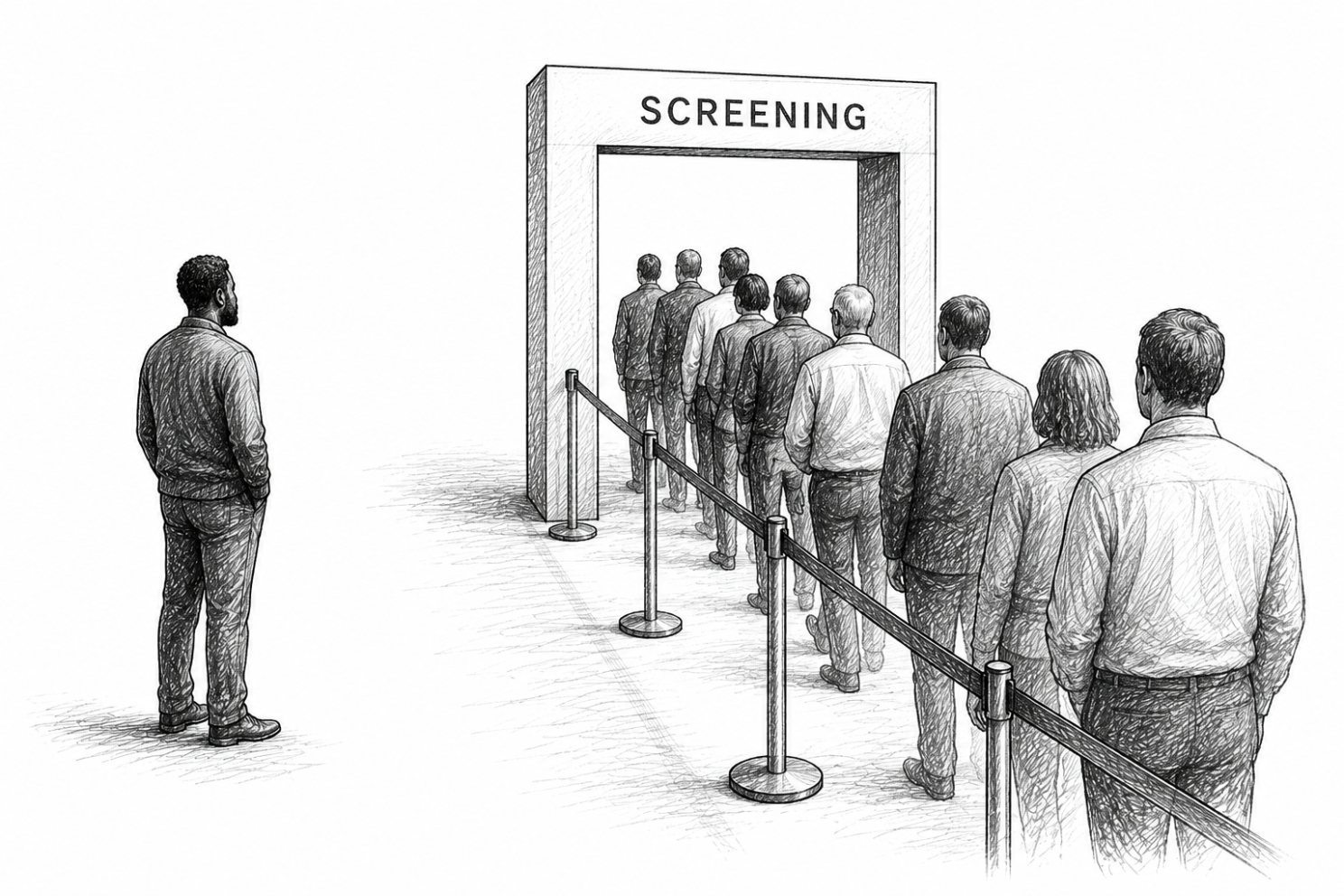
Black men are twice as likely to develop prostate cancer and twice as likely to die from it. That disparity has been documented for decades. It was not the organizing question when the screening system was built — and the system has never been fully redesigned around it. Last week the UK’s National Screening Committee recommended against population-wide PSA screening and simultaneously announced funding to expand the Transform trial specifically targeting Black men aged 45 to 74. The expansion is being called historic. What it actually represents is an acknowledgment that the men carrying the highest risk were never centered in the system designed to catch the disease early enough to save them. Black Men Are Twice as Likely to Die From Prostate Cancer. The Screening System Wasn’t Built Around That.

The access gap extends past healthcare and into global public health. The World Health Organization confirmed Wednesday that the Ebola outbreak in the Democratic Republic of Congo has reached 344 confirmed cases and 60 confirmed deaths, with the virus now crossing into Uganda where 15 additional cases have been confirmed. Only 45 percent of contacts have been traced — against a threshold of 90 percent needed to stay ahead of the outbreak. WHOneeds $115 million over the next three months to mount an adequate response. As of Wednesday, approximately 35 percent of that figure has been raised. The countries least affected are making decisions that hamper the response in the countries absorbing the cost. 344 Confirmed Cases. 45 Percent of Contacts Traced. The Ebola Response Gap Is a Structural Argument.
Michelle Obama was not delivering a research paper at SXSW London this week. She was having a conversation with her brother Craig Robinson during a live recording of her IMO podcast. The observation she made landed with the precision of a well-sourced argument: “I’ve never heard a white man talk about impostor syndrome. I haven’t met one.” Michelle Obama Wasn’t Introducing a New Idea. She Was Giving It a Bigger Room. Impostor syndrome was first documented in 1978. Sponsorship — not narrative — is the variable that most consistently determines who advances. The consulting partner who gets passed over does not have an impostor syndrome problem. She has a sponsorship gap — and the institution has an evaluation architecture problem.
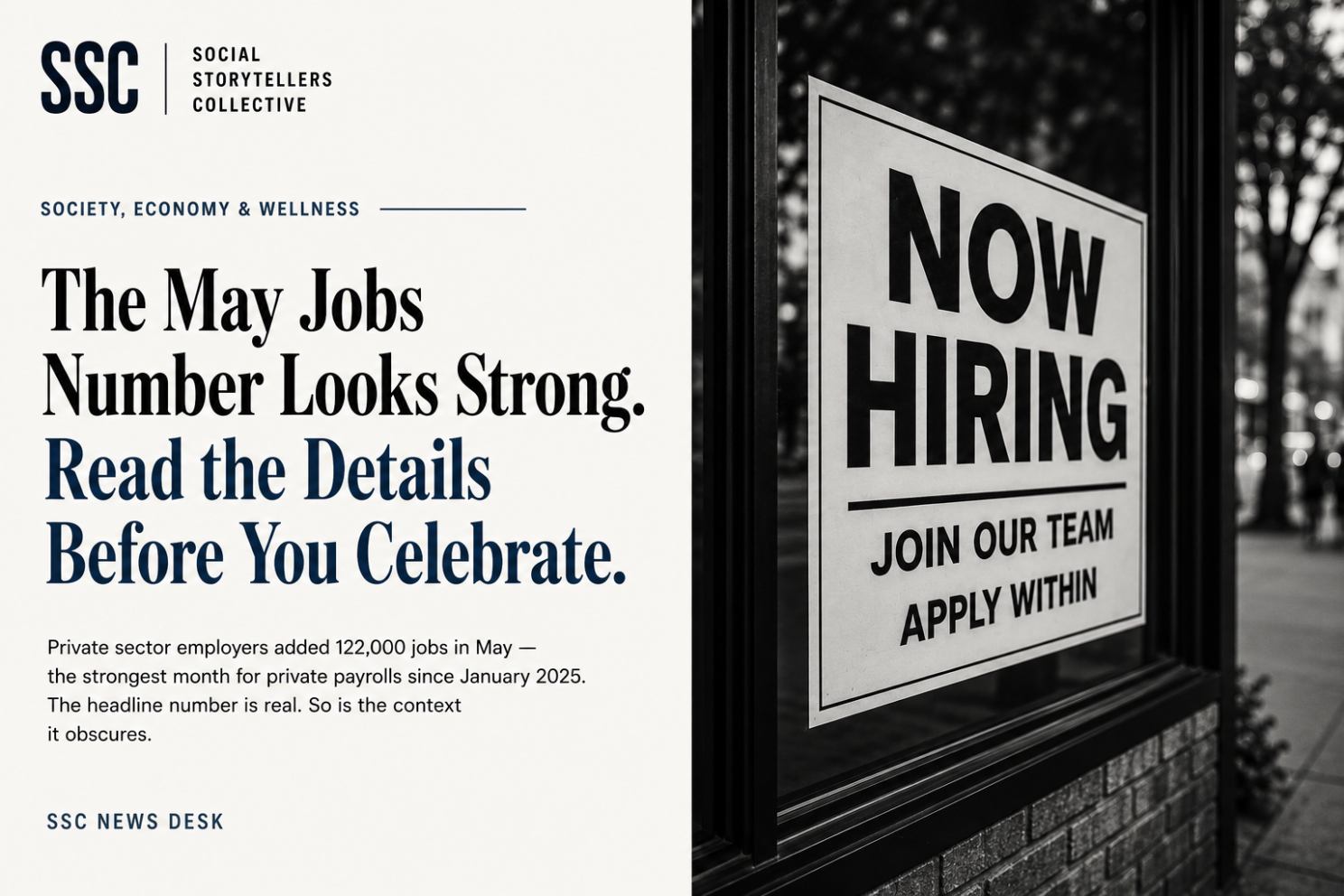
The May jobs report arrived with a headline that looked encouraging. ADP reported 122,000 private sector jobs added — the strongest month since January 2025 — with hiring described as more broad-based than in recent years. The details tell a more complicated story. Small businesses accounted for 67,000 of those jobs — positions that disproportionately skew toward lower wages and fewer benefits. The job-changer pay premium narrowed from 6.6 to 6.5 percent, a signal that worker leverage is cooling even as the headline number rises. The May Jobs Number Looks Strong. Read the Details Before You Celebrate. Friday’s Bureau of Labor Statistics employment report will be the next data point — and SSC will be watching not just the top-line number but who those jobs went to and what they pay.

The technology story running underneath the jobs data is about who is building the infrastructure those workers will eventually depend on. ChatGPT reached 1 billion global monthly active users in May — the fastest any app has ever hit that milestone. In the same period, Claude grew 640 percent year over year. Both companies filed for IPOs in the same week. Microsoft launched Scout — an AI agent that runs Microsoft 365 in the background without being asked, with internal planning documents describing the goal as making users “addicted” before the feature set expands. ChatGPT Hit 1 Billion Users. The Number Underneath It Is the One That Matters. The infrastructure and distribution decisions being made right now by a small number of companies will shape how billions of people access knowledge and perform work for decades. The communities least positioned to negotiate the terms of that dependency will absorb the cost of getting those decisions wrong.

Apple is making its own infrastructure move. iOS 27 — expected to be announced at WWDC as early as next week — will include a bill-splitting feature built directly into Apple Wallet and Messages. Apple Is Coming for Splitwise. Venmo Is Next. The convenience story is real. The strategic story is the one worth watching: Apple is not building a bill-splitting feature. It is building a reason for 1.5 billion iPhone users to process one more financial transaction without ever leaving their phone. That move connects directly to the question Google is now being forced to answer by the UK’s Competition and Markets Authority — which announced that publishers will be able to opt out of Google’s AI-generated search summaries. Google’s New Search Problem Isn’t About Technology. It’s About Power. Traditional Google Search was designed to send people somewhere else. AI search is designed to keep them where they are. Every information economy eventually faces the same question: who creates the value, and who captures it?
The extraction logic runs deeper than search and payments. A Glamour UK investigation, reported by Black Enterprise,found that AI-generated influencers modeled after Black women are attracting millions of views on TikTok and Instagram — built by scraping real Black women’s content, replicating their movements, facial features, and likenesses without consent, and funneling engagement toward paid subscription platforms featuring sexualized content. TikTok and Meta say violating accounts have been removed. Critics say the removals are insufficient without stronger legal protections and greater platform transparency. The women whose content trained the models have not been compensated. That is not a moderation failure. It is the business model.

The Los Angeles mayoral primary on Tuesday produced a result that deserves structural scrutiny rather than spectacle. Spencer Pratt — best known for appearing on The Hills — finished second with 30 percent of the vote, ahead of City Councilwoman Nithya Raman at 22 percent and within four points of incumbent Mayor Karen Bass. Pratt described the city’s unhoused population as people “shooting up fentanyl with their pants off” — a dehumanization strategy that collapses an entire population navigating addiction, mental illness, and economic displacement into a single image designed to produce disgust rather than understanding. Nithya Raman — the candidate with the most detailed policy record and the deepest structural engagement with homelessness — is in third place. The Celebrity Candidate Is the Symptom. Third Place Is the Diagnosis. When institutions fail visibly and the political vacuum goes unfilled, it does not fill with the most qualified alternative.
From the culture desk: BET announced its first-ever advisory board this week — Queen Latifah, LL Cool J, Bob Johnson, and leaders from finance, sports, and corporate media. The headline focused on the names. BET’s New Board Isn’t About Nostalgia. It’s About Succession. The significance is not who is sitting at the table. It is why BET suddenly believes it needs one — navigating life under the newly consolidated Paramount Skydance structure, preparing for the shutdown of BET+, and attempting to redefine relevance in an ecosystem where cultural authority is increasingly decentralized.

For more than two decades, DJ Screw’s catalog lived in car trunks, barbershops, and hand-to-hand tape exchanges across Houston — no major label, no streaming, no algorithm. His chopped-and-screwed sound shaped an entire city’s identity and then quietly shaped the rest of the music industry. Millions of listeners have encountered the descendants without ever hearing the source. The Algorithm Finally Found Houston — and what looks like a music story is actually a preservation story about which regional Black archives get protected on their own terms and which ones have to survive without institutional support until the industry decides they are worth finding.
Daily Visual Signal
One image that translates the day’s structural tension into a single frame.
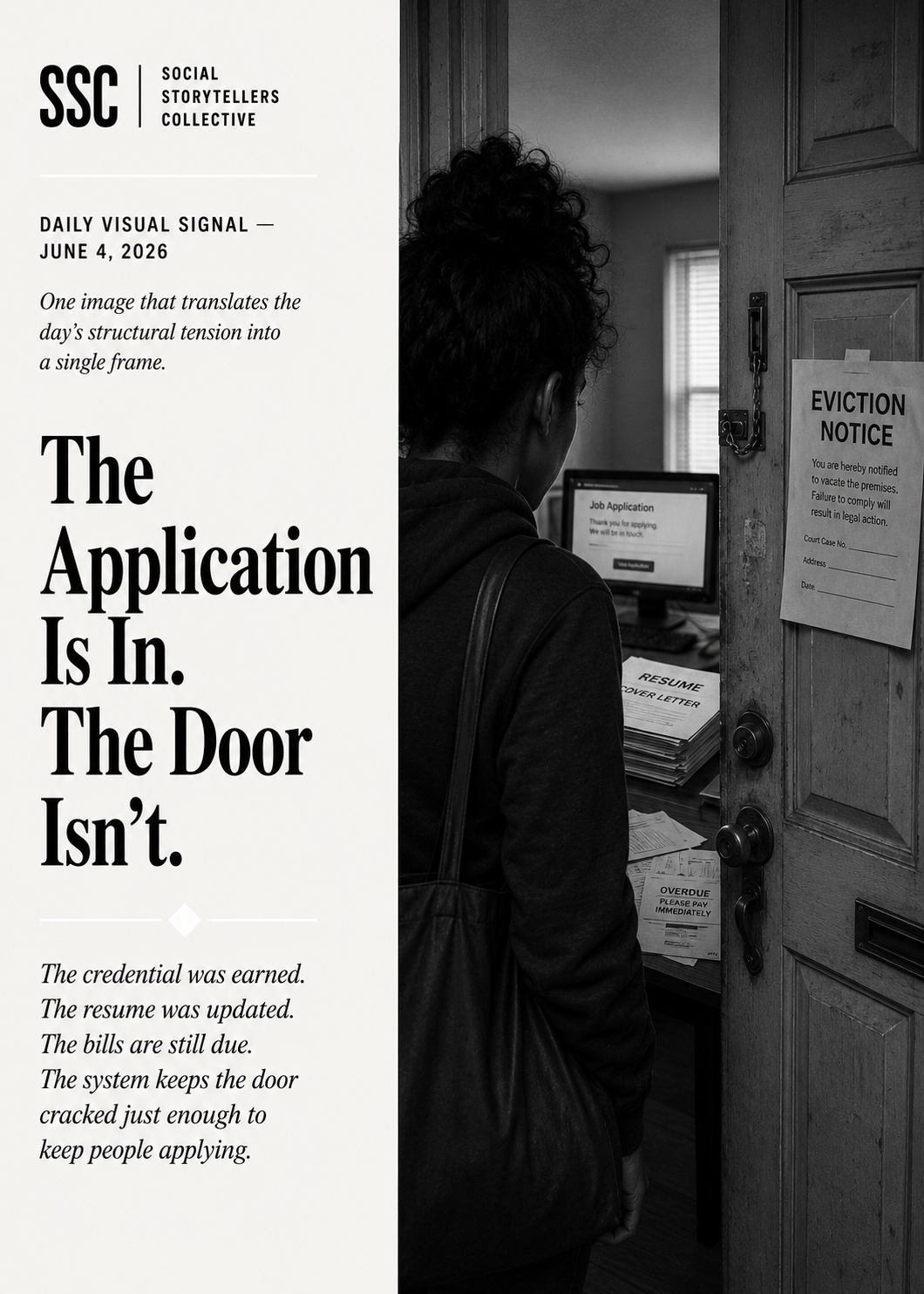
The credential was earned. The resume was updated. The bills are still due. The system keeps the door cracked just enough to keep people applying.
Featured Story | They Put Her in to Fix It. Now Watch How They Treat Her.

Denise Jones Gregory became the permanent president of Jackson State University on May 1 — after spending a year in the interim role stabilizing an institution that has cycled through four presidents in six years. Her predecessors left under circumstances ranging from financial scandal to a prostitution sting arrest to two unexplained sudden resignations. She is inheriting a student housing shortage, frayed alumni relationships, ongoing building renovations behind schedule, and an institution under pressure from a federal administration actively hostile to the HBCU mission. She is also receiving something none of her predecessors got: a year of outside leadership coaching, part of a $97,500 contract Mississippi Institutions of Higher Learning signed with AGB Search — the first time a Jackson State president has received such support when moving into the role.
That coaching is being framed as support. It is worth naming what it actually is: the baseline that should have been standard all along. University presidents are serving shorter tenures than ever — 5.9 years today compared to 8.5 years two decades ago according to the American Council on Education. Women presidents, particularly Black women, are consistently placed in leadership roles at HBCUs after periods of crisis and expected to fix what their predecessors broke — often without the board alignment, alumni trust, or structural support that would make that expectation realistic. Gregory is the second Black woman in a decade to hold the permanent title at JSU. The incoming JSU National Alumni Association president Earlexia Norwood said the support Gregory is receiving is well overdue — and that all the support possible should be given to her, just as it is given to all Mississippi university presidents. That last clause is the argument. The support being treated as exceptional for Gregory should have been standard. The fact that it was not is part of why Jackson State has had four leaders in six years. Read the full piece.
Thursday’s record carries the same thread it always does — the distance between who the system was built for and who absorbs the cost when it delivers. The greed is real. So is the guest list. We will be watching.
We will be back Friday. — SSC
All of today’s coverage lives at socialstorytellerscollective.substack.com. The full archive, beat navigation, and every linked piece are best experienced on a computer. If you have been reading and have not yet subscribed, we would be glad to have you with us.