
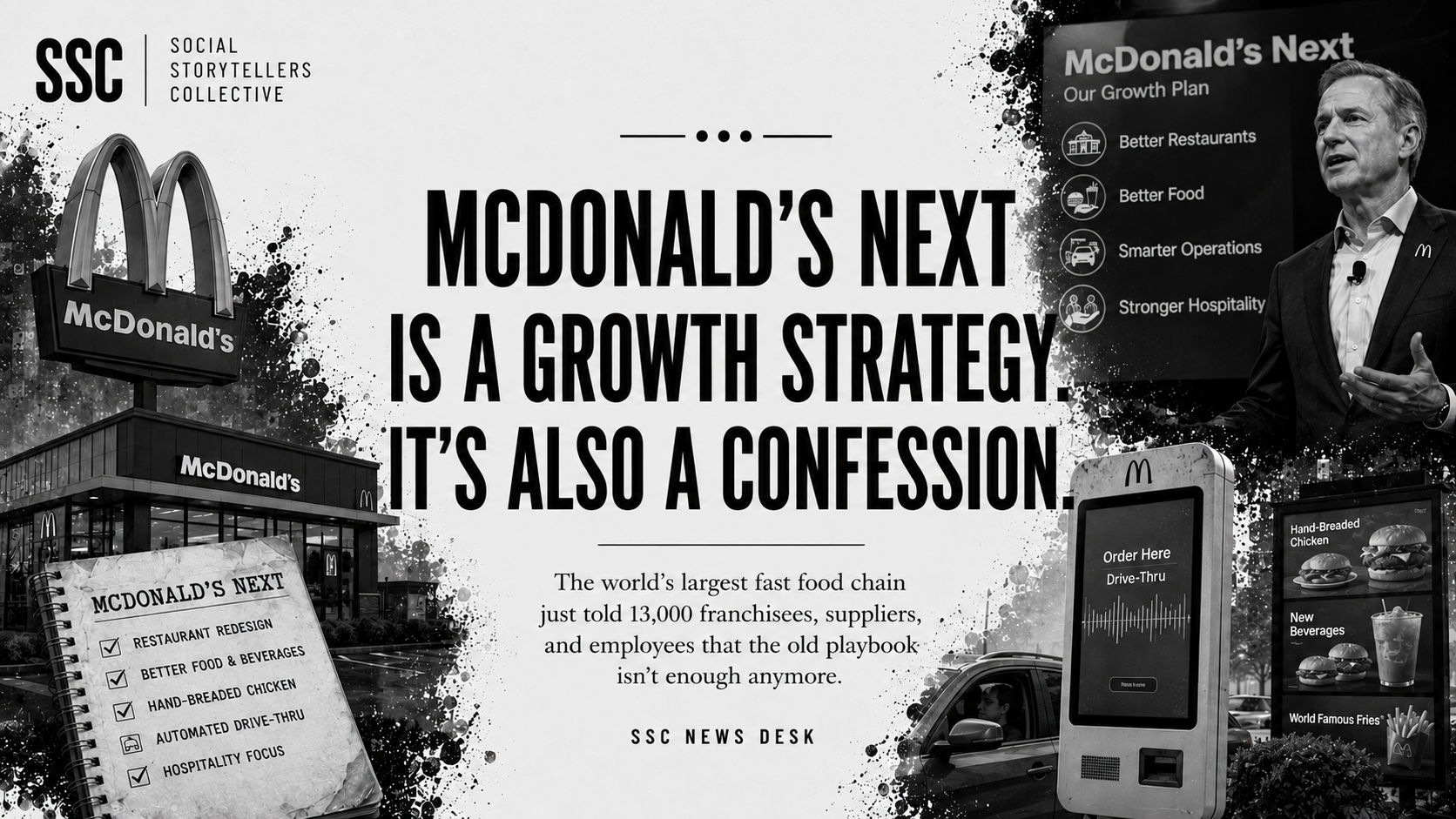
McDonald’s did not unveil a menu update on Monday. It unveiled an identity crisis with a press strategy. The company’s new “McDonald’s Next” global growth plan — announced to more than 13,000 franchisees, suppliers, and employees — calls for redesigned restaurants, upgraded food and beverages, hand-breaded chicken items, automated drive-thru ordering, and a renewed focus on hospitality. CEO Chris Kempczinski framed the moment plainly: traditional competitors are upgrading their menus, and a new wave of specialists are emerging. For the largest restaurant chain in the United States, that is a significant thing to say out loud.
McDonald’s spent the better part of the last decade competing on price, speed, and ubiquity — a strategy that worked until it didn’t. Value menu fatigue, shifting consumer preferences, and the rise of fast-casual competitors willing to charge more for a measurably better product have collectively applied pressure that a $5 meal deal can only partially address. The “McDonald’s Next” framing is the company acknowledging that the floor of the market — cheap, fast, consistent — is no longer a defensible position by itself. Quality is now part of the conversation in a segment that historically treated quality as optional.
The automated drive-thru pilot is the detail worth watching most closely. Five locations testing AI-powered ordering is a modest start, but the direction it points is not modest at all. McDonald’s operates roughly 40,000 locations globally. If automated ordering scales, it reorganizes the labor model of the single largest employer in the American fast food industry. The efficiency argument is the same one companies always make before restructuring their workforces: faster, more accurate, always available. The workers currently taking orders at those drive-thru windows have heard versions of that argument before. The upgrade being announced to franchisees and investors this week lands differently in the parking lot than it does on the earnings call.
McDonald’s is betting that its customers want better food and a better experience — and are willing to show up for it even as household budgets tighten. That is a real question. The same consumer sentiment data showing record lows in May is the backdrop against which McDonald’s is asking people to care about hand-breaded chicken and restaurant redesigns. Whether the brand can move upmarket in perception while holding its position as the affordable option is the tension at the center of this strategy. Ray Kroc built the company on value. McDonald’s Next is a bet that value alone is no longer enough to win.