
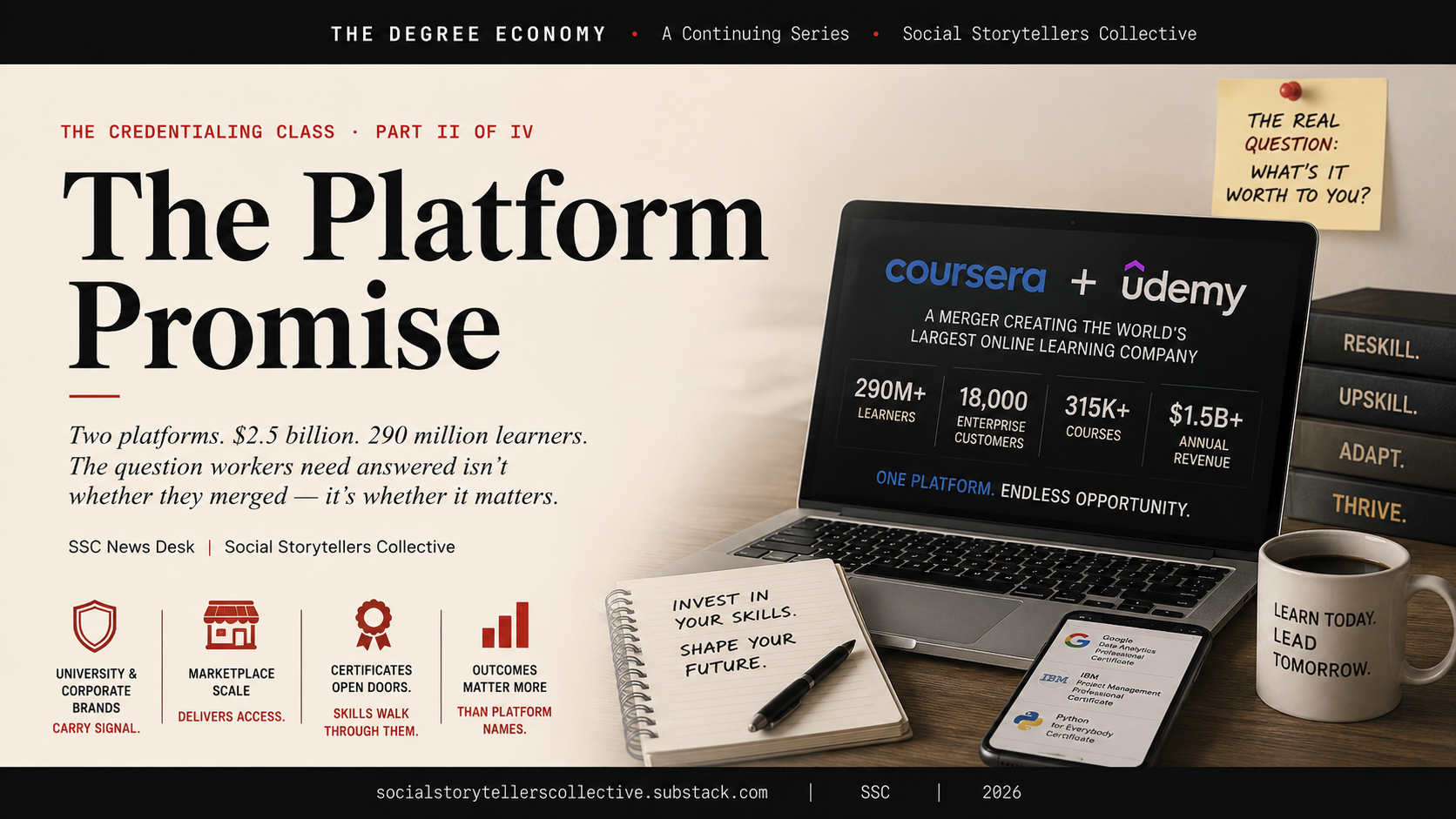
A $2.5 Billion Consolidation and an Unanswered Question
On May 11, 2026, Coursera and Udemy completed an all-stock merger creating a combined company valued at roughly $2.5 billion, reaching more than 290 million learners, 18,000 enterprise customers, and 95,000 content creators across a catalog of over 315,000 courses. The combined platform now generates over $1.5 billion in annual revenue. It is, by nearly every measurable metric, the largest online learning entity in the world.
The merger announcement came with reassurances: existing courses, certificates, subscriptions, and pricing remain unchanged. Learners were told nothing changes immediately. Instructors were told their agreements, contracts, and support structures stay in place. The integration work is still ahead. What the combined company has not yet answered — and what the press coverage largely did not ask — is whether consolidating two platforms with different credential philosophies produces something more valuable than either offered separately, or simply something larger.
That is the question workers need answered before they invest time and money into a platform certificate. And the answer, so far, is not the same for everyone.
What Platform Credentials Are Actually Selling
The platform credential tier — Coursera, Udemy, LinkedIn Learning, edX — is where most workers land first because it is the most visible and the most aggressively marketed segment of the micro-credential economy. The marketing works because the headline numbers are real. Employers do value credentials. Platforms do produce learners who get hired. But the gap between those general truths and a specific worker’s specific outcome is where the platform promise gets complicated.
Coursera’s value has always rested on one thing: the university and corporate brand attached to the certificate. A Google Data Analytics certificate on Coursera is not primarily a Coursera credential — it is a Google credential that Coursera delivers. That distinction matters enormously in a hiring stack. The certificate opens the door because Google’s name is on it, not because Coursera issued it. Strip the Google, IBM, or Meta brand from the top of the certificate and you have a course completion document from a platform most hiring managers assess case by case.
Udemy operates on a different model entirely. It is a marketplace — anyone with expertise can build and sell a course, which produces both its greatest strength and its most significant credibility problem. The top-rated Udemy courses in project management, Python, and Excel are genuinely useful. The certificate that comes with them carries minimal employer recognition on its own. What Udemy sells, at its best, is skill. What it cannot reliably sell is signal — the shorthand that tells a hiring manager something meaningful about a candidate without requiring them to investigate further.
LinkedIn Learning sits in a structurally different position than either. Its certificates carry limited weight compared to university-backed or corporate-issued credentials. But LinkedIn Learning badges display directly on the profile where recruiting happens — which gives them a visibility advantage that Udemy and even Coursera certificates do not have. A LinkedIn Learning badge does not tell a recruiter much. It tells them something. In a market where algorithms are doing the first round of screening, something that appears in the right field of a profile is not nothing.
The Merger’s Real Stakes
The Coursera-Udemy combination is being positioned as an answer to the demand for workforce reskilling in an era of rapid technological change. CEO Greg Hart described the merged entity as moving beyond a traditional course marketplace toward what he called a more adaptive, “agentic” skills-delivery platform — connecting skills identification, training, credentialing, and workforce deployment into an integrated system. The combined data on 290 million learners gives the platform the scale to build more sophisticated personalization and to make stronger claims about measurable learning outcomes.
That is the optimistic read. The more grounded read is this: Coursera brought university-backed credentials and structured learning. Udemy brought a massive marketplace and global reach — generating the majority of its revenue outside North America, with strong penetration in Europe and Asia. The merger creates the largest catalog in the industry. It does not automatically resolve the fundamental credibility gap between a Google-branded Coursera certificate and a self-paced Udemy course completion badge. Those two things are still not the same. They are now sold by the same company.
The integration work ahead — how instructor discovery, revenue models, course visibility, and certification pathways will work across the combined platform — will determine whether the merger produces genuine value for learners or simply a larger version of the same stratified marketplace. That work has not yet happened. Learners choosing between platforms today are making that decision without knowing what the combined entity will look like when it is fully integrated.
What Workers Should Actually Know
The platform credential is not worthless. It is context-dependent in ways that marketing materials are not designed to communicate. A few things that are reliably true regardless of platform:
The brand on the certificate matters more than the platform that delivered it. A Google Career Certificate through Coursera is a Google credential. A random course completion badge from the same platform is not. Workers should be choosing credentials based on who issued the underlying certification, not which platform delivered the course.
Employer recognition is not uniform across industries or roles. Platform credentials carry more weight in technology, data, and digital marketing than in finance, law, healthcare, or traditional corporate functions where accreditation structures and licensing boards define what is legitimate. Matching the credential to the hiring context is the actual skill — and it requires knowing more about how a specific employer screens than any platform will tell you.
Visibility matters on LinkedIn in ways it does not elsewhere. If the credential appears in the right field of a LinkedIn profile and matches keywords a recruiter is searching, it generates more value than a certificate sitting in a folder on a desktop. That is not a reason to choose LinkedIn Learning over a stronger credential — it is a reason to treat profile placement as part of the credential strategy regardless of where the learning happened.
The Coursera-Udemy merger creates the largest online learning platform in history. It does not change the fundamental calculus: the credential is only as strong as the relationship between the issuer and the people doing the hiring. Platform scale can amplify that relationship. It cannot manufacture it.
Part III of The Credentialing Class examines the programs where the short runway actually works — and why the ones that deliver durable mobility almost never generate the most press coverage.
The Credentialing Class is Part III of SSC’s ongoing Degree Economy series. Read Part I — Not All Credentials Are Created Equal — at socialstorytellerscollective.substack.com