
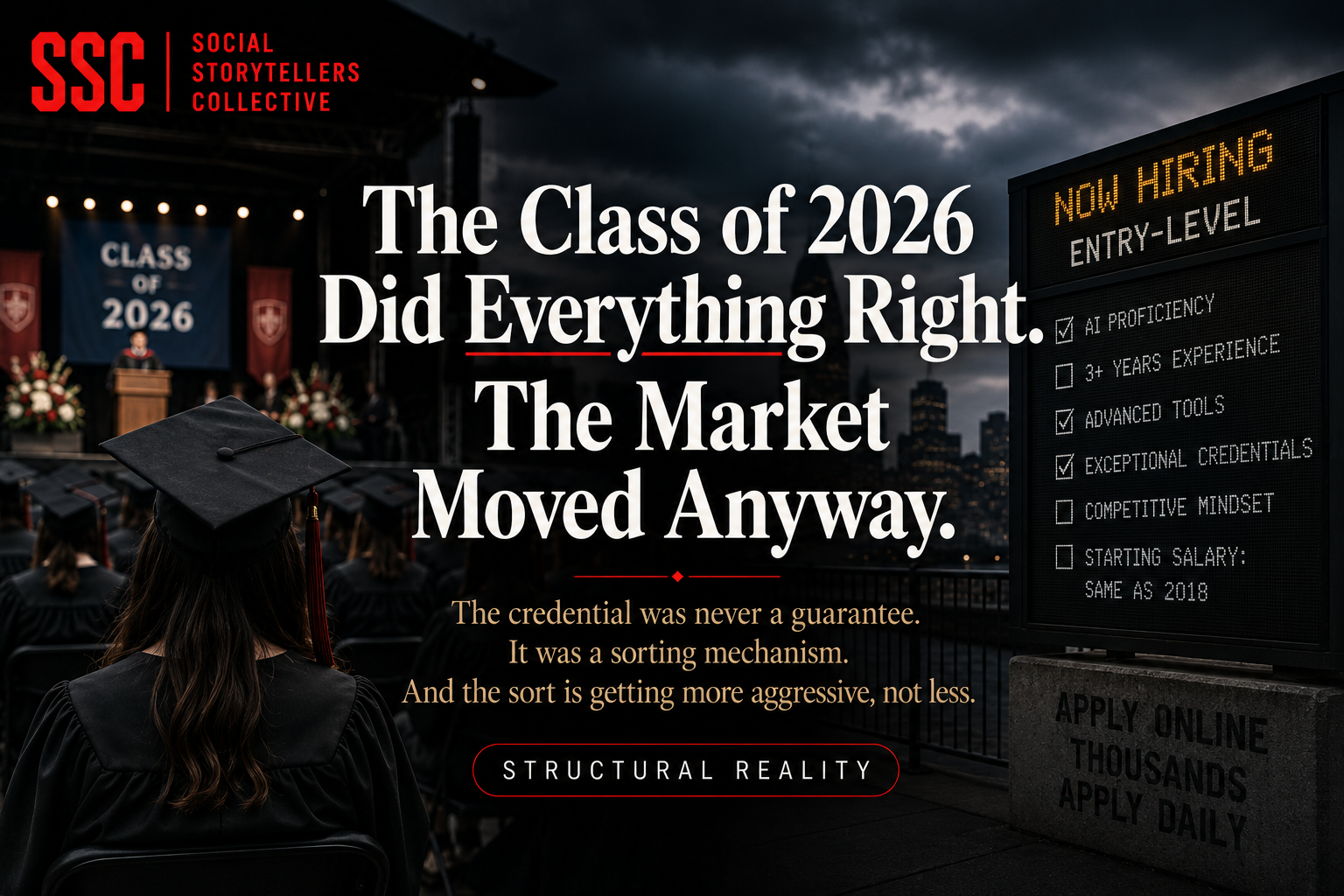
Commencement speakers who mention artificial intelligence at graduation ceremonies this spring keep getting booed. The students are not being dramatic. They are being precise. They spent four years building skills for a market that was being restructured underneath them in real time — and the people restructuring it were the ones on the stage telling them to stay optimistic.
The unemployment rate for recent college graduates hit 5.7% in the fourth quarter of last year — a four-year high. Junior-level job postings fell 7% last year, even as the share of graduates creating Indeed profiles nearly doubled, jumping to 19% in 2025. More people chasing fewer entry-level openings is not a skills problem. It is a structural one — and the structure is contracting at exactly the bottom of the ladder where every generation has always started. The credential economy promised that preparation would be rewarded. What the Class of 2026 is discovering is that the promise was always conditional, and the conditions keep changing.
35% of entry-level jobs now require AI skills. That sounds like an opportunity until you understand the mechanism. Requiring AI proficiency at the entry level is not an investment in young workers. It is a justification for a narrower applicant pool, a higher bar that costs the same starting salary to clear, and a filter that produces fewer hires while creating the appearance of rigor. The credential inflation SSC tracked in The Credentialing Class series has now reached the bottom of the hiring funnel. You need the skills to get the interview for the job that AI is simultaneously being used to eliminate. The threshold moves. The promise doesn’t.
Current graduates expect to earn an average of $80,004 one year after graduation. Actual starting salaries are $56,153. That $24,000 gap is not a miscalculation. It is the distance between what a degree was sold as delivering and what the market is currently paying — and it lands on top of student loan balances, rising rent, and a credit card debt environment SSC documented last week where $1.25 trillion in balances are carrying interest rates above 21%. The institutions that sold the credential are not the ones absorbing the shortfall. The graduates are. And the graduates who absorb it hardest are the ones who had the least cushion going in — first-generation students, Black and brown graduates, students from working-class families who borrowed the most because the credential was supposed to be the way through.
Those building AI have been candid about their ambition to automate large categories of white-collar work, including much of what a college degree has historically unlocked. BlackRock CEO Larry Fink warned earlier this year that “when this year’s college graduates enter the workforce, we could see the highest unemployment rate among them in years — even without a recession.” The standard story about unemployment spikes is that recessions cause them. What Fink is describing is structural displacement — a permanent reorganization of which roles exist at the entry level — happening in an economy that by conventional metrics is not in recession at all. The jobs are not being eliminated in a downturn. They are simply not being created. The market is not contracting. It is sorting. And it is sorting more aggressively, along more dimensions, with more tools, than any previous generation of graduates has faced.
As SSC documented in The AI Resume Screen Won’t See You Coming, AI screening tools favor white-associated names 85% of the time and operate at 98.4% of Fortune 500 companies before a human ever sees an application. The Class of 2026 learned the tools. The tools are still screening them out. The filter is not neutral and it was never designed to be. It was designed to produce a manageable number of acceptable candidates from an unmanageable pool — and every time the pool grows, the filter tightens. The credential was always a sorting mechanism. The Class of 2026 is just the first generation to arrive at the sort with nowhere left to appeal.