
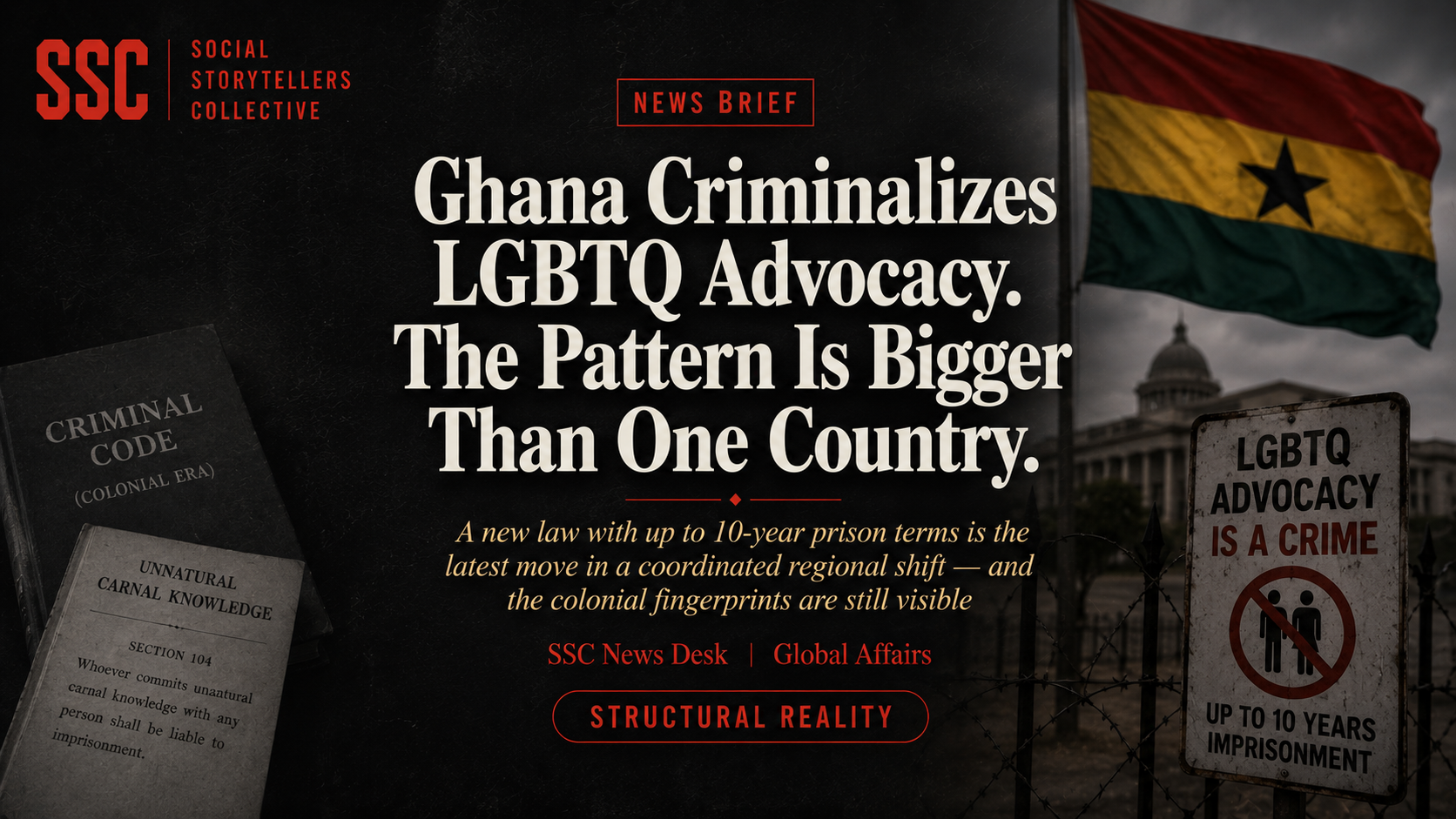
Ghana’s parliament passed legislation Friday imposing prison terms of up to 10 years for promoting LGBTQ activities and three years for same-sex acts, with President John Dramani Mahama expected to sign it into law. The bill also bans funding LGBTQ organizations and criminalizes advocacy — expanding far beyond the colonial-era law already on the books that prohibits what it calls “unnatural carnal knowledge.” That existing law was never repealed. This one adds criminal penalties for speaking about the issue at all.
The framing from supporters is cultural sovereignty — protecting Ghanaian family values from outside influence. That framing deserves scrutiny. The law being expanded is itself a colonial import, written into Ghana’s legal code by British administrators. The tradition being defended was largely installed by the same outside forces now being invoked to resist criticism. More than 30 of Africa’s 54 countries currently criminalize same-sex acts, with punishments ranging from lengthy prison terms to the death penalty in countries including Somalia, Uganda, and Mauritania. Ghana is not an outlier. It is part of a coordinated regional pattern that has accelerated in recent years, with religious lobbying groups — many with documented ties to U.S.-based evangelical networks — driving the legislative push across multiple countries simultaneously.
Human Rights Watch condemned the bill and called on Ghana’s government to uphold international legal protections guaranteeing equality, nondiscrimination, and privacy. Ghana’s own Finance Ministry warned when an earlier version passed in 2024 that enactment could jeopardize billions in international financing. That version was never signed. This one has a president ready to move. The fight over who gets to exist openly — and who gets criminalized for saying so — is not contained to West Africa. As SSC reported today in The Most Endangered Historic Places in America Are Being Erased on Purpose, the Stonewall National Monument is on this year’s endangered list precisely because the erasure of LGBTQ history from federal properties is already underway at home. The mechanism differs. The direction is the same. The people who will live inside this law — who cannot leave, cannot organize, and now cannot speak — are not abstractions in a geopolitical debate. They are the story.