
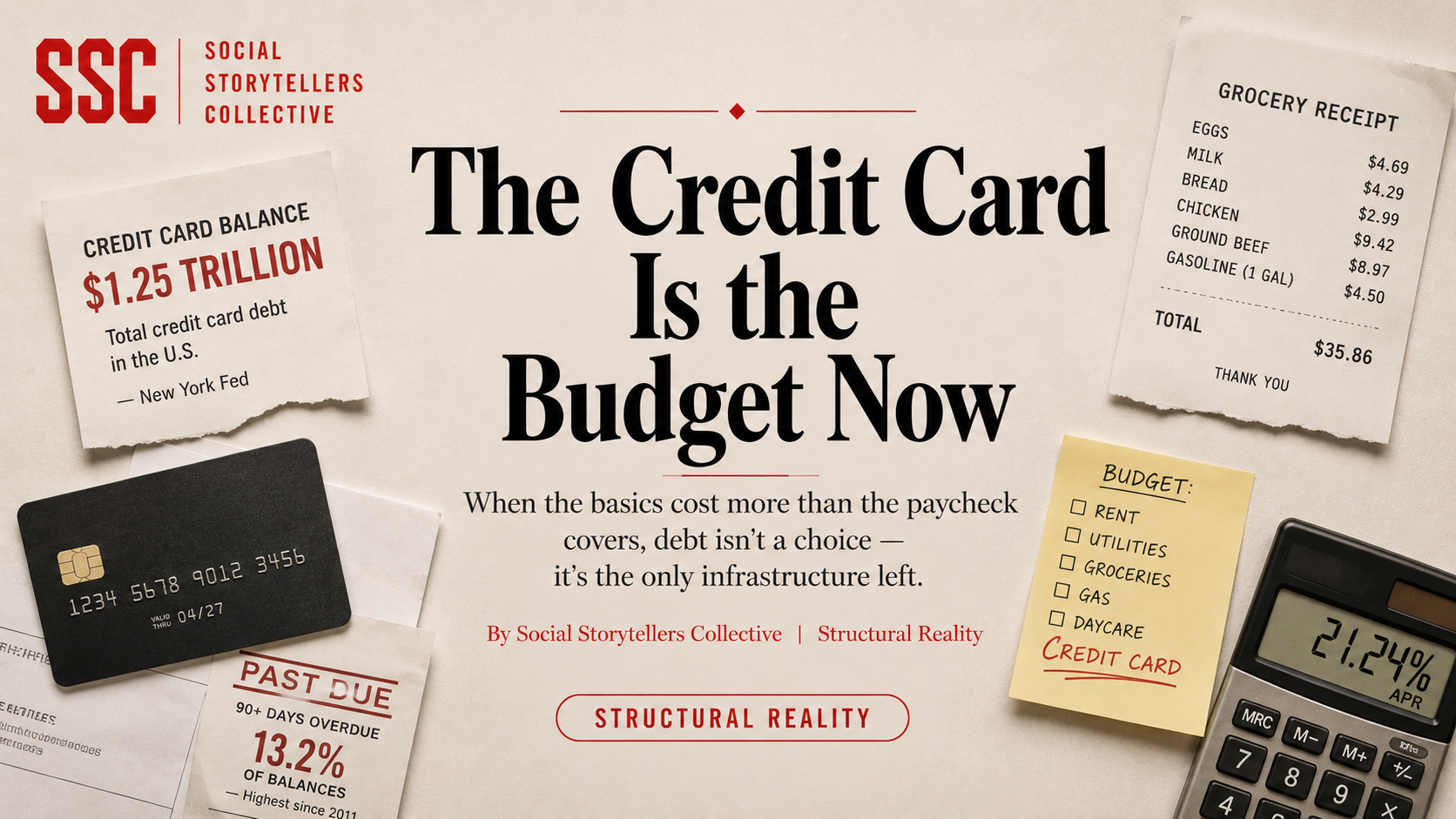
Americans are carrying $1.25 trillion in credit card debt. That number comes from the Federal Reserve Bank of New York, and it is not a rounding error. It is the baseline — the floor of what households across this country currently owe on plastic, after a seasonal dip from the all-time high of $1.28 trillion set at the end of 2025. The number that matters even more is the one sitting right next to it: credit card balances have risen 63% since 2021, when pandemic-era savings kept debt at its lowest point in years. In five years, Americans went from the most financial cushion they had seen in decades to the most debt they have ever carried. That is not a personal finance story. That is an economic one.
Here is how it happened. The average credit card APR is now sitting above 21% — the highest sustained level since the Federal Reserve began tracking it. That means every dollar you cannot pay off at the end of the month immediately starts accruing interest at a rate that would have been considered predatory a generation ago. And people cannot pay it off because the cost of everything else went up first. Food. Housing. Healthcare. Gas. A gallon of regular gas averaged $4.50nationally this week, up from about $3.14 a year ago. When the basics eat the paycheck, the credit card covers the rest. It is not a choice. It is the only remaining infrastructure between a household and a shortfall.
The people falling behind are not who the dominant narrative wants you to picture. 43% of Americans struggling with credit card debt have a four-year university or master’s degree — up from 34% in 2021. Brookings research found that one-third of middle-class families are struggling to afford basic necessities like food, housing, and child care. This is the same cohort SSC has been tracking across multiple beats — the $100K household now driving Walmart‘s market share gains, the budget traveler who quietly exited the summer travel data as documented in The Summer the Vacation Became a Luxury Good, the worker whose employer used the AI displacement narrative as cover for layoffs that had nothing to do with automation. The people who were supposed to have made it are the ones getting squeezed hardest right now, and the credit card balance is where that pressure finally becomes visible.
The New York Fed’s own researchers acknowledged the K-shaped economy in the credit card data directly, noting “some weakness in lower-income households” in the delinquency numbers. But the delinquency data tells an even starker story at the bottom. Over 13% of balances are at least 90 days overdue — the highest level since 2011. When a bill goes 90 days past due, it is not because someone forgot to pay it. It is because the money was not there. Three missed months is not a slip. It is a structural collapse playing out one household at a time, in numbers large enough that the Federal Reserve is tracking it as a system-wide signal.
The personal savings rate has collapsed to 4.0% in Q1 2026, down from 6.2% just two years ago. That is the cushion evaporating in real time. And the University of Michigan consumer sentiment index fell to 53.3 in March — deep inside what the survey defines as recession territory — even as unemployment held steady at 4.3%. That disconnect is the whole story. The job market looks stable on paper. The household budget tells a different truth. People are employed and still falling behind, because employment and stability are no longer the same thing in an economy where the cost of living has outrun wages for three consecutive years. The credit card is not evidence of recklessness. It is evidence of a gap — between what things cost and what the economy actually pays most people to live — and that gap is widening faster than any individual household can close it.
#KShapedEconomy #CreditCardDebt #StructuralInequality #TheAccessShift #Inflation #SSC