
The headline from Bank of America‘s latest research sounds like good news: younger workers who switch jobs see dramatically higher wage growth than those who stay put. Gen Z job switchers saw after-tax wages grow four times faster than their counterparts who stayed in their roles. An 8% median wage increase for switchers versus 5% for stayers in Q1 2026. On paper, the math is straightforward — move around, make more money. The problem is that the paper version of this economy and the lived version are two different places entirely, and the distance between them is where most workers actually live.
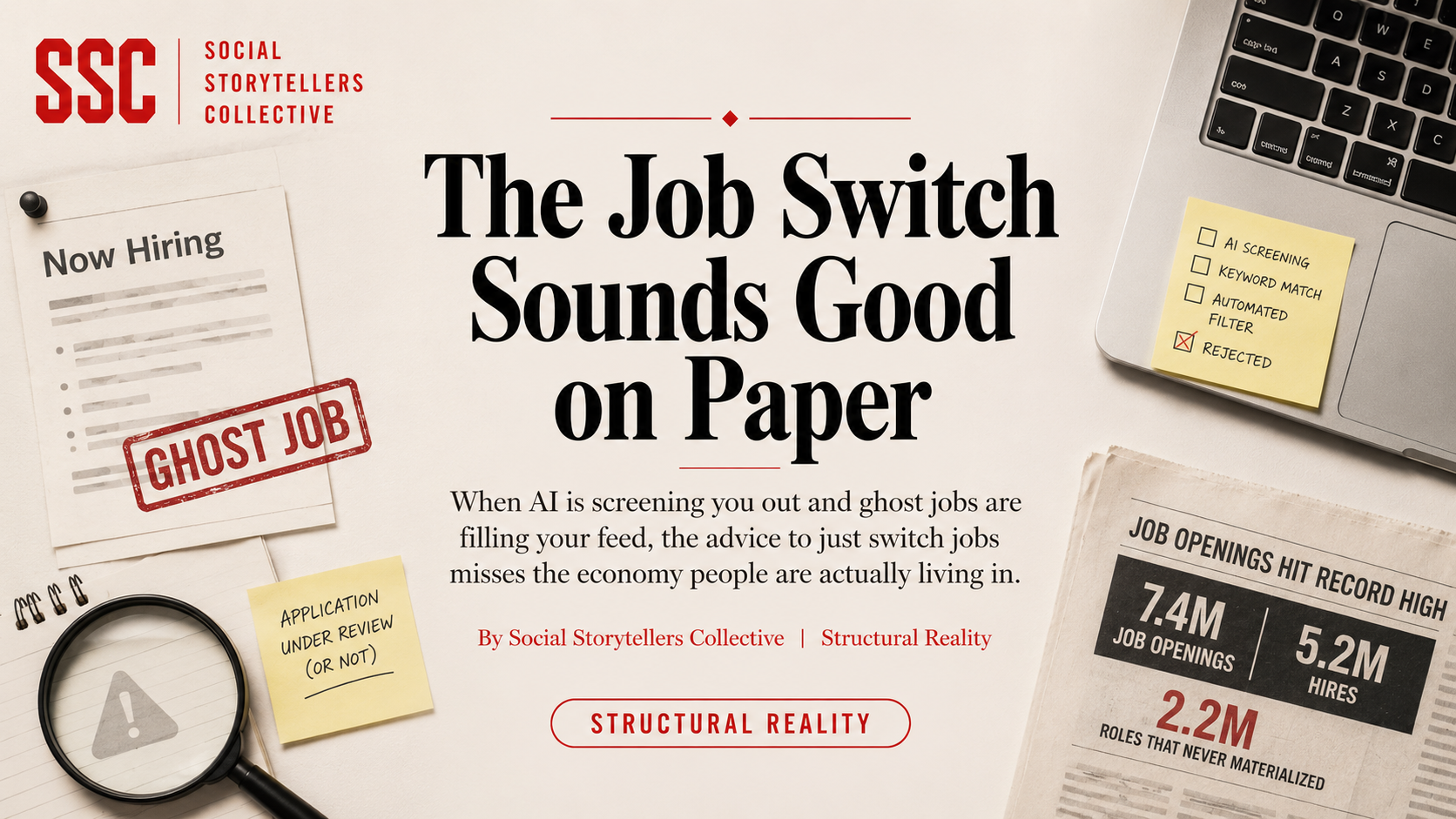
Here is what the Bank of America data does not account for: you cannot switch into a job that does not exist. The same period producing these wage-growth numbers is also producing one of the most structurally distorted hiring environments in recent memory. SSC reported on this directly in April — Employers Are Posting Jobs They Don’t Intend to Fill. The Market Signal Is the Point. — and the numbers are not subtle. In June 2025, employers reported 7.4 million job openings but made only 5.2 million hires, leaving more than 2.2 million roles that never materialized. Since 2021, the ghost job rate has persisted at roughly 28 to 32 percent each month. A LiveCareer survey of HR professionals found that 45% of managers admit they regularly post ghost jobs, while another 48% do so occasionally. The practice is not marginal. It is industry standard. The switch Bank of America is recommending requires an open door. A meaningful share of the doors on the market right now are painted on the wall.
And even when the jobs are real, getting to a human being who can evaluate your application has become its own structural barrier. As SSC documented in The AI Resume Screen Won’t See You Coming, AI resume screening tools now favor white-associated names 85% of the time — and in direct comparisons, Black male-associated names were never preferred over white male-associated names. Not once. Nearly 98.4% of Fortune 500 companies now use AI in their hiring process, which means this is not an edge case. It is the standard. The systems are trained on companies’ existing hiring data — which means historical decisions that already favored certain demographics get replicated at scale, automatically, before a human ever sees a name. A Gen Z worker with a nonlinear path, a community college credential, or experience that does not map neatly onto a standard resume template can be algorithmically eliminated before anyone reads a word they wrote. The advice to job-switch assumes the application clears the first gate. For a significant portion of younger workers — particularly Black and brown workers, workers without four-year degrees, and workers from non-traditional backgrounds — that gate is the whole problem.
This connects directly to what SSC has been tracking in The Labor Market Has a Black Male Problem — and the Data Proves It’s Not About Skills. Prime-age Black men achieved the same certification rates as their peers in a computer repair training study and saw zero employment gain while others moved forward. Same credential, same completion rate, different outcome. The Bank of America wage-switching data is real — but it describes an opportunity that is not distributed equally across the labor market. Telling workers to switch jobs in an economy where 28 to 32% of posted openings were never real, and where algorithms screen out applicants before a human ever reviews them, is advice that works for some people and functions as a closed loop for others.
The one finding in the research that does not get enough attention is the data on top earners. For workers in the top 5% of wages, staying put produced nearly 10% wage growth — while switching produced less than 2%. Loyalty pays at the top. At the bottom and middle of the wage scale, it does not. That asymmetry is not a quirk. It is the structure of the economy made legible in a single data point. The people with the most leverage — whose skills are hardest to replace, whose networks open doors before applications are ever submitted, who are never filtered by an algorithm because they never needed to apply cold — those workers are rewarded for staying. Everyone else is told to keep moving. The gap between those two experiences is not closing. It is the story.
#KShapedEconomy #LaborMarket #GenZ #JobSwitching #AIHiring #GhostJobs #TheAccessShift #SSC