
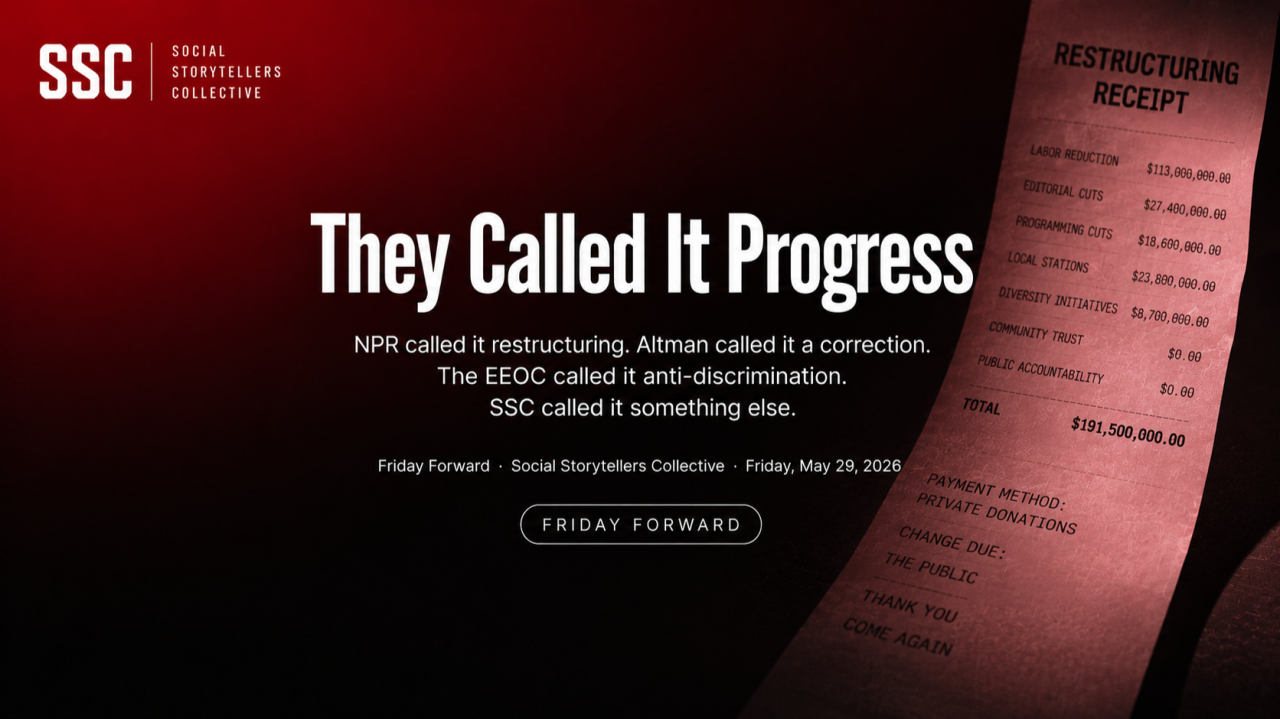
They Called It Progress
NPR called it restructuring. Altman called it a correction. The EEOC called it anti-discrimination. SSC called it something else.
Friday Forward — May 29, 2026 Social Storytellers Collective | Weekly Edition
This was not a quiet week.
Eleven days after Social Storytellers Collective documented what would happen when NPR directed $113 million in private donations toward infrastructure while the editorial budget stayed exposed, the buyouts arrived. Ten journalists laid off. Eighteen more offered buyout notices. The journalists walking out — including national political correspondent Don Gonyea and investigations correspondent Joe Shapiro — are not leaving because public media failed. They are leaving because the system that was supposed to sustain public media was deliberately dismantled, and the replacement doesn’t need as many of them to run. SSC called it before it happened. The Buyouts Arrived. Social Storytellers Collective Saw Them Coming is the full account — and The Money Went to the Machine. The Journalists Got Buyout Notices is the piece we published ten days before the receipts arrived.
That story is the thread running through everything we covered this week. Who controls the story, who pays when the story changes, and what fills the space when the institutions that were supposed to hold the line let go.
A LinkedIn post celebrating $775,000 senior communications salaries at elite tech companies framed it as proof that storytelling is having a moment. The $775,000 Question: Who Gets to Tell AI’s Story? read it differently. The same industry paying those salaries has spent five years cutting the journalists — disproportionately Black and Brown — most equipped to fill them. The national average for a director of communications is $107,000. The ceiling at Netflix is $1.2 million. That is not a skills gap. It is an access gap.
Sam Altman and Dario Amodei walked back their AI job apocalypse predictions the same week both their companies filed for IPOs. The workers who spent 2025 restructuring their lives around those forecasts did not get a correction — they got a schedule that served the people who made the mistake, not the people who lived inside it. The Correction Nobody Asked For names what that schedule actually is.
A Navigator Research focus group found Black men had largely stopped trusting mainstream media. The political class responded by asking how to reach them. When the Story Keeps Getting You Wrong, You Stop Reading It asked the harder question — why would they trust institutions that have spent years misdescribing their reality? Bryson Davis reported this month that 650,000 Black men exited the labor force between November 2025 and April 2026. The headline called it stabilization.
The EU‘s Entry/Exit System went live on April 10 and produced seven-hour queues at Lisbon, five to six hours at Geneva, and chaos across Paris CDG, Madrid, Barcelona, and Prague. The operational failure is the visible story. A decade of independent research shows facial recognition technology misclassifies Black women at a rate of nearly 35 percent while achieving near-perfect accuracy for white men. Europe’s New Border System Has a Six-Hour Wait. For Some Travelers, the Problem Runs Deeper Than That is not a travel disruption story. It is an equity story.
A Note On The Blue Dot Story
Earlier this week SSC published Blue Dot Fever Is Exposing the Real Concert Economy — examining unsold seats at major tours as evidence that the market is finally responding honestly to an industry that kept raising prices while fans ran out of room. The average concert ticket is now $144, up from $82 in 2020.
Randy Nichols , a strategic advisor and artist manager with decades of live entertainment experience, challenged our framing directly. His argument: the Blue Dot narrative didn’t originate with fans — it spread from scalper Twitter, amplified by secondary market operators whose arbitrage is under serious pressure as artists reclaim control of their inventory. StubHub went public in September 2025 at $23.50 a share and was trading around $8.70 by March 2026 — a decline of more than 60 percent in six months. Vivid Seats has lost roughly 88 percent of its value from its 52-week high.
We updated the piece. We stand by the core argument — the ticket prices are real, the audience selectivity is real, and the illusion of endless demand is cracking. But the scalper pressure angle was missing and it changes the framing in meaningful ways. We featured the exchange in The Follow Up, a new section of our newsletter dedicated to exactly this kind of discourse. Randy‘s full piece — Blue Dot Fever and the Scalper Narrative: Don’t Fall For It — is worth reading alongside ours. This is how SSC wants to work. We get it right. When we don’t, we say so.
The Cost Of Existing In America Right Now
The same household runs through four SSC stories this week. In The Price of Being Sick in America Is Not Accidental, Leena Alridge connects the One Nation, Overcharged coalition launch to the $187 billion in SNAP cuts moving through Congress and the USDA‘s decision to stop measuring food insecurity at precisely the moment when what happens next matters most. The seven largest for-profit health insurance companies booked more than $54 billion in profits last year. The system is not broken. It is working as designed.
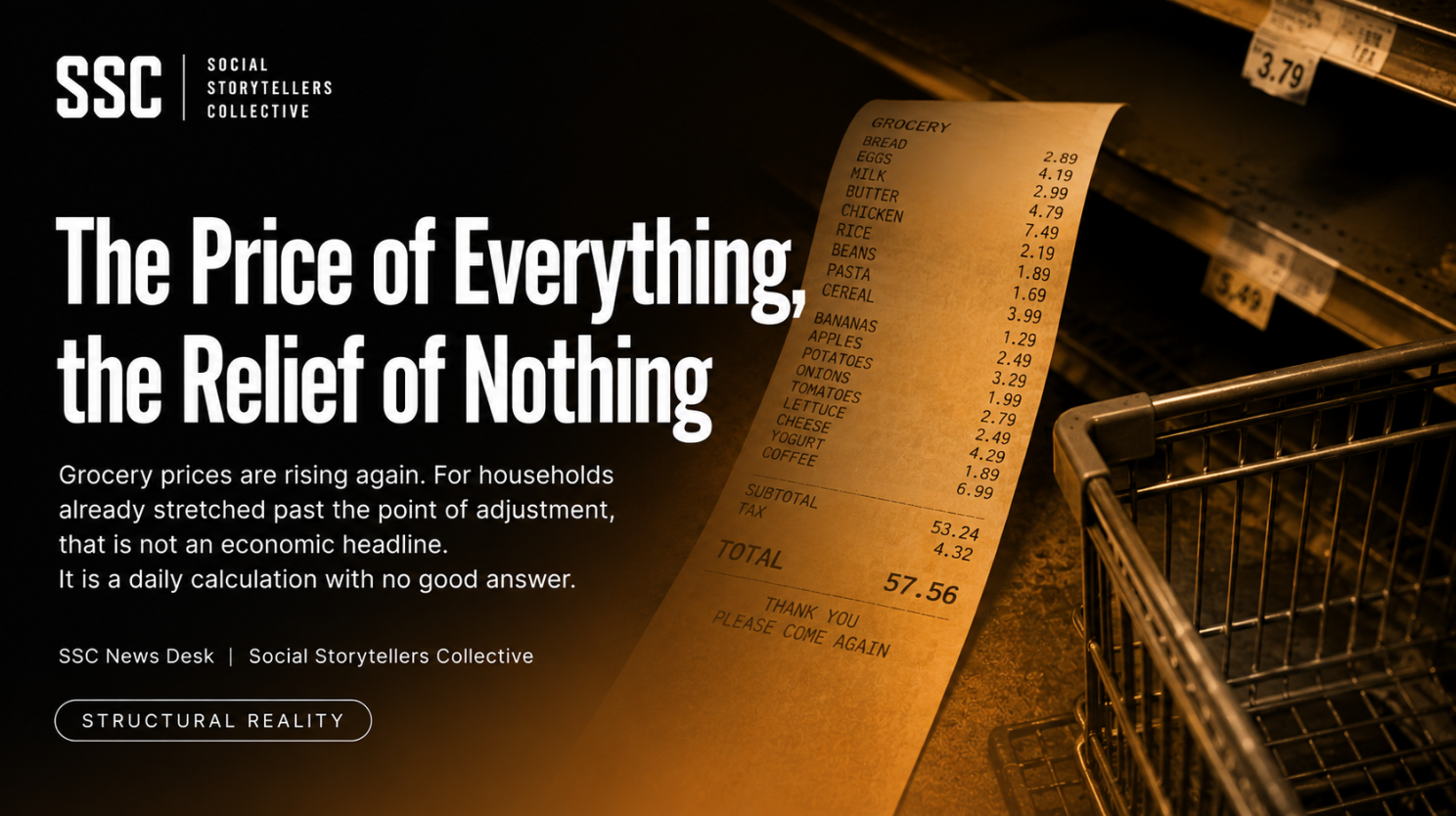
The Price of Everything, the Relief of Nothing traces the compounding pressure of the Iran war’s energy shock, a strong El Niño forming in August, and those same SNAP cuts arriving simultaneously in the households already spending the highest share of their income on food. A Million Buyers Gone. The Market Didn’t Lose Them Equally shows what that compression looks like as a structural exit — the share of buyers earning under $100,000 dropped from 50 percent to 37 percent since 2020, not because those buyers stopped wanting cars, but because Ford, GM, and the rest of the industry eliminated the vehicles they could afford. Consumer Confidence Is Falling. The Behavior Change Already Happened closes the loop — two-thirds of consumers are cutting back, and the brands that built growth models around post-pandemic spending as a permanent baseline are finding out it was always conditional.
The Labor Market And The Workers It Stopped Counting
The DOGE cuts produced 275,240 layoff announcements in March 2026 alone — the third-highest monthly total in history. The Federal Government Was the Most Reliable Path to the Middle Class for Black Americans. DOGE Just Dismantled It names what the efficiency framing is designed to obscure: between February and July 2025, Black women lost 319,000 jobs while white men gained 365,000. The Jobs Numbers Looked Good. The Workers Who Stopped Counting Themselves Don’t Show Up in Them puts a face on the data — Wanjiru Chege, a 25-year-old public health professional who received her federal termination notice and started posting DOGE layoff resources on TikTok because no institution was providing those answers.
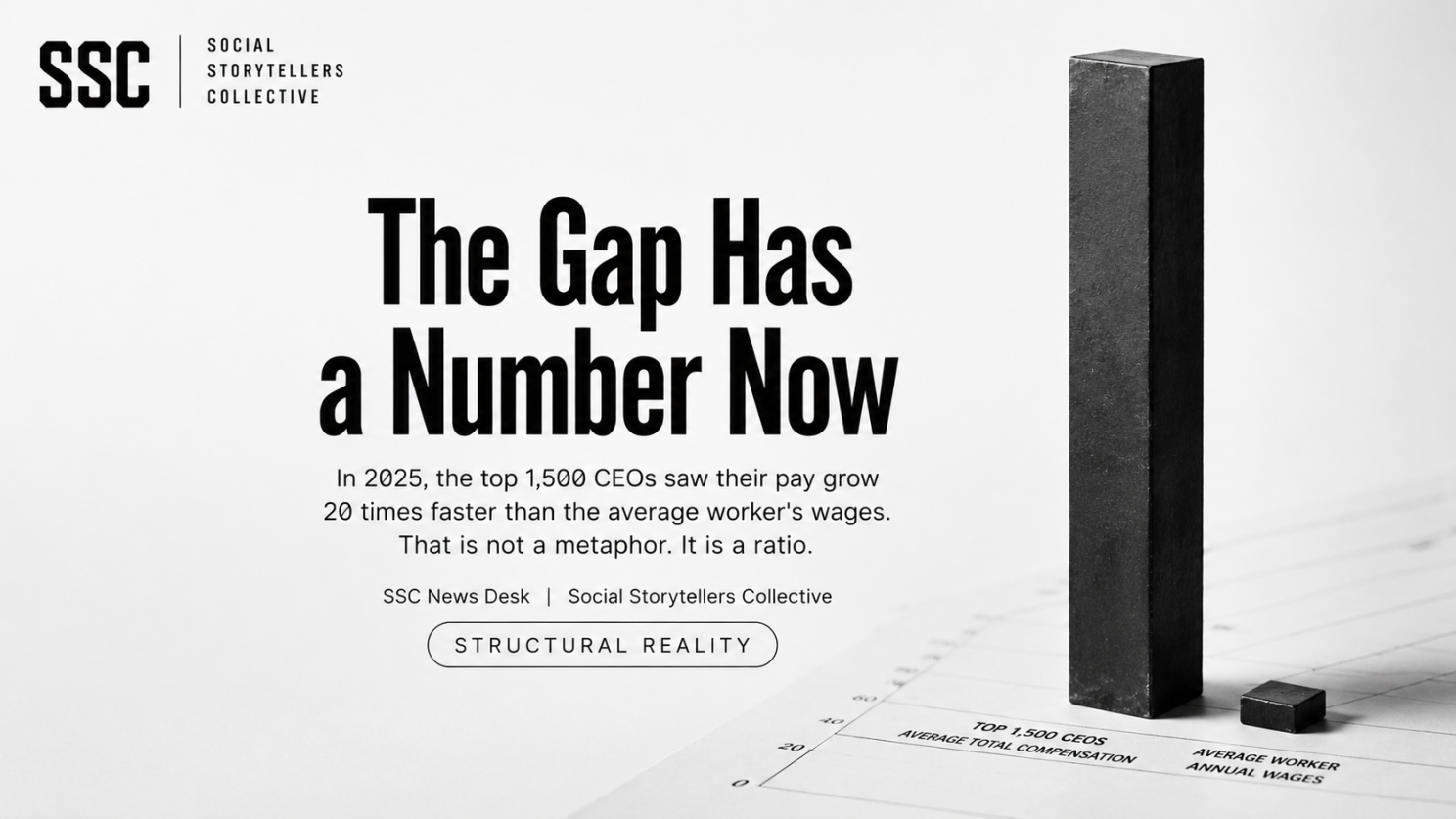
Jensen Huang told the world executives are lying about AI layoffs — then The Man Who Sells the Chips Just Called Out the CEOs Using Them as Cover named the conflict of interest he didn’t address. The Gap Has a Number Now makes the structural argument concrete: in 2025, the top 1,500 CEOs saw their pay grow 20 times faster than the average worker’s wages. The AI Layoffs Aren’t Working closes with the Gartner data: 80 percent of companies piloting AI reported workforce reductions with zero correlation to higher ROI. The layoffs are real. The AI explanation isn’t.
Infrastructure, Access, And Who Controls The System

Meta generated $196 billion in advertising revenue in 2025 on the arrangement where users were the product. In Free Was Never Free. Now Meta Is Making That Official, Instagram Plus at $3.99, Facebook Plus at $3.99, and WhatsApp Plus at $2.99 represent not a product launch but the conversion of digital public space into tiered private space. American Airlines Just Chose Starlink. The Upgrade Is Real. The Access Question Isn’t examines what it means when American Airlines, Delta Air Lines , and United Airlines all build their connectivity infrastructure on a single man’s network — the same man whose initiative cut nearly 280,000 federal jobs disproportionately from Black workers. And Airports Became Immigration Checkpoints. The Staffing Crisis Was the Door traces how a DHS shutdown and a TSA staffing crisis produced more than 800 arrests at 14 airports — none of it requiring new legislation, none of it publicly announced.
Accountability And Who The System Was Built To Serve
The agency created by the Civil Rights Act of 1964 to protect workers from discrimination is now investigating Nike for trying to diversify its workforce. The Agency Built to Fight Discrimination Is Now Fighting Diversity traces how Nike‘s public diversity commitments became the evidence — and the enforcement structure currently creates an incentive to have never tried. When the Jury Said Meta Built a Predator’s Paradise, It Meant the Design Was the Crimeexamines two verdicts in two days that applied product liability logic to software for the first time. ProPublica’s Workers Just Fought the First Battle Over Who Owns the Work That Trains the Machine documents the first newsroom strike called in part over AI protections — the first legal test of whether workers have any structural claim on the value their labor creates when that labor trains systems designed to replace them.
The Culture And Who Controls It
Thirty years ago JAY-Z couldn’t get a major label to sign him and pressed Reasonable Doubt independently. Thirty Years of Reasonable Doubt Is a Business Argument, Not Just a Music Story examines the D’USSÉ campaign as proof of concept — the ownership argument the album’s title was always gesturing toward, arriving on schedule. They Built the Culture. Now They Own the Platform makes the same argument with Sway Calloway and DJ King Techlaunching SKT Network on infrastructure they own. Death Row Just Landed in Las Vegas. The Timing Is Not Coincidental closes the ownership trilogy — Snoop Dogg entering the highest-volume cannabis retail market in the country with a brand built on cultural IP he controls.
Vibe Is Coming Back to Print. That’s Not Nostalgia — It’s an Ownership Argument examines the Quincy Jones-founded magazine returning to newsstands June 2 with a first run of 1,000 copies — a curatorial argument against algorithmic platforms that flatten Black culture into engagement metrics. The Same Economy Producing Present Fathers Is Producing Monetized Motherhood examines parenting’s split into two labor systems — one supported by institutional flexibility, another forced to monetize life itself. Ghana Is Becoming a Destination for Single Fathers. The Women Making It Possible Deserve a Closer Look asks who bears the physical cost — surrogacy in the United States runs $150,000 to $220,000, programs in Ghana start at $35,000, and surrogates receive approximately $10,000. The legal framework protecting those women is not yet comprehensive legislation. The bill that would close those gaps has been in draft form since 2021. It has not passed.
Everlane Just Sold to Shein. Its Founder Is Starting Over Without Venture Capital. That’s the Story closes the culture section — a founder who discovered the sale of the brand he built through press reports and responded by starting over without giving anyone else the power to do it again.
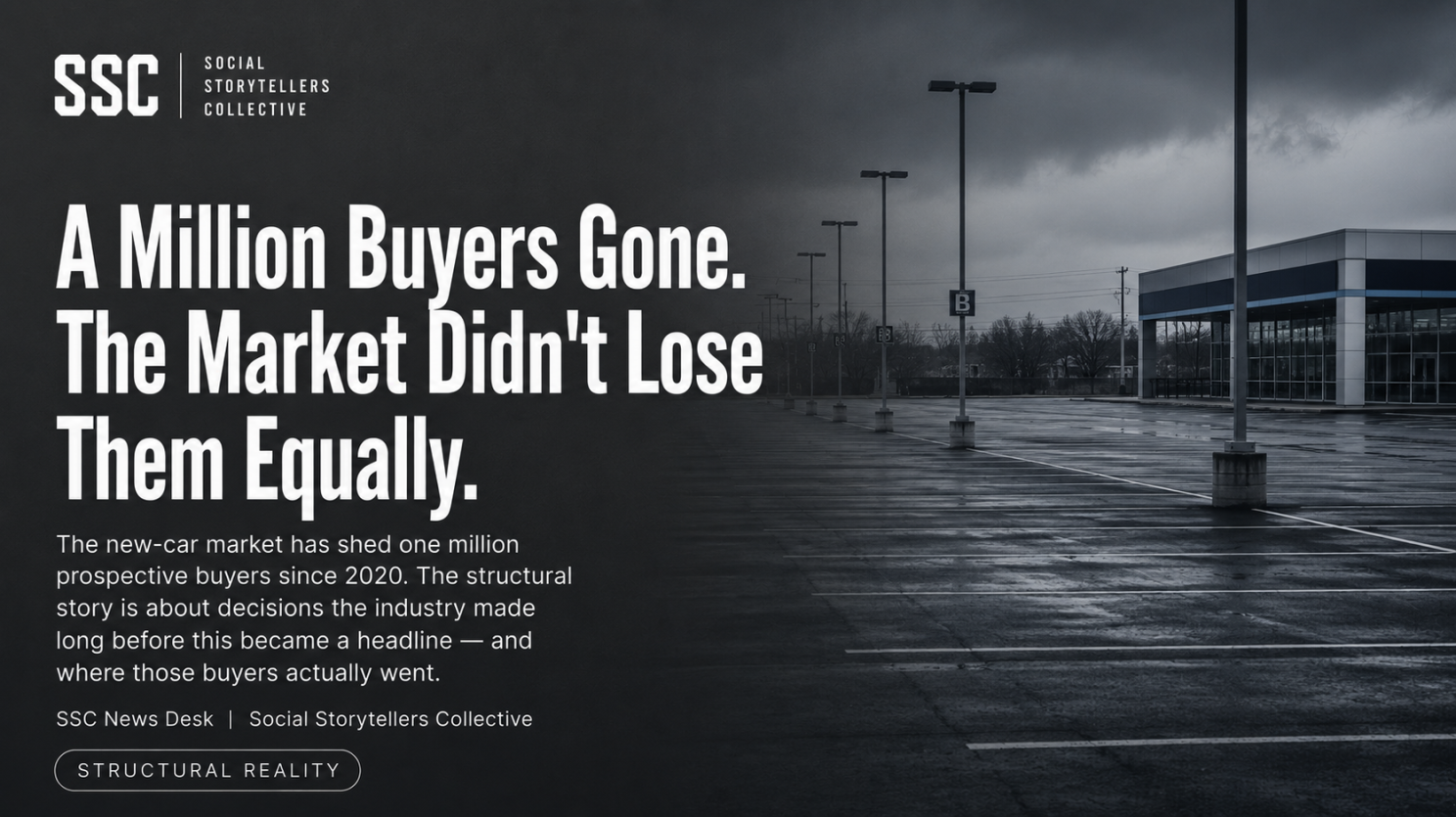
A Million Buyers Gone. The Market Didn’t Lose Them Equally documents what happens when an industry optimizes itself out of reach for the people who needed it most. The share of new-car buyers earning under $100,000 dropped from 50 percent to 37 percent since 2020 — not because those buyers stopped wanting cars, but because Ford, GM, and the rest of the American auto industry deliberately eliminated the entry-level vehicles they could afford in favor of high-margin trucks and SUVs. The used car market that was supposed to absorb them repriced accordingly. Buyers with credit scores between 501 and 600 are now financing used vehicles at interest rates of 19 percent. The exit from new cars didn’t lead somewhere affordable. It led somewhere differently expensive — and in a country where a car is not a consumer preference but a survival requirement, that distinction matters enormously.
What We Are Watching
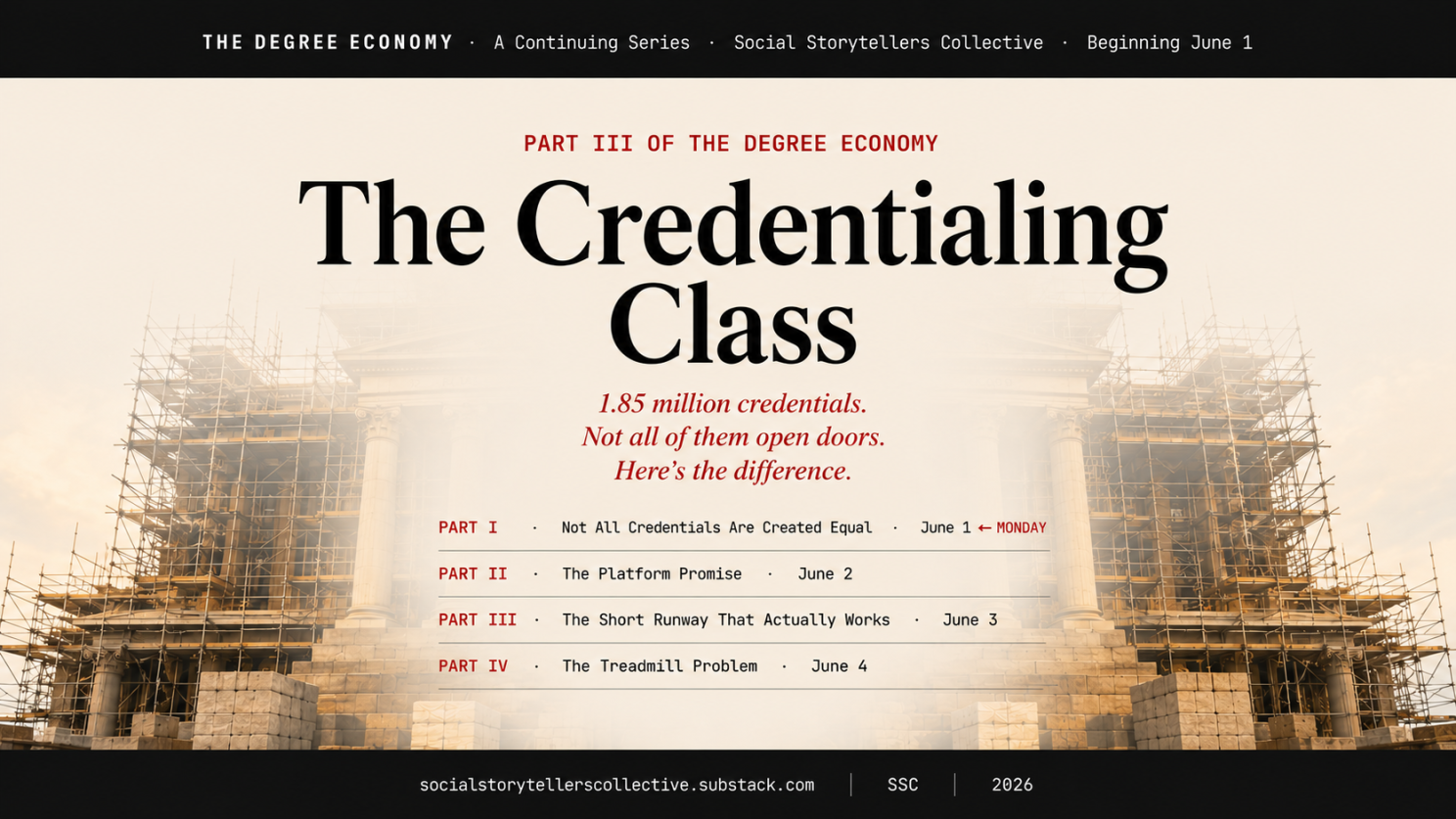
The credentialing economy is splitting. Starting Monday, The Credentialing Class — Part III of The Degree Economy series — examines which credentials actually open doors and why. Four parts. Four days. One argument.
We are watching the EEOC‘s Nike investigation as a test case — The Agency Built to Fight Discrimination Is Now Fighting Diversity documented how the enforcement structure currently creates an incentive to have never tried, and the verdict will determine how far the agency’s mandate reversal goes. We are watching the NPR story closely. The journalists leaving are not the story. The information environment expanding in their absence is.
The through line this week was not hard to find. Across labor, media, healthcare, culture, and consumer markets, the same dynamic kept surfacing — decisions made at the top, costs absorbed at the bottom, and language designed to make the distance between those two floors sound smaller than it is. SSC’s job is to read that distance clearly and name it honestly. That is what we did this week. We will be back next Friday with more.
See you next Friday.
— The SSC Team Social Storytellers Collective
socialstorytellerscollective.substack.com
Every piece in this edition and our full archive lives at socialstorytellerscollective.substack.com. The archive, beat navigation, and every linked piece are best experienced on a computer. If someone forwarded this to you and you are not yet a subscriber, we would be glad to have you with us.