
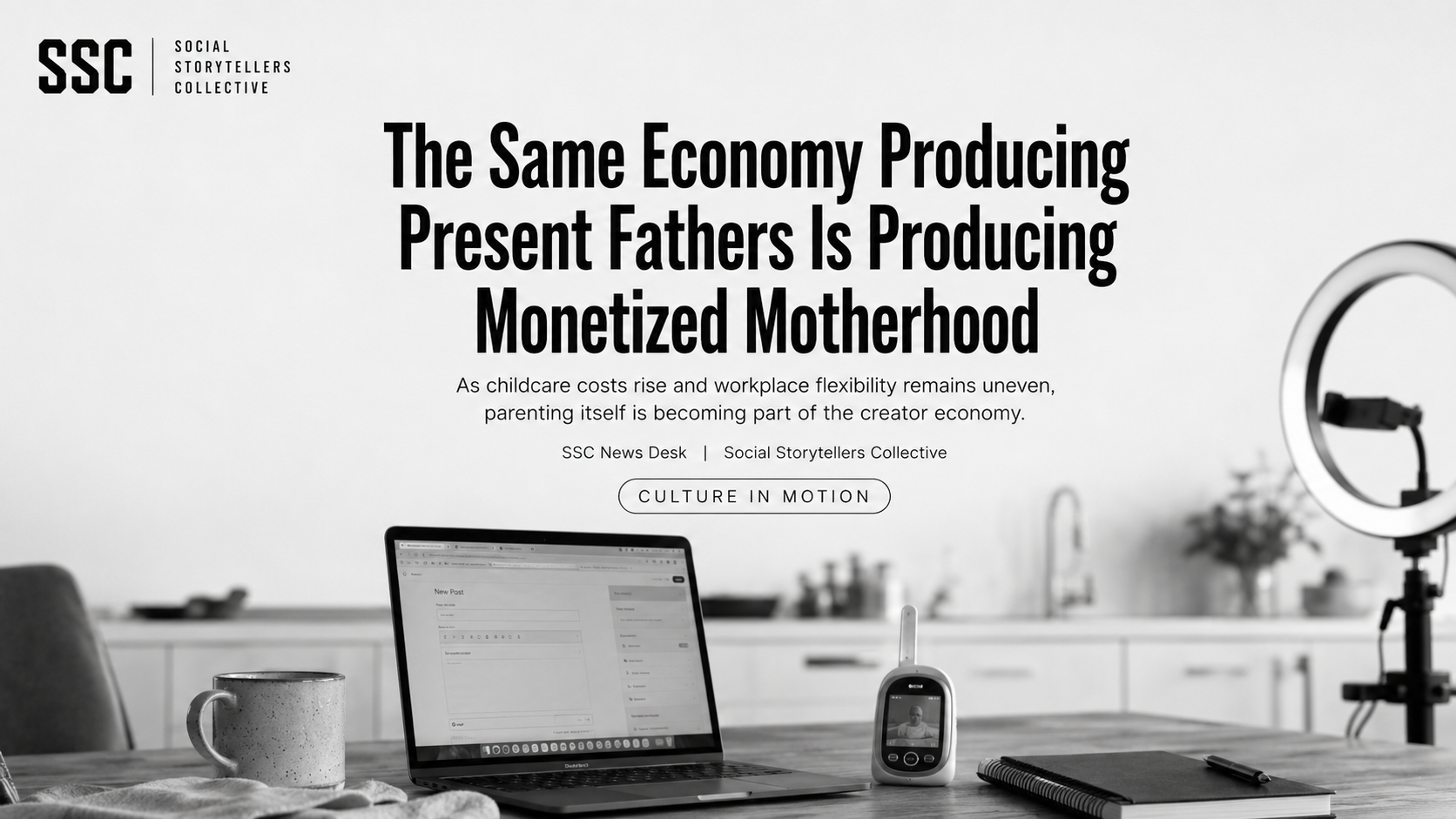
A recent Fast Company report noted that more women are turning to family influencing as childcare costs continue climbing and career penalties tied to motherhood persist. On the surface, the story reads like another creator economy trend. But the deeper signal is economic. Parenting is increasingly splitting into two different labor systems — one supported by institutional flexibility and another forced to monetize life itself.
Just days ago, SSC covered the growing number of college-educated fathers leaving work earlier and spending more time at home. The shift was framed publicly as cultural progress, but the deeper reality was about leverage. The workers with the most institutional power are increasingly able to negotiate flexibility without sacrificing career mobility. Presence has become a privilege attached to credentialed work, managerial autonomy, and economic positioning — and for many mothers, the equation looks entirely different.
Childcare costs continue rising across major American cities while caregiving interruptions still carry professional consequences that disproportionately affect women. In response, some mothers are building parallel income systems around the labor they are already performing inside the home. Parenting becomes content. Domestic routines become monetizable. Daily life becomes platform inventory. The creator economy did not invent caregiving labor — it simply found a way to extract economic value from work the formal labor market has historically underpaid, ignored, or treated as invisible. Meal preparation, scheduling, emotional management, child development, homemaking, and family coordination now exist inside a platform ecosystem that rewards visibility, relatability, and constant accessibility.
That transformation creates a new structural tension. The home is no longer functioning solely as a private space. Increasingly, it operates as a production environment — children become part of the brand architecture, intimacy becomes engagement strategy, and authenticity becomes monetizable. The same platforms rewarding “real life” are also incentivizing families to remain perpetually visible in order to sustain income.
The larger story is not really about influencing at all. It is about what happens when flexibility becomes unevenly distributed across modern parenthood. Some families gain leverage through institutions. Others are pushed toward platforms. Both are responding to the same economy — they are simply navigating it through different survival models. The distinction between those two paths is not cultural. It is structural. And the gap between them is widening.