
The backlash exposed an unresolved argument about lineage, identity, diaspora, and who gets cultural authority inside Blackness itself.
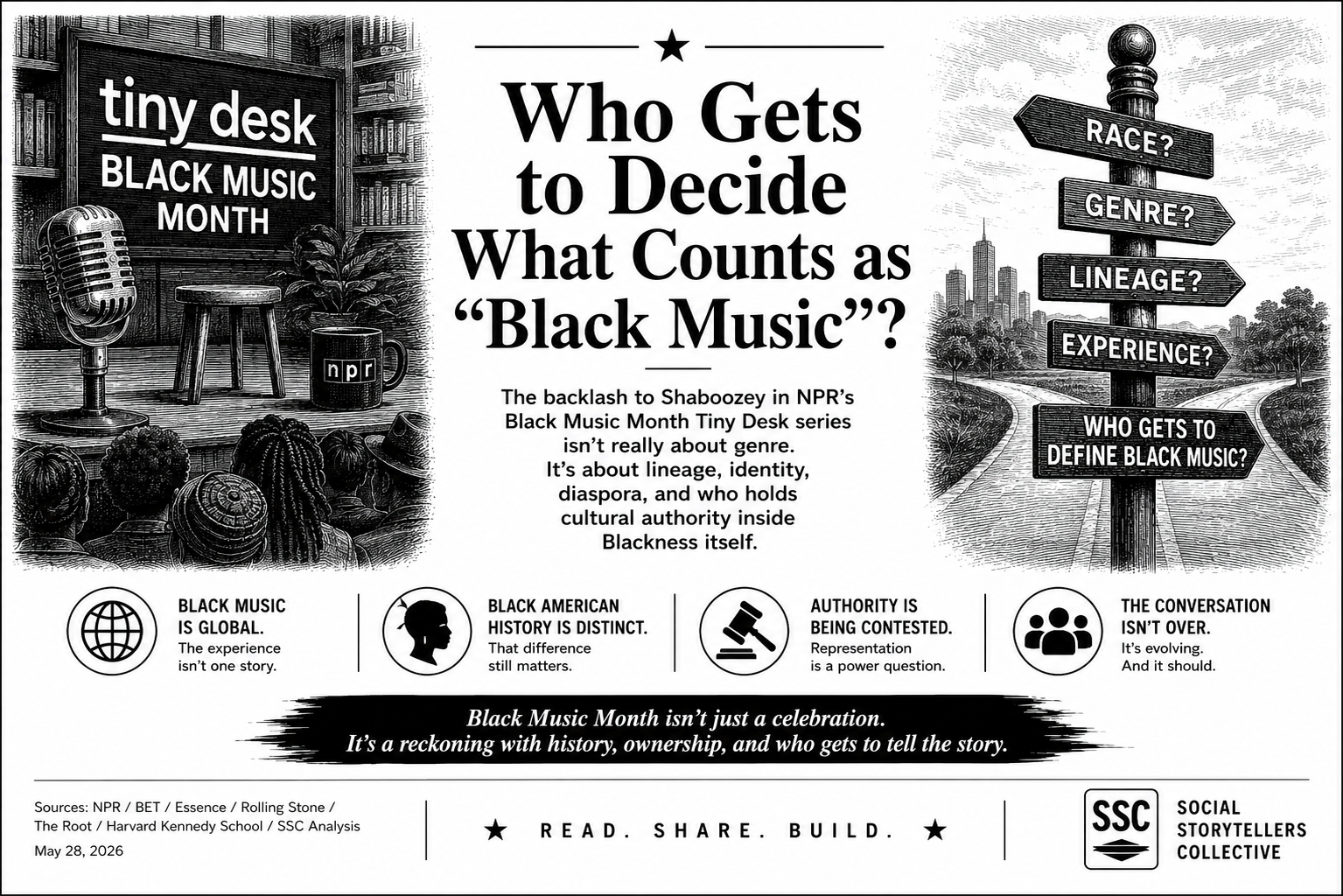
Black Music Month has never been a simple celebration. It is an acknowledgment that the music Black people created — blues, gospel, jazz, soul, funk, hip-hop, R&B, country, house, and every hybrid form in between — built an industry that did not always build them back. That history is why NPR‘s Tiny Desk Black Music Month series carries weight beyond a performance lineup. When the series included Shaboozey alongside Joe, Ayra Starr, Eve, Bow Wow, Floetry, and Fred Hammond this year as part of a BET-inspired celebration of Black music history and influence, it wasn’t the full lineup that generated friction. It was one name.
The pushback against Shaboozey wasn’t an argument about whether he is Black. It was an argument about whether his relationship to Black American musical identity carries the same cultural specificity as the other artists in the series — and that distinction moved quickly from a conversation about sound into something more layered: whether Black music is defined by race broadly, by genre lineage, by cultural experience, or specifically by the historical experience of Black Americans whose communities created many of these forms under conditions no other group in this country shared.
Part of what made this conversation so charged is that country music itself is no longer neutral territory. Beyoncé‘s Cowboy Carter forced mainstream audiences to reckon with the erased Black foundations of country and Americana — what the album documented, as SSC examined in The Syllabus Is Not the Problem, was not just Black erasure from country music as a genre but Black erasure from “country” as a body politic — from the institutions, the history, and the national narrative that the genre has long been used to represent. The album became so culturally significant that Harvard Kennedy School lecturer Ayushi Roy built a public policy course around it, using Cowboy Carter to examine why programs like Medicaid and SNAP consistently fail to reach the families they were designed to serve. The argument Cowboy Carter makes about who counts as American and who receives institutional support is the same argument Black Music Month is implicitly making every June. That reconsideration opened the door for artists like Shaboozey — but it also raised the stakes for who walks through it and how.
Unlike Beyoncé, whose relationship to Black Southern lineage is rarely questioned inside Black American discourse, Shaboozey arrived in this conversation already carrying unresolved tension. Earlier this year, remarks he made tied to immigration and identity during awards season were interpreted by some Black Americans — particularly those who identify as ADOS, American Descendants of Slavery — as flattening the distinct historical experience of Black Americans into a broader immigrant narrative. The concern wasn’t that Shaboozey was claiming a Black identity he doesn’t have. It was that his framing, in a moment when Black American specificity is under active erasure in policy, curriculum, and public discourse, failed to honor the difference between diasporic Blackness and the particular historical experience of people whose ancestors were enslaved on American soil and who have been fighting for recognition inside American institutions ever since. He later clarified that he was not attempting to erase Black American contributions and acknowledged that his wording had fallen short. But the clarification didn’t fully close the conversation — and it’s why his inclusion in the Tiny Desk series generated a different reaction than Ayra Starr‘s, even though both artists carry diasporic Black identities.
Ayra Starr‘s inclusion felt additive. She exists inside a genre ecosystem — Afrobeats — that audiences already culturally associate with contemporary African identity and global Blackness. Her presence in a Black Music Month celebration expanded the frame in a way that felt coherent with the series’ intention. Shaboozey‘s inclusion landed differently because he sits inside country music, a genre mid-renegotiation around ownership and historical reclamation, while also carrying the unresolved weight of what he said about Black American identity earlier in the year. For some critics the question wasn’t simply “does he make Black music?” It was “whose Black experience is being centered, and whose is being generalized in the process?”
That is what makes this more than a genre argument. Black music has never described one sound. It describes a cultural ecosystem shaped by Black people across geographies, migrations, religions, and histories. But within that ecosystem there are real and ongoing tensions around origin, ownership, and historical specificity. Blackness is global. The Black American experience is also historically distinct. Those two truths don’t cancel each other out — but they do collide, with increasing frequency, in public cultural conversations where institutions are making decisions about representation without always having the tools to navigate the difference. SSC examined the same pattern in Are Black American Beauty Creators Being Passed Over for the Diaspora? — where Black American creators whose culture built the beauty industry’s aesthetic vocabulary are being systematically overlooked in favor of diaspora creators whose Blackness reads as more globally marketable. The industries are different. The architecture is the same.
What this moment makes clear is that audiences are no longer only debating music. They are debating authority — who gets to narrate Blackness, who gets to symbolize Black culture publicly, and when institutions celebrate “Black music,” what exactly they are celebrating: a racial category, a cultural lineage, a political history, or all of those things simultaneously. The Shaboozey conversation became charged not because a Black country artist is an impossible fit for Black Music Month, but because the specific combination of genre, timing, and prior controversy made his inclusion feel, to some, like an institution reaching for inclusion without doing the work of understanding what it was including. That gap — between institutional gesture and cultural literacy — is the conversation Black Music Month has always been trying to close. This year it became the conversation itself.