
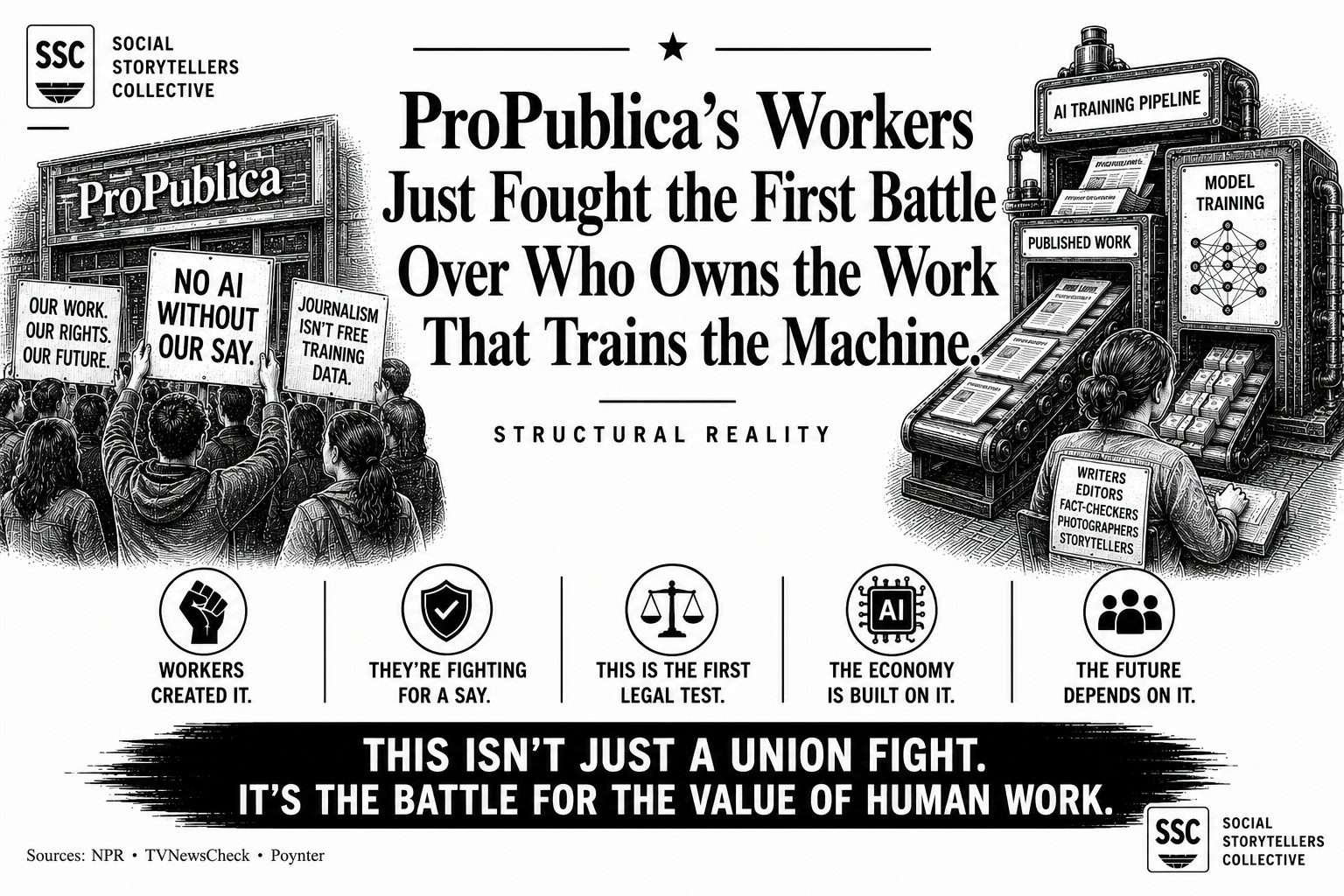
On March 20, 2026, 92% of ProPublica Guild members voted to authorize a strike — the first such vote in a major U.S. newsroom called in part over protections against artificial intelligence. Out of roughly 150 journalists, editors, videographers, and business-side staff, the vote came after more than two and a half years of collective bargaining negotiations over the Guild’s first contract — negotiations that began shortly after the union was recognized in August 2023. The central dispute wasn’t wages, though wages were part of it. It was language that would prohibit ProPublicafrom laying off workers due to AI adoption — and, critically, that would require union consent before ProPublica could strike any deal licensing published work to train generative AI. The Guild eventually walked on April 8. It was the first U.S. newsroom strike in history called over AI protections.
The immediate trigger was ProPublica management’s unilateral implementation of an AI policy beginning March 13 — before the contract was settled and without union input. The newsroom had already joined the Lenfest Institute’s AI Collaborative, backed by OpenAI funding, placing a machine learning engineer in the newsroom for two years. The guardrails the Guild was seeking included the right to continue bargaining over generative AI implementation, a prohibition on AI-related layoffs, a commitment not to surveil workers’ AI tool usage, an editorial integrity and disclosure policy, and union consent before any licensing deals that would use published work to train AI models. ProPublica has never had layoffs. The union acknowledged that. What they were asking for was a structure to handle layoffs if they happen — because in 2026, an investigative newsroom taking OpenAI money while refusing to commit to AI job protections is not a hypothetical risk. It is a timeline.
The mainstream frame on this story has been “union vs. management at a nonprofit newsroom” — a niche labor dispute, sympathetic but contained. That framing misses what’s actually being litigated. The ProPublica Guild is asking a court and a bargaining table to recognize that the reporting, writing, and editorial judgment its members produce has value beyond the article — that it can be extracted, processed, and used to train systems that will eventually compete with the workers who created it. The NYT Guild is currently in its own contract negotiations after its agreement expired in February 2026, with AI language already at center stage — including a proposal that Guild members receive a share of revenue earned when their work is licensed for AI training. ProPublica is the test case. The Times is the institution where the stakes get larger. Every content-producing organization in the country is watching how this resolves.
What the ProPublica strike makes visible is a structural asymmetry that runs across the knowledge economy: the workers who create the training data for AI systems have no guaranteed claim on the value those systems generate. In legacy industries, labor’s claim on productivity gains was established through decades of organizing, legislation, and case law. In the AI economy, those claims are being contested before the industry is even mature — which means the precedents set now will shape the distribution of gains for a generation. NewsGuild of New York president Susan DeCarava was clear on the picket line: “We’re going to see more and more concentrated conflicts between media bosses and journalists and media workers over who has a say and how AI is used in their workplaces.” The ProPublica Guild walked out over a contract at a nonprofit. What they were actually fighting over is whether workers in the knowledge economy will have any structural leverage in the AI transition — or whether that transition will simply happen to them.