
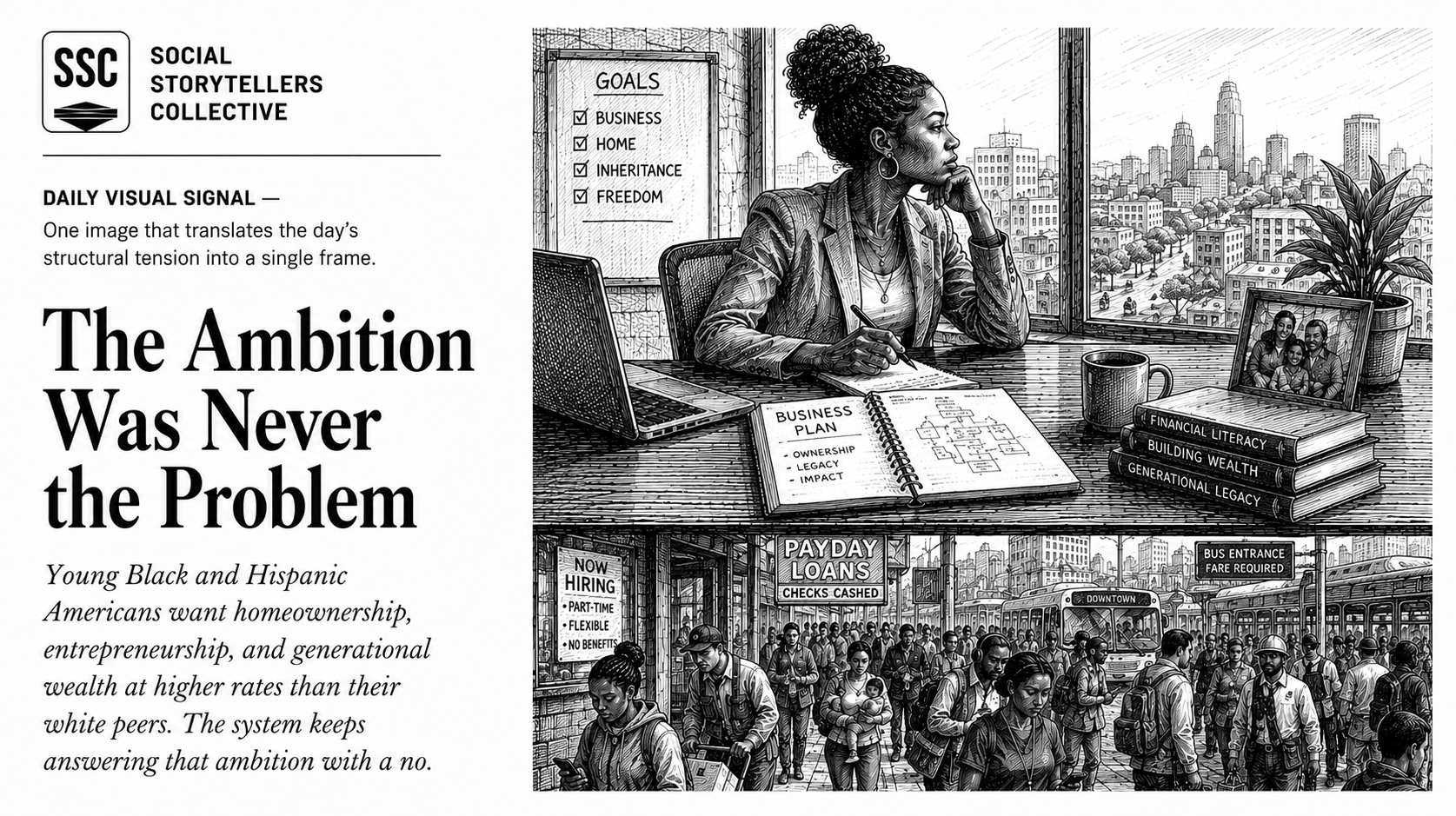
67% of Black Gen Z aspire to own a business. 55% of Hispanic Gen Z share that aspiration. Among white Gen Z, the number is 34%. The ambition is not close — it is nearly double. The same pattern holds for homeownership and generational wealth: 77% of Black Gen Z and 70% of Hispanic Gen Z aspire to build an inheritance to pass on to the next generation. Only 18% to 20% expect to receive one themselves, compared to 33% of their white peers who expect an inheritance.
That gap — between what young people of color want and what the system has historically allowed them to build — is the subject of Ambition Without Access, a new study released on May 14, 2026 by the Julian Bond Institute for Financial Equity Research, an initiative of the Center for Responsible Lending. The report is direct in its central finding: young Black and Hispanic Americans are not disengaged from the economy or indifferent to wealth-building. They are trying to build the same things their white peers are trying to build — and encountering a structurally different set of obstacles when they do.
The homeownership numbers tell the story plainly. The homeownership rate for non-Hispanic white households stands at 75.1%. For Black households, 44.2%. For Hispanic households, 48.7%. That gap is not a preference gap. It is a structural one — rooted in decades of discriminatory lending, redlining, the disproportionate impact of the 2008 foreclosure crisis on households of color (roughly 30% of homes owned by Black and Hispanic people were foreclosed versus 11% of homes white people owned), and ongoing barriers to accessing the kind of responsible financial products that would make ownership possible.
Candice Wang, Senior Researcher at CRL and report co-author, named the mechanism clearly: “Young Black and Hispanic Americans are more likely to have grown up in households where alternative financial services were part of their parents’ financial lives, and their white and Asian peers are more likely to have parents who owned their homes and set up savings accounts for them when they were young.” The inheritance gap is not just about money. It is about the financial infrastructure — the accounts, the credit history, the homeownership equity — that gets built in childhood and compounds across a lifetime.
The report also found that regardless of race, financial instability is widespread among younger generations. Less than half of Gen Z (48%) and Millennials (45%) say they are on track to accumulate enough savings for a comfortable retirement. Among aspiring entrepreneurs who feel off track, 38% say they simply do not know how to get started — a gap that is not about motivation but about access to the networks, capital, and knowledge infrastructure that turn ambition into ownership.
This is the story that runs underneath the Bank of Mom and Dad housing data SSC covered earlier this week. The first-time homebuyers ages 25 to 34 with older co-borrowers has quadrupled since 2000 because the system now requires parental wealth to access homeownership at scale. For the households without that parental wealth — disproportionately Black and Hispanic households where the inheritance gap is widest — the co-borrower option simply does not exist. The aspiration is higher. The structural access is lower. And the gap between those two facts is where the racial wealth divide lives and compounds.
The Julian Bond Institute is named for civil rights icon and founding CRL board member Julian Bond — co-founder of the Student Nonviolent Coordinating Committee, longtime NAACP leader, and a man who spent his life arguing that economic equity and civil rights were the same conversation. Ambition Without Access is that argument made in data. The problem is not the aspiration. It never was. The problem is the architecture of a financial system that generates different answers to the same ambition depending on what your parents were able to build.
SSC covers access, housing, and the structural forces shaping economic life in America.