
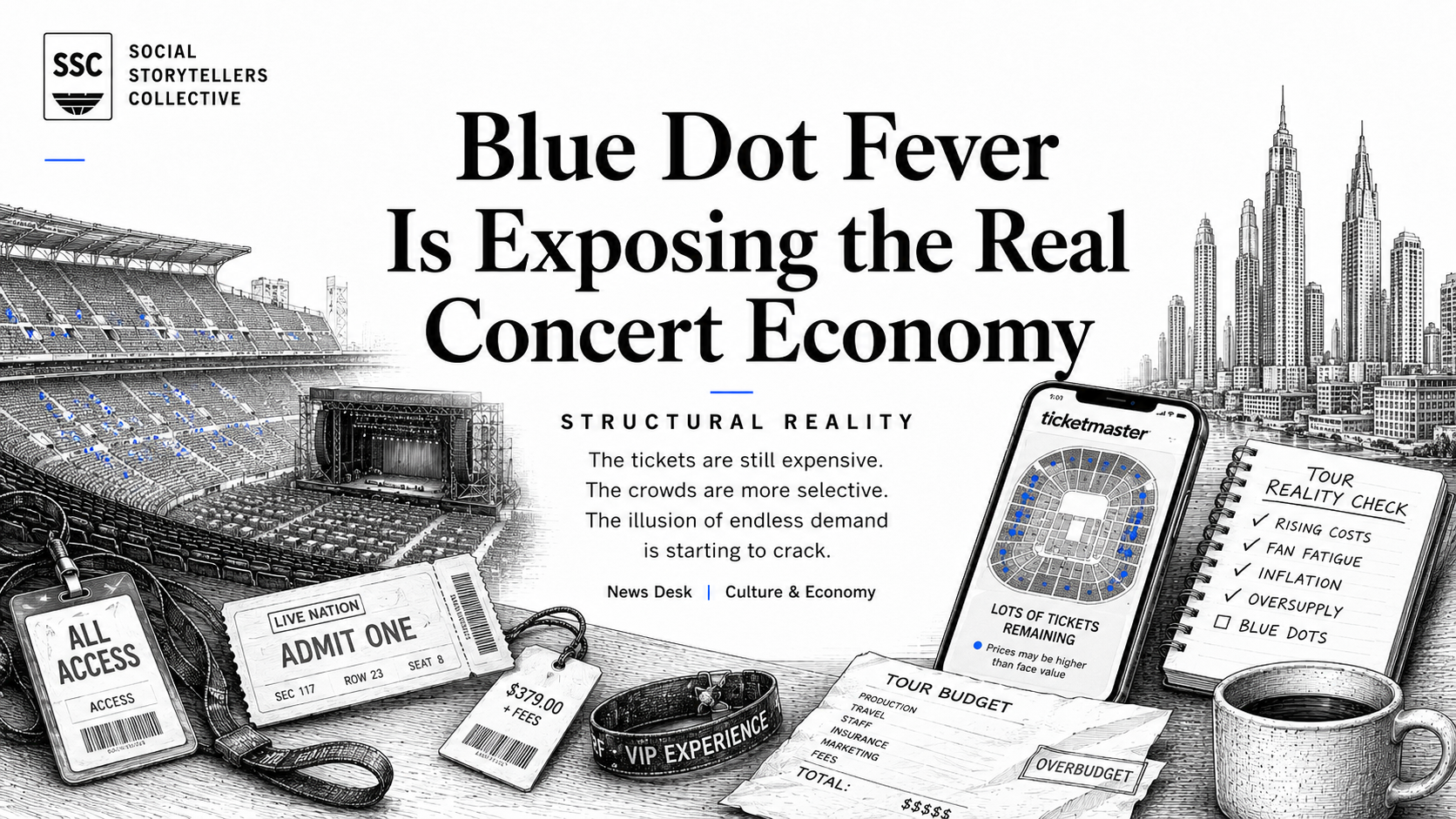
The live music industry spent years convinced that complaints were just noise. Fans posted about price gouging, griped about service fees, and still showed up. So promoters pushed further — stadium tours for mid-tier acts, dynamic pricing that turned floor seats into four-figure gambles, venues scaled to algorithmic projections rather than actual demand. The assumption was never really tested. Until now.
Executives, promoters, and fans are increasingly calling it “Blue Dot Fever” — a reference to the unsold seats scattered across Ticketmaster venue maps in the days and weeks before shows. What started as quiet industry anxiety has gone public. Tours are being downsized. Dates are being postponed. Some are being canceled outright. The Pussycat Dolls are among the latest acts to cancel swaths of a U.S. arena tour amid lagging ticket sales, joining Meghan Trainor, Zayn, Jelly Roll, and Post Malone — the latter two shutting down one-third of their co-headlining stadium run. The blue dots are not a bug. They are the market responding honestly.
The evidence is not abstract. A Ticketmaster venue map from Post Malone’s opening night shows the outer bowl of the arena washed in lighter sections — unsold seats fanning out from the floor on the first date of a major stadium run. Opening nights are supposed to sell. They carry the energy of announcement, the social proof of being first. When they don’t close, it means the demand was never there at the price being asked, and the tour is already underwater before it has played a single show.
It’s worth noting that not everyone in the industry reads the blue dot pattern the same way. Randy Nichols, a strategic advisor and artist manager with decades of live entertainment experience, argues that the Blue Dot Fever narrative didn’t originate with fans — it spread from scalper Twitter, amplified by secondary market operators whose arbitrage is under serious pressure as artists reclaim control of their inventory. His evidence is structural: StubHub went public in September 2025 at $23.50 a share and was trading around $8.70 by March 2026 — a decline of more than 60% in six months. Vivid Seats has lost roughly 88% of its value from its 52-week high. These aren’t companies struggling in a struggling industry. They are companies whose core business model is getting squeezed — and some of the loudest voices pushing the crisis narrative have a direct financial interest in keeping artists from controlling their own tickets. Industry cancellation rates, Nichols notes, are running at 1-2%, flat to historical norms. That context belongs in this analysis.
Touring became more expensive for artists and crews — fuel, labor, insurance, production, and transportation costs all climbed — and those costs were passed directly to fans through higher base prices, parking fees, service charges, and VIP upsells. The average concert ticket price in 2026 is $144, up from $115 last year and $82 in 2020. At the same time, inflation reshaped what fans could actually afford. Housing costs rose. Travel got more expensive. Essentials started competing with entertainment. Fuel costs this summer are compounding the squeeze further, driving up expenses for large-scale tours moving set pieces between cities. The industry kept raising prices as if none of that was happening.
The contraction is not evenly distributed. According to Chartmetric data tracking the decline in touring artists from 2022 to 2024, the share of superstars actively touring fell from 44% to 36%. Among mid-level artists, it collapsed from 19% to 12%. The artists closest to the margin are the ones most exposed. Superstars absorb a bad cycle. Mid-level acts cannot. They need near-capacity venues to break even, they have less leverage to negotiate costs, and they are the first to disappear from tour schedules when the economics stop working.
The industry also misread what social media was actually measuring. Viral moments, streaming numbers, and TikTok cycles created the appearance of mass demand. But visibility is not conversion. A song can dominate social media without selling out a venue. Streaming popularity, nostalgia, and social media buzz do not always translate into thousands of $100-plus seats — mega-stars and must-see tours continue to sell, while arena and stadium runs that depend on cultural momentum find the math doesn’t hold. Companies treated the post-pandemic surge in concert spending as a new behavioral baseline and built touring cycles around it. When that wave receded, the inventory problem became impossible to hide.
Nostalgia is being tested as a ticket-sales strategy in real time, and Chance the Rapper has become one of its most instructive case studies. After releasing an album fans received poorly, he launched the Big Tour — which went through repeated reschedules and rerouting before he canceled it entirely, citing family time and new music. The fuller picture arrived in court filings: his former long-term manager Pat Corcoran sued him in Illinois, alleging Chance blamed him personally for the album’s poor reception and the tour’s weak ticket sales.
“This was not an artist pausing to regroup. It was an artist whose commercial footing had shifted, who couldn’t fill the venues his brand once justified, and who pointed at his management when the numbers came in.”
His response was to announce a 37-date Coloring Book 10th Anniversary Tour — retreating to the project that made him rather than trying to sell audiences on who he is now. Industry observers note the decision to anchor the tour around Coloring Book rather than his 2025 album Star Line is a deliberate calculation, and that he enters the road in what analysts are calling an uncertain live entertainment climate, with artists across genres encountering turbulence from slow ticket sales. The venues booked are smaller than his peak run. Whether that reflects smart calibration or an advance acknowledgment that the market has moved is the question the tour will answer.
Audiences have also changed how they relate to live entertainment. Fans increasingly treat a concert ticket not just as a portal to a live experience but as an asset to be banked or traded — a dynamic that once belonged to scalpers and has now spread to general audiences facing real financial decisions. They curate, they wait, they compare resale prices against face value before committing. The scarcity that historically drove urgency has weakened.
Live music is not in collapse. Oasis sold out its first North American tour since 2008 within an hour, and Coldplay has seen massive demand despite the height of their popularity being two decades ago. But those are the exceptions that define the rule. The pressure is concentrated in the middle — acts trying to hold venue sizes they no longer have the audience for at the prices being charged.
Blue Dot Fever is the industry’s correction arriving in public, seat by seat. The economics underneath the modern touring business were built on the assumption that fans would keep absorbing higher costs indefinitely, that engagement would always convert, and that the growth era had no ceiling. What the blue dots are showing is that there was always a ceiling. The industry just never had to find it before.
This article has been updated on May 27, 2026 to include industry perspective on the secondary ticket market’s role in shaping the Blue Dot Fever narrative.