
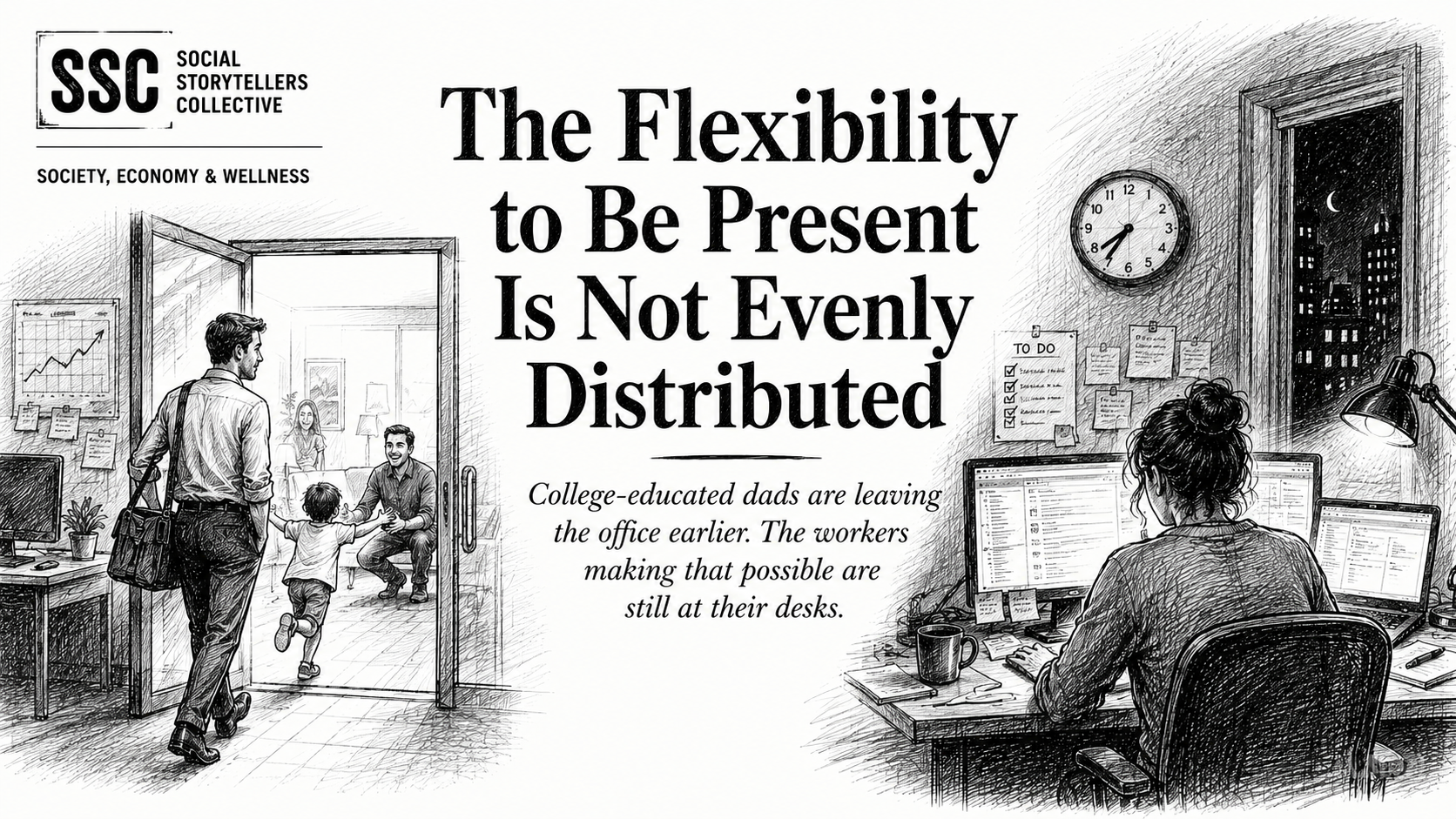
The Wall Street Journal reported this week that college-educated fathers are leading a shift away from long office hours — trading face time for presence at home, rewriting the implicit contract between professional identity and time. The data is real. The trend is documented. And it connects to something SSC has been tracking all year that the headline doesn’t name.
The flexibility to leave the office early is not a cultural shift. It is a leverage shift. And leverage, in 2026, is distributed the same way everything else is — by credential, by income level, and by the kind of job that lets you set your own terms before anyone pushes back.
The workers with the most institutional power are quietly rewriting the rules of professional culture in their favor. That is not a criticism. It is a description. CEOs at Nestlé, HSBC, 3M, and Unilever are simultaneously telling their workforces to perform harder, faster, and with higher standards — as SSC documented in When CEOs Call It Performance Culture, Follow the Layoff Notice — while the workers at the top of those same organizations are increasingly structuring their days around personal priorities. The language of performance culture flows downward. The flexibility of professional autonomy flows upward.
The AI pods story is the same argument in a different room. As SSC examined in The Team Didn’t Get Smaller. The Worker Did., Coinbase cut 14% of its workforce and reorganized around three-person teams doing the work of fifteen. The workers absorbed into those pods are not leaving early. They are absorbing more. They are managing AI systems, handling cross-functional responsibilities that once belonged to entire departments, and doing it inside an environment that measures output at a pace that makes face time irrelevant — not because the culture has become more humane, but because the workload has become too compressed to waste time performing presence.
The dad leaving at 3PM has a job that allows for that negotiation. The worker still at the desk at 7PM is often the one whose labor is making the 3PM departure structurally possible.
That distinction matters because the narrative around involved fatherhood — which is genuinely good news, genuinely worth documenting — can easily become a story about individual choice rather than structural access. The college-educated father choosing presence over face time is exercising something real: a renegotiation of what professional success looks like, a rejection of the performance theater that has defined office culture for decades. That renegotiation is worth having.
But it is easier to have when your employer cannot easily replace you. When your credentials create enough leverage that leaving early reads as confidence rather than disengagement. When the performance review is not the thing standing between your family and your ability to keep the lights on.
The workers without that leverage are not choosing differently because they value their families less. They are navigating a labor market that has spent the last three years concentrating risk at the bottom and flexibility at the top. The AIdisplacement wave, the performance culture vocabulary, the pod compression model — all of it is pushing the same direction. The people with the most options are taking them. The people with the fewest are absorbing what’s left.
The headline is about dads. The data is about class. And the story underneath both is about what the American workplace is quietly becoming — a place where the terms of engagement are increasingly set by the people who already have the most, and absorbed by the people who can least afford to push back.
The flexibility gap is not a generational story. It is not a gender story. It is a leverage story. And until the structural conditions that create leverage — credential access, income security, job market optionality — are more evenly distributed, the dads leaving early and the workers staying late are living inside the same system with very different sets of choices.
SSC covers the structural forces shaping work, identity, and economic life in America.