
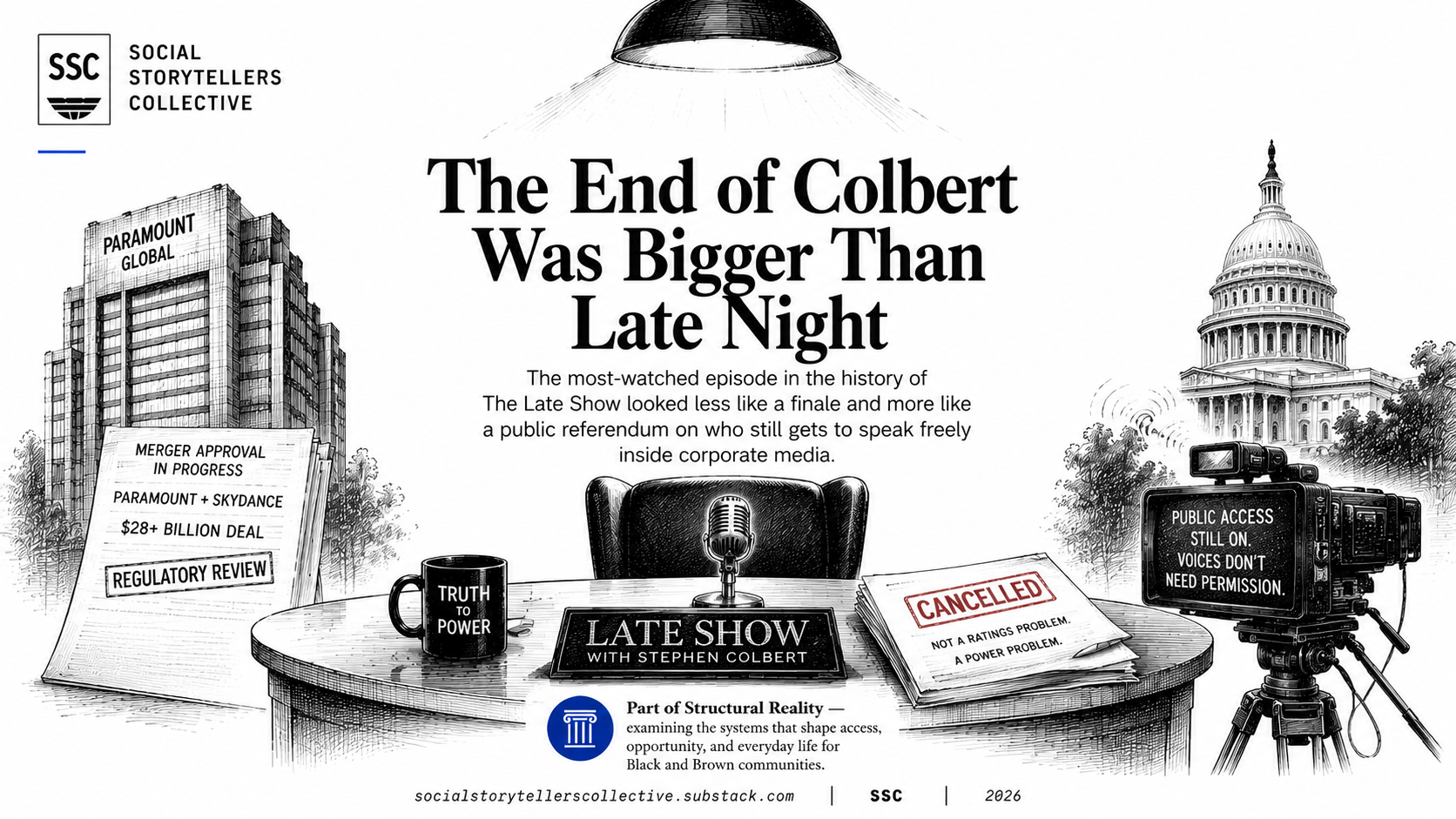
An estimated 6.74 million viewers tuned in Thursday night to watch the final episode of The Late Show with Stephen Colbert, making it the most-watched weeknight episode in the history of the franchise and surpassing the show’s 2015 premiere audience of 6.55 million. The scale of the audience mattered because the show was not collapsing when it ended. Colbert was still winning his time slot. The program had just earned its sixth Emmy nomination for Outstanding Talk Show. Yet the cancellation announcement arrived last July only days after Colbert publicly described Paramount Global’s $16 million settlement with Donald Trump as a “big fat bribe” tied to a larger corporate reality: the company needed federal approval to clear regulatory obstacles surrounding its proposed merger with Skydance Media. Paramount insisted the cancellation was “purely a financial decision.” Two U.S. senators publicly questioned the timing anyway. The audience appeared to hear the contradiction clearly.
The story matters because late-night television has historically operated as one of the last commercially viable spaces where political satire could still function at mass scale. For decades, hosts like Johnny Carson, David Letterman, Jon Stewart, and later Colbert occupied a peculiar role inside American media: entertainers who also acted as informal pressure valves for public distrust, political absurdity, and institutional hypocrisy. What changed over the last decade is that satire itself became politically consequential enough to threaten corporate interests surrounding it. Colbert’stransformation from quirky cable comedian on Comedy Central into one of the loudest anti-Trump voices on broadcast television fundamentally altered the relationship between entertainment and governance. The host was no longer just generating ratings. He was generating friction.
That friction became more complicated because the economics of media consolidation increasingly reward corporate stability over editorial unpredictability. The proposed Paramount-Skydance deal reportedly carries an enterprise value north of $28 billion, meaning regulatory relationships suddenly matter as much as audience loyalty. Inside that framework, satire becomes difficult to separate from shareholder risk. Mainstream coverage framed the cancellation as a television business story about declining ad revenue and changing viewer habits. But the deeper story is about what happens when political commentary exists inside conglomerates simultaneously negotiating with the same political system being criticized on-air. The contradiction is structural: the larger and more consolidated media companies become, the narrower the margin for truly adversarial speech inside them.
The public reaction reflected growing awareness that audiences now instinctively read corporate decisions politically, especially when timing aligns too neatly with institutional incentives. Trust in American media institutions has already deteriorated sharply. According to Gallup, confidence in mass media fell to 31% in 2024, near historic lows. At the same time, satire increasingly functions not merely as comedy but as civic interpretation for millions of viewers trying to process political chaos through cultural language. The Late Show was never just a program. It was part of a larger ecosystem where comedians became translators between institutional power and public frustration. That helps explain why the finale drew such extraordinary numbers. People were not simply watching a host leave television. They were watching what many perceived as another narrowing of acceptable dissent inside mainstream media infrastructure.
Then came the part that transformed the story from cancellation into signal. Less than 24 hours after the CBS finale, Colbert resurfaced on Monroe Community Media, a public-access station in Michigan, alongside Jack White, Jeff Daniels, and Eminem in a deliberately chaotic segment that looked almost anti-corporate by design. Jack White carried a boombox. Jeff Daniels made sandwiches. Eminem appeared as the fire marshal. And Colbert joked that he hoped Monroe Community Media “doesn’t get acquired by Paramount.” The production quality looked intentionally local, almost defiant in its refusal to resemble prestige television. That mattered because it reframed the story entirely. If corporate platforms become increasingly managed environments, public-access aesthetics suddenly begin to look politically symbolic again. The migration path for satire may no longer move upward toward larger institutions. It may move outward toward smaller, less controllable ones.
The shift parallels broader patterns happening across journalism, music, and digital culture. As institutional media becomes more consolidated, independent creators increasingly operate as parallel trust networks outside legacy systems. Podcasts now rival cable news audiences. Independent newsletters routinely break stories traditional outlets miss. YouTube commentators often shape political discourse faster than network panels. Even musicians have begun bypassing major label structures through direct audience ecosystems. The underlying pattern is not simply technological decentralization. It is institutional avoidance. Audiences increasingly assume that large organizations manage speech according to financial exposure first and editorial principle second. Once that assumption hardens, every cancellation begins to feel less like programming strategy and more like governance.
What happened to Colbert ultimately lands beyond one television show or one merger review. America is entering a period where the infrastructure carrying speech matters as much as the speech itself. Satire once operated as a democratic release valve partly because viewers believed comedians still possessed enough independence to challenge power publicly without corporate interference shaping the boundaries. That belief is becoming harder to sustain. Political comedy will survive. Independent voices will continue to emerge. But the center of gravity is shifting away from heavily managed corporate platforms toward spaces with fewer institutional constraints, lower financial stakes, and less dependence on regulatory goodwill. You can cancel the show. You cannot fully cancel the voice. But corporate media can still reshape how visible that voice becomes.