
Enrollment growth is a signal. It is not a foundation. The history of HBCUs is full of moments where increased interest — driven by cultural visibility, political crisis, or the failures of surrounding institutions — produced enrollment surges that the underlying infrastructure could not fully absorb. Students arrived. The resources to serve them at scale did not. And the gap between momentum and sustainability became the story.
What makes the current moment different is that the infrastructure investment is arriving alongside the enrollment surge rather than lagging behind it. And the most significant piece of that investment landed on April 29, 2026, at Howard University.
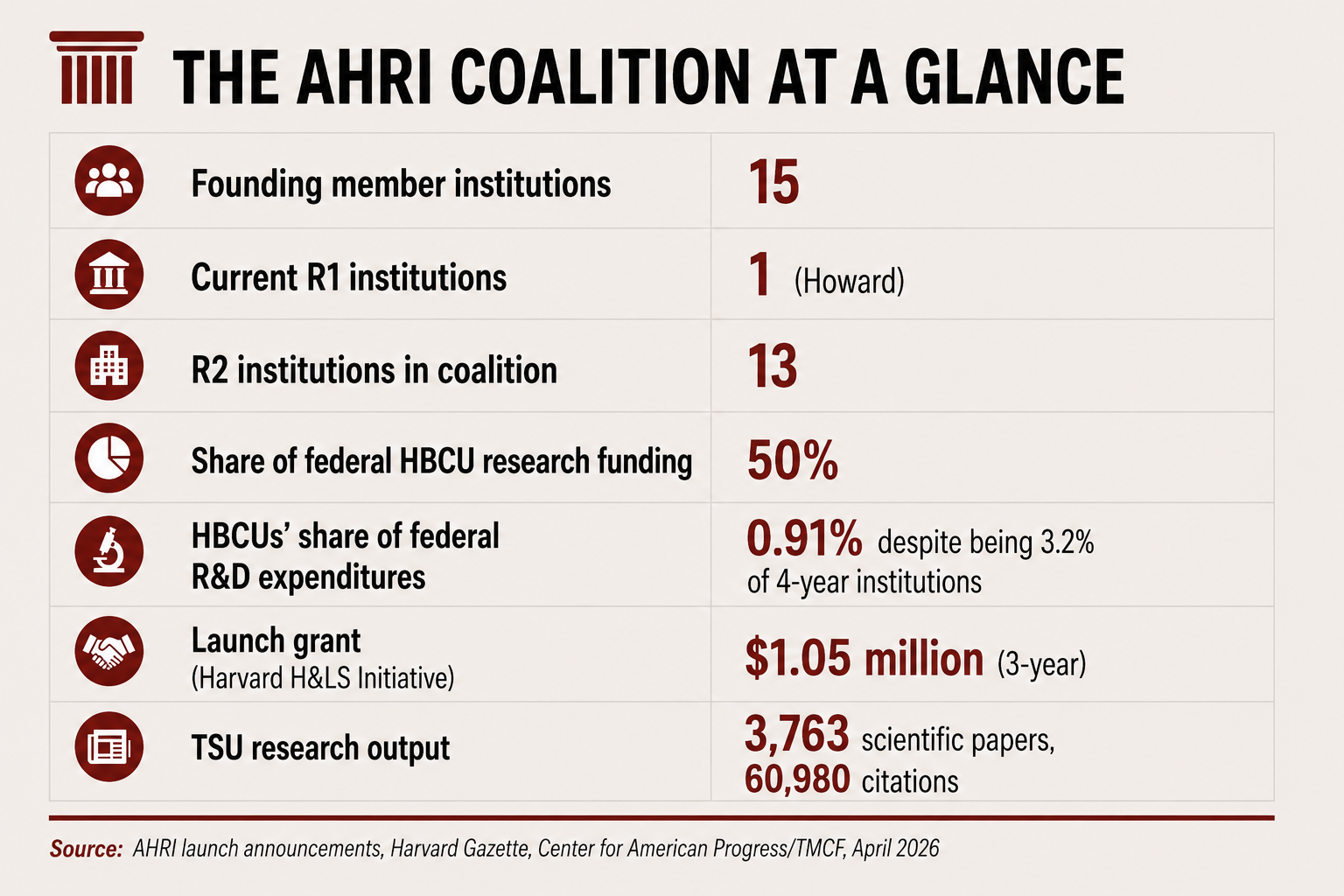
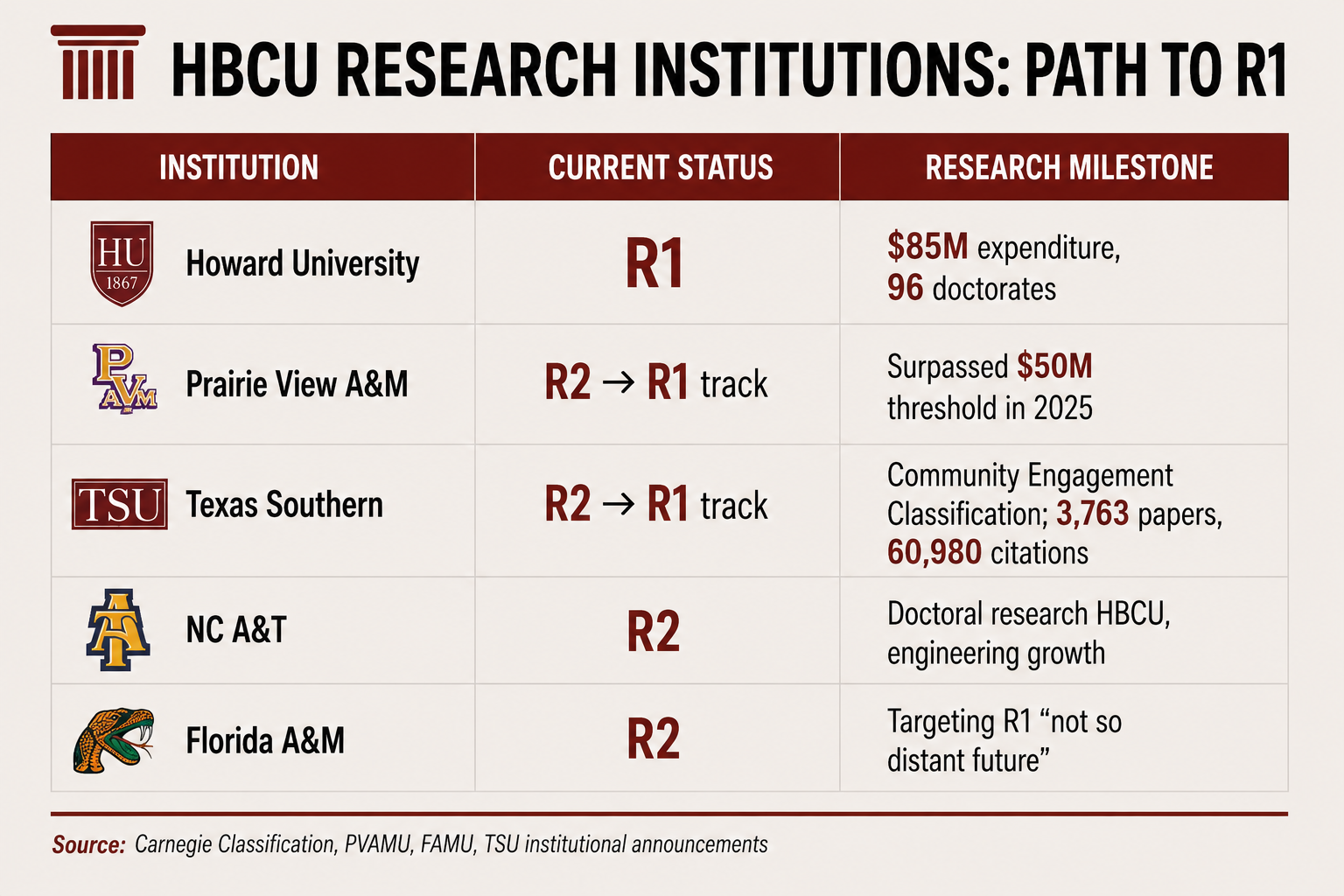
The Association of Historically Black Colleges and Universities Research Institutions — AHRI — formally launched on April 29, 2026, at Howard University. The coalition brings together 15 of the top HBCU research institutions in the country, working collectively to expand research capacity, innovation, and impact. AHRI’s founding members include Howard University — the only HBCU to hold R1 Carnegie Classification — alongside 13 R2 institutions including Clark Atlanta University, Delaware State University, Florida A&M, Hampton University, Jackson State University, Morgan State University, North Carolina A&T, Prairie View A&M, South Carolina State University, Southern University, Tennessee State University, Texas Southern University, and Virginia State University.
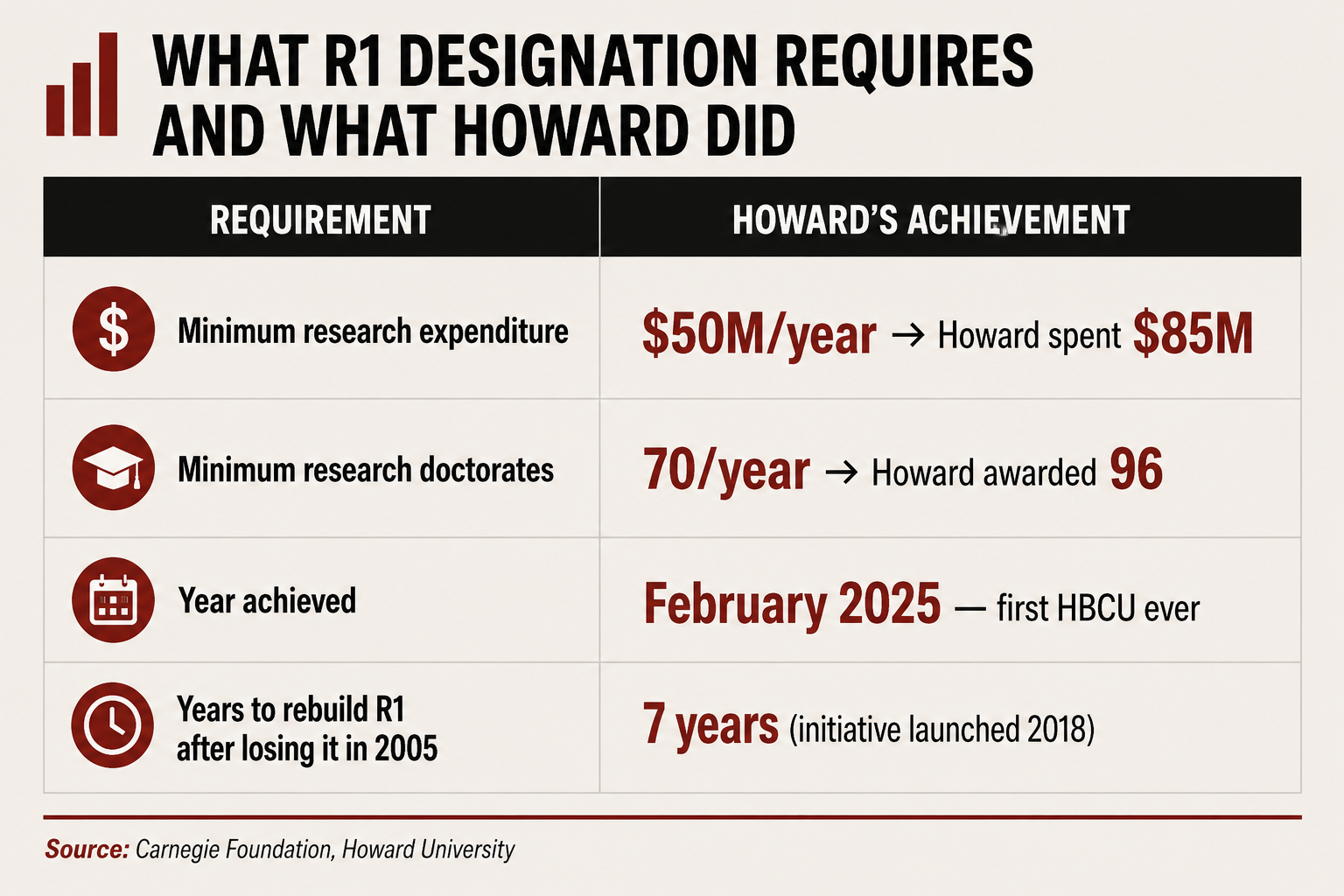
The R1 designation is the context that makes AHRI legible as structural rather than symbolic. Howard became the first HBCU in history to achieve R1 status in February 2025. That milestone gave HBCUs a model. AHRI gives them a collective pathway to replicate it. AHRI institutions collectively account for 50% of all competitively awarded federal research funding among HBCUs — which means the coalition is not starting from scratch. It is organizing existing research capacity into a structure that can pursue larger grants, share infrastructure, build faculty pipelines, and create the kind of sustained research output that R1 classification requires. Harvard University announced a three-year, $1.05 million grant to AHRI through the Harvard and the Legacy of Slavery Initiative. Prairie View A&M surpassed the $50 million annual research expenditure requirement in 2025 and is now focusing on boosting its PhD programming in mechanical and electrical engineering.
What distinguishes the research mission of several AHRI institutions is that it is not organized around prestige production. Texas Southern University holds a Carnegie Community Engagement Classification that specifically names public health, environmental justice, and economic mobility in Houston as the terrain its research is designed to address. That is the model AHRI is scaling: research capacity that is rigorous enough to compete for federal funding and grounded enough to serve the communities the institutions were built for.
The significance of AHRI’s co-location within the Association of American Universities is worth pausing on. The AAU is the consortium of 71 leading research universities in North America — the institutional home of the research university model that HBCUs have historically been excluded from on structural rather than merit grounds. AHRI being housed within AAU is not just a convenience of office space. It is a signal about where HBCUs are positioning themselves in the research ecosystem — not as peripheral institutions asking for inclusion, but as institutions whose collective research capacity entitles them to a seat at the table where research priorities, funding structures, and graduate education standards are set.
The philanthropic context matters here too. As SSC documented in The Billion-Dollar Shift That Didn’t Ask for Permission, MacKenzie Scott’s unrestricted HBCU giving has crossed $1 billion — and that flexible capital is precisely what allowed enough HBCU institutions to reach R2 status that a coalition of 15 research institutions became achievable. The Bloomberg $600 million gift to four HBCU medical schools is part of the same infrastructure picture. As Part IV — The HBCU Squeeze documented, the federal funding environment is simultaneously hostile — and as SSC covered in The Federal Government Just Redefined DEI as Discrimination, executive orders may expose employer-HBCU recruiting relationships to legal challenge. AHRI represents something the federal funding environment cannot fully reach: a structure that HBCUs own, govern, and are building together, on terms they set.
Ruth Simmons — former president of both Brown University and Prairie View A&M — said the effort is important because HBCUs too often work in isolation from dominant research institutions. “The launch of AHRI represents an important inflection point for the HBCU research landscape,” she said, “bringing institutions that have too often worked in isolation into sustained collaboration with one another and with the country’s leading research universities.”
Why This Matters
The HBCU enrollment surge documented in Part V — While PWIs Contract, HBCUs Are Growing is meaningful. It is also fragile — dependent on infrastructure that takes decades to build and can be disrupted faster than it was constructed. AHRI is the most significant structural investment in HBCU research capacity in a generation. It does not solve the federal funding crisis. It does not close the endowment gap. But it creates something that neither individual institutions nor government policy has previously provided: a formal, collective structure through which HBCUs can build research capacity at scale, pursue the designations that unlock the next tier of funding, and position themselves not as institutions recovering from historical exclusion but as institutions leading the next era of American research. The infrastructure moment is here. Whether the resources required to sustain it arrive is the question Part VII will address.
Part VI of The Degree Economy. Part I — The Credential Is Deflating | Part II — AI Ate the ROI | Part III — Who Gets Left Out of the Sale | Part IV — The HBCU Squeeze