
The coffee chain isn’t just shrinking. It’s deciding which locations can still be the kind of place people want to stay, and giving up on the ones that can’t.
At first glance, Starbucks‘ latest announcement looks like standard retail belt-tightening. The company said Thursday it will close about 250 North American coffeehouses this week, about 1% of its roughly 18,000 locations on the continent. It’s the second major round of closures under CEO Brian Niccol, following 627 closures across North America and Europe last September.
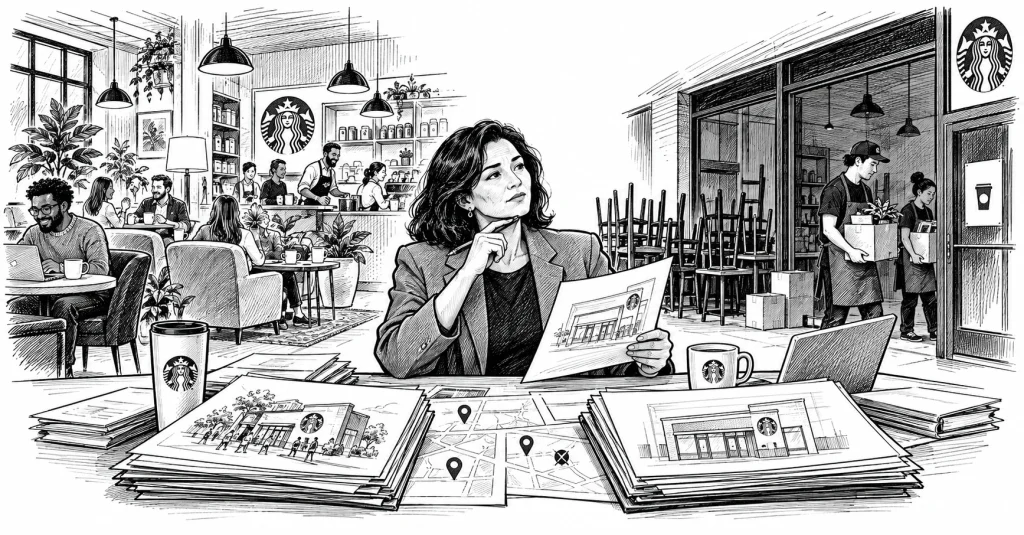
The closures, though, are only half the story. In the same stretch, Starbucks has renovated more than 1,000 coffeehouses across the U.S. and Canada since late 2025 and plans to finish at least 1,500 by the end of its fiscal year. Taken together, those two numbers show a company rebuilding its store network around one question: which of its stores can actually function as a coffeehouse.
Chief operating officer Mike Grams told employees that the stores being closed either weren’t producing acceptable financial results or couldn’t consistently deliver the experience Starbucks wants for customers and employees. The company hasn’t said which stores are closing or how many are in the U.S.
The price is about $300 million in restructuring charges, according to CNBC. Roughly $200 million covers early lease exits and severance, and the other $100 million is noncash write-downs of store assets. Starbucks also cut its forecast for net new coffeehouse openings this fiscal year to about 440, from 600 to 650, while saying it still expects to grow its North American footprint over time. Affected workers are being offered transfers or severance.
The cuts also reach the union. Starbucks Workers United, which represents about 700 unionized company-owned U.S. stores, said 20 of its stores are on the closure list, or 8% of the total.
What’s being rebuilt
The renovations tell you what Starbucks thinks a store should be. The company calls them “uplifts,” and they’re designed to be quick and relatively cheap, about $150,000 per location, with little to no closure time. They bring back softer seating, warmer materials, lamps, plants, local artwork and a redesigned espresso bar that gives customers a better view of the baristas. Ceramic mugs, glassware, condiment bars and more power outlets are coming back too, along with a service standard the company calls Green Apron Service.
Starbucks has described the effort as a more than $1 billion reinvestment in existing stores. Earlier full remodels cost as much as ten times more per location. The rollout has moved from New York and Southern California to Chicago and now includes Atlanta, Austin, Dallas, Houston, Miami, Nashville, Orlando, Seattle and Washington, D.C., along with pilots in Canada and Mexico.
Reversing a decade of design
The move stands out because it reverses the direction Starbucks spent years pushing. The company helped normalize the mobile-ordering, pickup-first coffee run, and mobile orders still make up about one-third of U.S. transactions. It built pickup-only stores in office buildings and busy corridors to get customers in and out as fast as possible. Now it’s phasing that format out. Niccol said the approach had become too transactional and lacked the warmth and human connection the brand is built on.
The new flagship prototype reflects that shift: 32 seats, a drive-thru and about 30% lower construction costs. A small-format version in New York has about 10 seats. The message is that convenience still matters, but it has to share space with a room people want to sit in. A store that can only process orders no longer fits the plan.
That’s the logic behind the closures. Starbucks isn’t only cutting stores that lose money. It’s also cutting stores that can’t host the experience it’s now selling, whether because of their footprint, location or layout. Stores that can be turned into a gathering place get $150,000 in renovations. Stores that can’t are closed.
Who absorbs the change
For customers, that could mean a Starbucks that’s more comfortable in some neighborhoods and gone in others. Because the company hasn’t released a full list, it’s not yet possible to tell whether closures are concentrated in dense urban areas, transit corridors or lower-traffic suburbs. That pattern will show who is losing access to what has functioned for years as affordable public space.
For workers, the effects vary. Some are being offered transfers or severance. Those at renovated stores are working under new service standards backed, the company says, by bigger rosters, better scheduling, weekly pay and doubled paid parental leave for hourly employees. The union’s count is also worth watching. Twenty of 250 closures is a small number, but it will draw scrutiny given the continuing labor fight between Starbucks and Workers United.
For landlords and commercial corridors, the $200 million in lease exits and severance is a reminder of how much of American retail real estate has been anchored by one green logo. Closing even 1% of the network will leave empty storefronts that someone else has to fill.
The bet
Niccol’s plan appears to be gaining traction. Starbucks reported positive global comparable sales in its fourth quarter for the first time in seven quarters. The larger question is whether customers will reward a return to comfortable seating and ceramic mugs in a market shaped by drive-thrus, delivery apps and remote work.
Starbucks is betting that the third place, somewhere between home and work where people can spend time without being in a hurry, still has value, and that people will pay for it if the room feels worth staying in. The 250 closures are the cost of that bet. The 1,500 renovations are the evidence Starbucks thinks it can win.
Sources: Reuters Connect, CNBC, AP via U.S. News & World Report, Starbucks 8-K, Starbucks, Starbucks Stories, Restaurant Dive, Retail TouchPoints, CRE Daily, Starbucks proxy statement