
This week, when My Mixtapez posted that Rich Homie Quan’s team was releasing a music video after his death, the internet reached immediately for the AI question — even though the video used no AI at all. The footage was real. The family approved it. And still, the assumption arrived before anyone checked the facts.
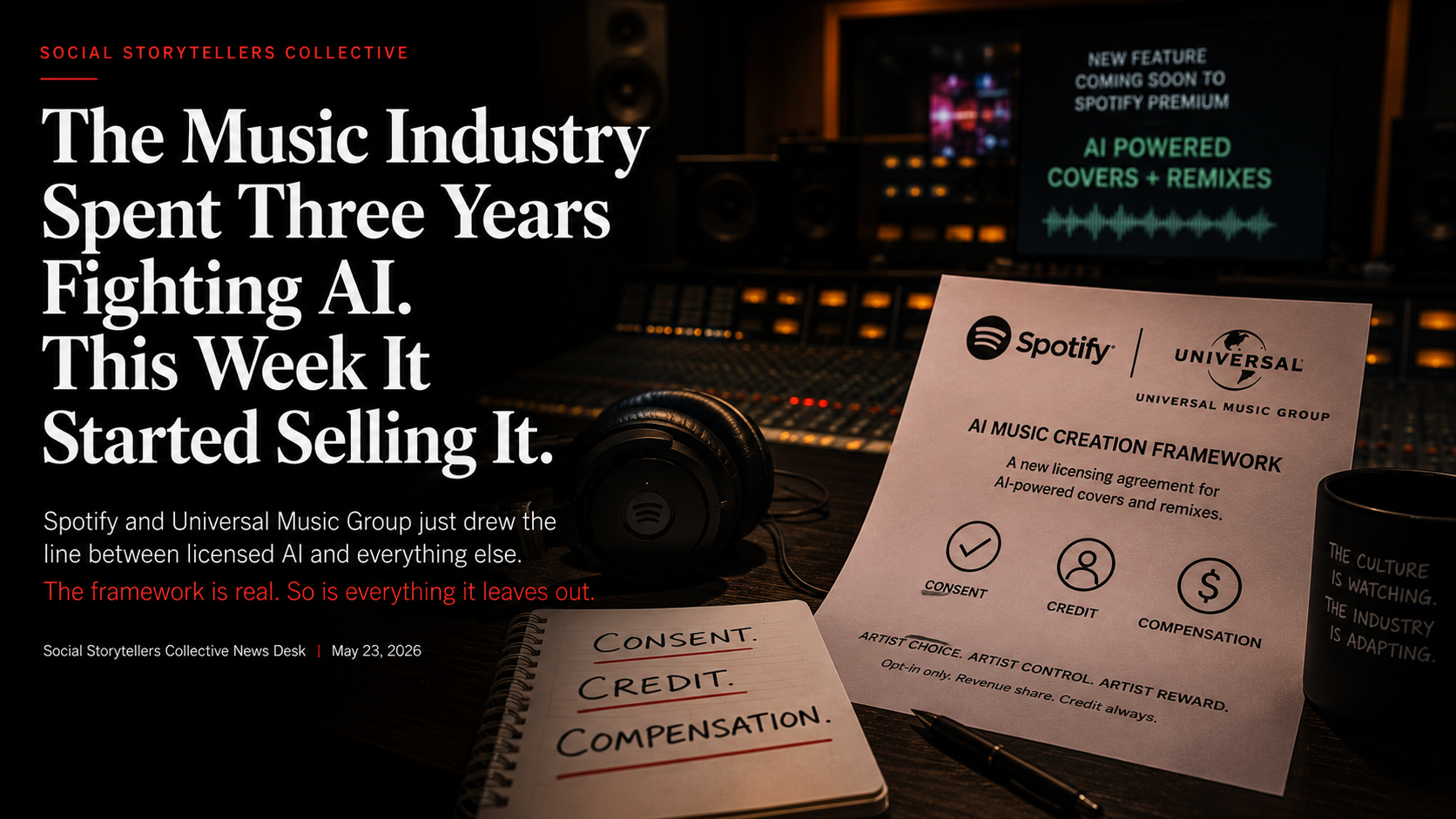
That reflex is the context for what Spotify and Universal Music Group announced on Wednesday. The two companies struck a landmark licensing agreement that will allow Spotify Premium subscribers to create AI-powered covers and remixes of songs from participating artists — opt-in only, with consent, credit, and compensation built into the framework from the start. The feature launches as a paid add-on. Artists who choose to participate share in the revenue it generates. Artists who don’t are not included.
The framework rests on three words that Spotify Co-Chief Alex Norström used in the announcement: consent, credit, and compensation. Those words are doing significant work — because they represent exactly what was absent from every AI music tool that came before this one. Suno and Udio built generative music products by training on existing recordings without artist permission, triggering major label lawsuits still working through the courts. Anonymous accounts have flooded platforms with AI-generated deepfakes of Tupac, Amy Winehouse, and dozens of other artists, living and dead, without any mechanism for the artists or their estates to object, be credited, or be paid. The question the Rich Homie Quan moment revealed is that audiences have already absorbed AI as a default assumption. The industry is now racing to build frameworks before the assumption becomes the architecture.
Spotify has 761 million users across 184 markets, including 293 million paying subscribers. Universal Music Group is the world’s largest music rights company. The scale of what this agreement covers is significant. So is the scale of what it doesn’t. UMG is one label. Sony Music and Warner Music Group have not announced comparable agreements. Independent artists outside major label deals have no equivalent framework — no opt-in mechanism, no revenue share, no structural protection. The line between licensed AI and unlicensed AI has been drawn inside a specific platform, with a specific partner, covering a specific segment of the global catalog.
The music industry spent three years in court, in Congress, and in the press arguing that AI was an existential threat to artist rights. That argument was not wrong. What Wednesday’s announcement confirms is that the industry has decided the more durable move is not to stop AI from entering music — it is to own the terms of its entry. Consent, credit, and compensation are the terms. The question now is who gets to negotiate them — and who finds out after the fact that they were never in the room.