
Lamont Newell is 17 years old. He is the valedictorian of Verbum Dei Jesuit High School, an all-boys institution in South Los Angeles. He holds a 4.4 GPA. He was accepted to 65 colleges — including Notre Dame, Dartmouth, and Columbia University, where he will study industrial engineering on a full scholarship this fall.
He is also the first male in his family to graduate high school.
For much of his childhood, Lamont and his family did not have a permanent address. They moved repeatedly. At points, they had no roof over their heads. They slept in a car. The parking lot where they sought refuge was at South Park Recreation Center in South LA — the same place where Lamont learned to code at a summer camp as a child, the same place he returned to when the cameras arrived to tell his story.
“There were times where we didn’t have a roof over our head, but we had a car,” his mother Antanika Barnes said, standing in that parking lot. “We didn’t have a place to stay so we would come and sleep in this parking lot.”
That is the place that produced a Columbia admit. That is the place that produced 65 acceptance letters.
The Number Is the Story — and It Isn’t
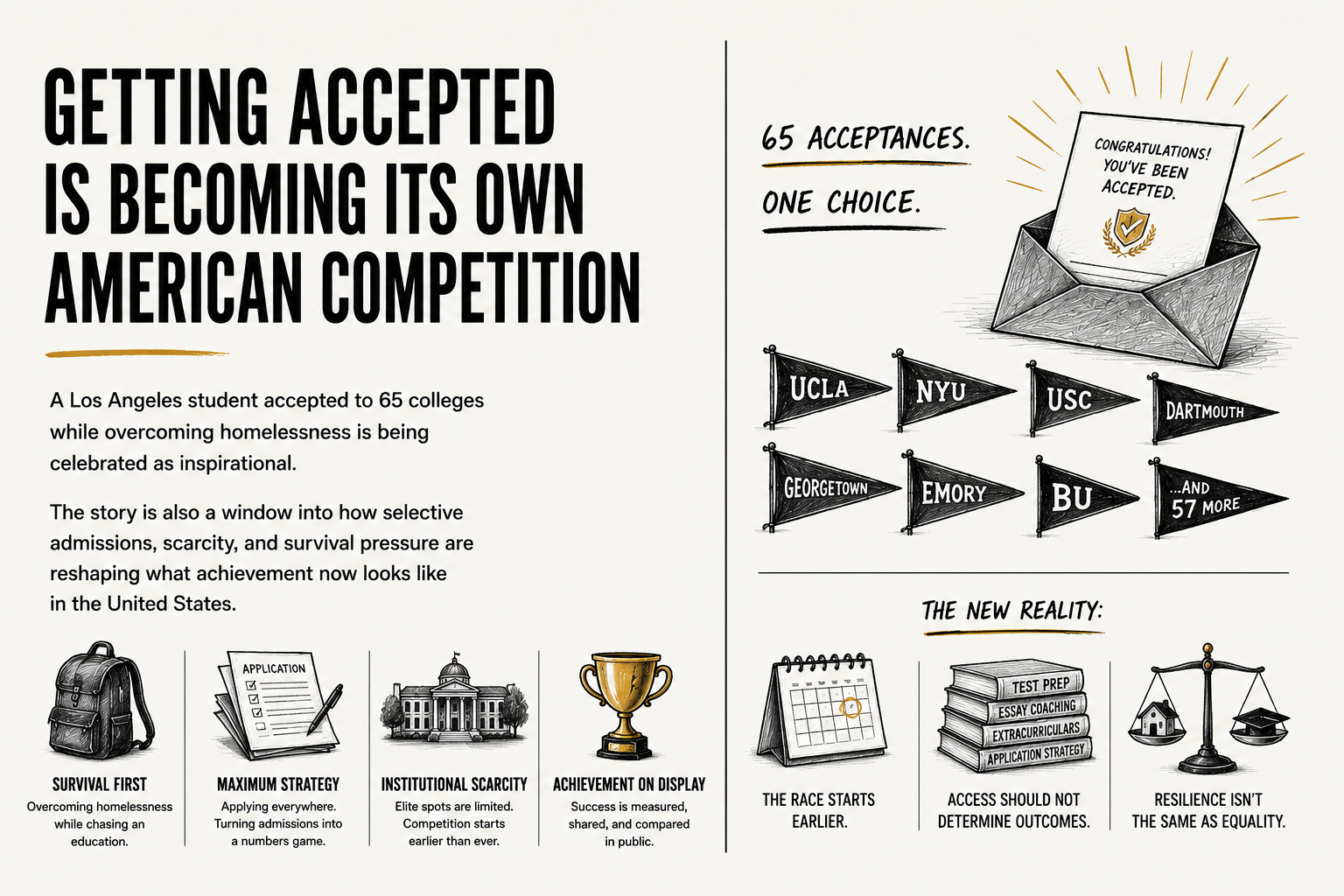
The coverage of Lamont’s achievement has focused, understandably, on the number. 65 is extraordinary. It is the kind of figure that stops a scroll, demands a headline, earns a segment on GMA. It signals that someone applied widely, optimized carefully, and executed a strategy designed to maximize optionality in a system that increasingly rewards exactly that.
But 65 is also a window into what the American admissions process has become — not just for exceptional students, but for every student navigating the landscape Lamont navigated.
The modern college admissions system has structurally transformed over the past two decades. The rise of the Common App, test-optional policies, and the normalization of applying to ten, fifteen, twenty schools has produced an environment where volume itself has become a signal of seriousness. Students are counseled to apply broadly, to treat each application as a unit in a portfolio rather than a commitment, to hedge against rejection with range. The students who execute that strategy most effectively are typically the ones with the most resources: counselors, test prep, essay coaching, and the time and stability to manage a multi-application campaign across their junior and senior years.
Lamont did not have those resources in the conventional sense. What he had was a mother who refused to accept a ceiling, teachers who saw what he was capable of and put him in front of opportunities — including a NASA program in Houston his sophomore year that sparked his engineering interest — and a community institution, South Park Recreation Center, that gave him structure when the larger system was not structured around his stability.
“The main reason I wanted to apply to so many schools,” Lamont told ABC News, “was my mom didn’t get to go to the college she wanted to go to. She didn’t really get to apply as many as she wanted to. So my plan was to do the direct opposite.”
That sentence contains an entire generational argument. Antanika Barnes did the work of a parent under conditions that would have broken most people — raising a son as a single mother at 21, navigating housing instability, gang violence in the family’s orbit, the chronic uncertainty of a life in motion. She identified her son’s gifts early. She found the summer camps. She watched him become what she could not be, through a pathway she helped clear despite not having cleared one for herself.
The public celebrates the outcome because the outcome feels hopeful. That hope is real. Lamont Newell is going to Columbia University on a full ride, and that is an extraordinary thing that deserves to be said plainly and celebrated without qualification.
What the Number Also Says
Embedded within the hope is another reality that the coverage of Lamont’s story largely leaves in the margins.
The admissions system that Lamont navigated with such precision is the same system that has become, for many students, a competitive accumulation exercise — one where volume signals excellence, where students are encouraged to apply broadly, optimize every metric, and transform adolescence into a long-form portfolio project. The students most prepared for that exercise are typically the ones whose families have the most resources to invest in it. The students least prepared are typically the ones whose families are focused on more immediate survival.
Lamont threaded that needle through a combination of exceptional ability, institutional support, a mother who refused to accept the terms the situation offered, and a community space that held him when the broader environment did not. That combination is real. It is also rare.
His story does not indict the admissions system. It does illuminate it. When a student needs to apply to 65 colleges to feel secure about accessing the opportunity he deserves — when the sheer volume of applications becomes both the strategy and the signal — the system is communicating something about how much uncertainty it builds into the lives of the students who most need certainty.
Lamont will study industrial engineering at Columbia. He plans to study abroad in Egypt. He has a long-term goal that is, in its own way, the most SSC sentence of this entire story: he wants to build an institution at South Park Recreation Center to teach Black kids in his community how to work in STEM.
He wants to give back to the parking lot.
What Comes After the Headline
Lamont Newell is not a symbol. He is a 17-year-old from South LA who did something extraordinary under conditions that were not designed to make it easy — and who, in the middle of receiving national attention, is already thinking about what he owes the community that carried him.
“You may feel like during your situation there is no path out,” he said, “but there is always an exit to your destination.”
His mother put it plainly: “This not only means something great to me, but it’s very influential to my family as a whole because now the youth that comes after him are going to see that there’s another way out.”
The acceptance letters are real. The full ride is real. The parking lot is real. All three of those things belong in the same sentence — because they are all part of the same story about what it actually takes to get through a door that the system keeps making harder to find.
65 colleges said yes. Columbia is where he’s going. And somewhere in South LA, a recreation center is waiting for what comes next.