
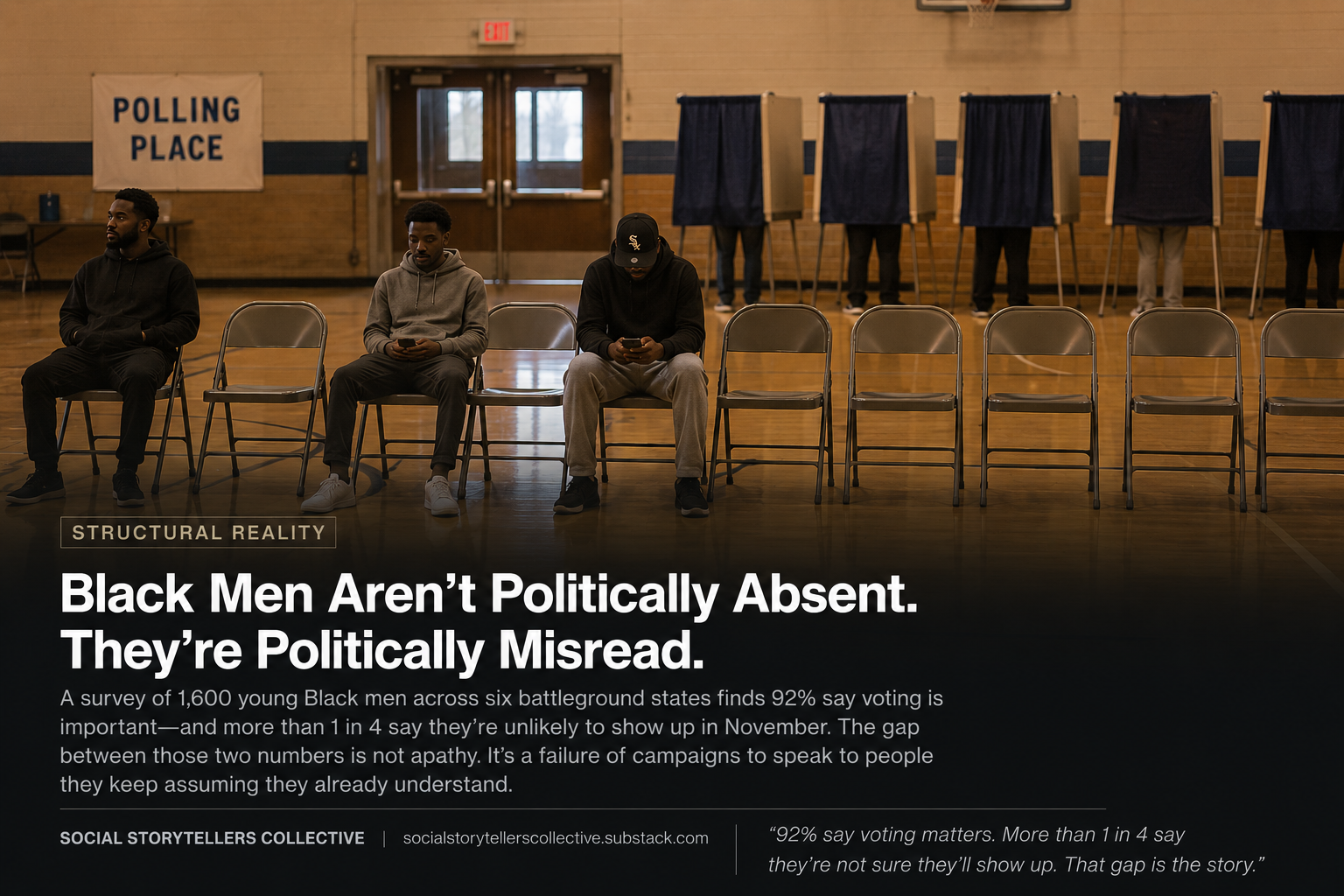
The gap between those two numbers is not apathy. It’s a failure of campaigns to speak to people they keep assuming they already understand.
Michael Bland has a message for every campaign that thinks it understands the Black male voter: you’re not losing them because they don’t care. You’re losing them because you keep sending the wrong message, through the wrong channels, at the wrong time, about the wrong things — and they can tell.
“Black men are not politically absent, they are politically misread,” said Bland, executive director of Black Men Vote, a nonpartisan organization focused on mobilizing Black male voters. He commissioned one of the largest dedicated surveys of Black men in recent years — 1,600 registered Black male voters ages 18 to 45 across six battleground states: Georgia, Michigan, Mississippi, North Carolina, Pennsylvania, and South Carolina. The findings don’t describe a disengaged electorate. They describe an electorate that has been consistently underestimated, intermittently courted, and structurally ignored between election cycles — and is making its own calculations about whether showing up is worth it.
The headline number is 92% — the share of respondents who say voting is important. That is not an electorate that has given up on democracy. The number sitting right next to it is the one campaigns need to read carefully: a little more than 1 in 4 say they are uncertain or unlikely to vote in the 2026 midterms. That gap — between believing voting matters and planning to do it — is not cynicism. It is a rational response to years of being treated as a guaranteed constituency rather than a persuadable, investable one.
The survey, conducted by HIT Strategies between February 17 and 24, found an electorate that doesn’t fit the political boxes campaigns typically deploy. A majority identified as Democrats. But 1 in 5 identified as independents. Another 1 in 5 as Republicans — with “family values conservative” as the most common identity among those with conservative leanings. The HIT Strategies polling identified six distinct voter segments among young Black men: Base Dems who follow the news closely and plan to vote make up roughly 1 in 3 respondents. Trump Voters represent about 20%. Young Supporters who backed Harris in 2024 are about 16%. The “Disengaged and Demobilized” — what Blandcalls the “Team Couch coalition” — are about 15%. “Sympathetic but Uncertain” voters who backed Harris in 2024but may sit out the midterms are roughly 10%. And “Distrustful Voters” — people who disliked both candidates but still plan to participate — come in at about 12%.
What surprised Bland most was not ideology. It was media. YouTube dominates political information consumption among young Black men — 90% use the platform multiple times weekly, and 57% identify it as their go-to source for breaking political news. Half actively seek out political content. 44% mostly encounter it through social media feeds. When scrolling, they stop for music, humor, memes, and news — in that order. Which means civic information is competing directly with entertainment for attention, and campaigns that don’t understand that environment are not reaching these voters at all. The feeling that stories aren’t landing isn’t suppression — it’s architecture, and campaigns running TV ads and mailers into a YouTube ecosystem are operating on a map that doesn’t match the territory.
Bland referenced the Harris campaign’s 2024 rollout of its “Platinum Plan“ targeting Black men as the clearest recent example of what not to do. “Late invitations are for fools,” he said. “Voting had already started and voter participation was already down. We could sniff out a fake or a phony in a minute.” The plan landed weeks before election day. The opportunity it was supposed to address had been building for years without sustained investment.
The issues young Black men say they care about are not, Bland argues, fundamentally different from what other Americans care about. “Black men are worried about the economy, we’re worried about our family, worried about putting food on our table, can we pay for higher education, the extreme cost of daycare,” he said. “That day-to-day is not just a Black problem or a caring problem. It’s an American problem.” Austin Joiner, a 27-year-old insurance firm supervisor in Macon, Georgia, put it plainly: the cost of rent in Atlanta has kept him from moving into the city even though he wants to. Housing. Stability. Family. The concrete material conditions of a life — not the incarceration rates and recidivism statistics that campaigns typically lead with when they bother to address Black men at all.
Bland drew the historical parallel directly. “There was a time where Louisiana was blue. There was a time Tennesseewas blue,” he said. “Democrats stopped investing in them. And we don’t want that same issue with Black men and them not coming back to voting.” The warning is not abstract. The 2024 presidential results showed a measurable shift among Black male voters away from the Democratic coalition. The 2026 midterms — with Georgia, North Carolina, Pennsylvania, and Michigan all in play — will tell us whether that shift was a moment or a movement. The answer depends largely on whether campaigns invest in Black men as a year-round constituency rather than a last-minute mobilization target.
The survey says the votes are there. The question is whether anyone is willing to do the work to earn them before it’s too late to matter.
Social Storytellers Collective | Structural Reality Read the full End of Day Closing Note — drops at 3PM CDT weekdays.