
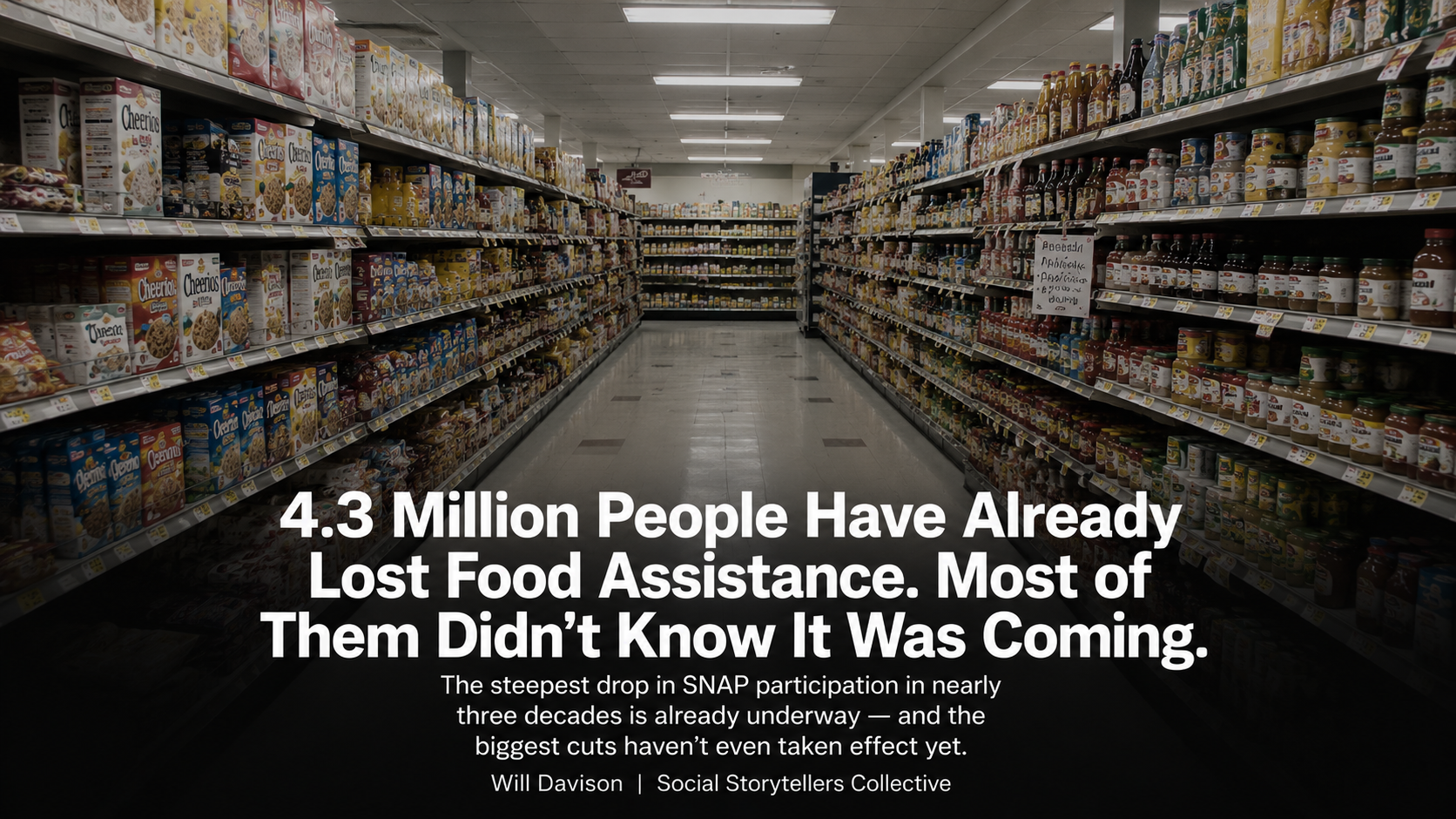
The number arrived without a press conference. No ceremony, no announcement, no moment when a specific policy crossed a specific line and the country paused to register what had changed. It showed up in the data quietly: 4.3 million people have already been removed from the Supplemental Nutrition Assistance Program since the One Big Beautiful Bill Act became law last July 4th. The drop in SNAP participation is the steepest in nearly three decades — the last time it fell this fast was 1996, when Congress made cuts that the policy world still references as a cautionary case study in what happens when you remove a food safety net faster than the economy can absorb the impact.
This time, the cuts are larger. And the steepest provisions haven’t taken effect yet.
What Is Already Happening
The OBBBA included $187 billion in cuts to SNAP over the next decade. The law imposed new work reporting requirements, tightened eligibility verification timelines, shifted more administrative costs to states, and removed benefits for most legal immigrants. The Congressional Budget Office estimated millions would lose access. What the data is now showing is that the participation decline is outpacing even those projections — meaning people are being removed from the program faster than the law’s explicit timeline requires.
The reason is administrative. States, under pressure to reduce payment error rates and operating with fewer federal administrative dollars, are implementing eligibility processes that create friction — longer wait times, call center backlogs, shorter response windows for documentation. People who remain fully eligible are being removed because they can’t navigate the paperwork fast enough. Anti-hunger advocates at a Capitol Hill briefing in late April were explicit: the mechanism producing much of the current drop is not the law’s formal provisions. It is the law making the program harder to access, and people falling through the gaps that creates.
Independent grocers in communities where SNAP made up a significant share of revenue are already adjusting. In Chicago’s Austin neighborhood, a grocery store that opened last fall is watching its SNAP share of monthly revenue fluctuate dramatically — down from what had been a reliable baseline. Community food programs that existed to supplement SNAP, not replace it, are being asked to absorb demand they were never designed to carry. “Absolutely not enough to cover people,” one program director said of her initiative. “This is a small drop in meeting the need.”
What Is Still Coming
The provisions that have already taken effect are the front end. The larger structural changes are still on the timeline. Work reporting requirements — 80 hours per month of employment, training, or volunteer activity — become mandatory for most adult recipients. Eligibility redeterminations, now required every six months rather than annually, add a recurring administrative hurdle that research consistently shows removes eligible people who simply can’t manage the recertification process. USDA is also finalizing new retailer stocking standards that food access advocates warn will push some smaller grocery stores — particularly in low-income and rural communities — out of the SNAP network entirely, leaving families with fewer places to use benefits they still technically hold.
The SNAP cuts do not exist in isolation. They land alongside Medicaid eligibility changes, reduced administrative capacity at federal nutrition agencies, and a USDA reorganization that is moving program leadership and staff out of Washington. The people most affected — low-income working families, children, seniors, people with disabilities, and legal immigrants who paid into the system for years — are navigating all of these systems simultaneously, often without the administrative bandwidth or legal support to hold their place in each one.
There is a particular cruelty in the timing of these numbers landing on the Friday before Memorial Day weekend. Forty-five million Americans are on the move this weekend — a record. The travel story, the holiday story, the summer-kickoff story are real. So is this one. The same economy producing that record is the one in which 4.3 million people have already lost access to the program that kept food on the table. Those two data points do not cancel each other out. They describe the same country from two different vantage points.
The steepest SNAP participation drop in three decades is not a statistic that will trend on social media this weekend. It will not interrupt the holiday. It is already underway in the communities least equipped to absorb it — and the larger provisions of the law that produced it haven’t even arrived yet. That gap between what is happening and when it registers publicly is worth holding onto. The food insecurity being built right now will show up in the data months from now. By then, the framing will have moved on.
Pay attention to it now.