
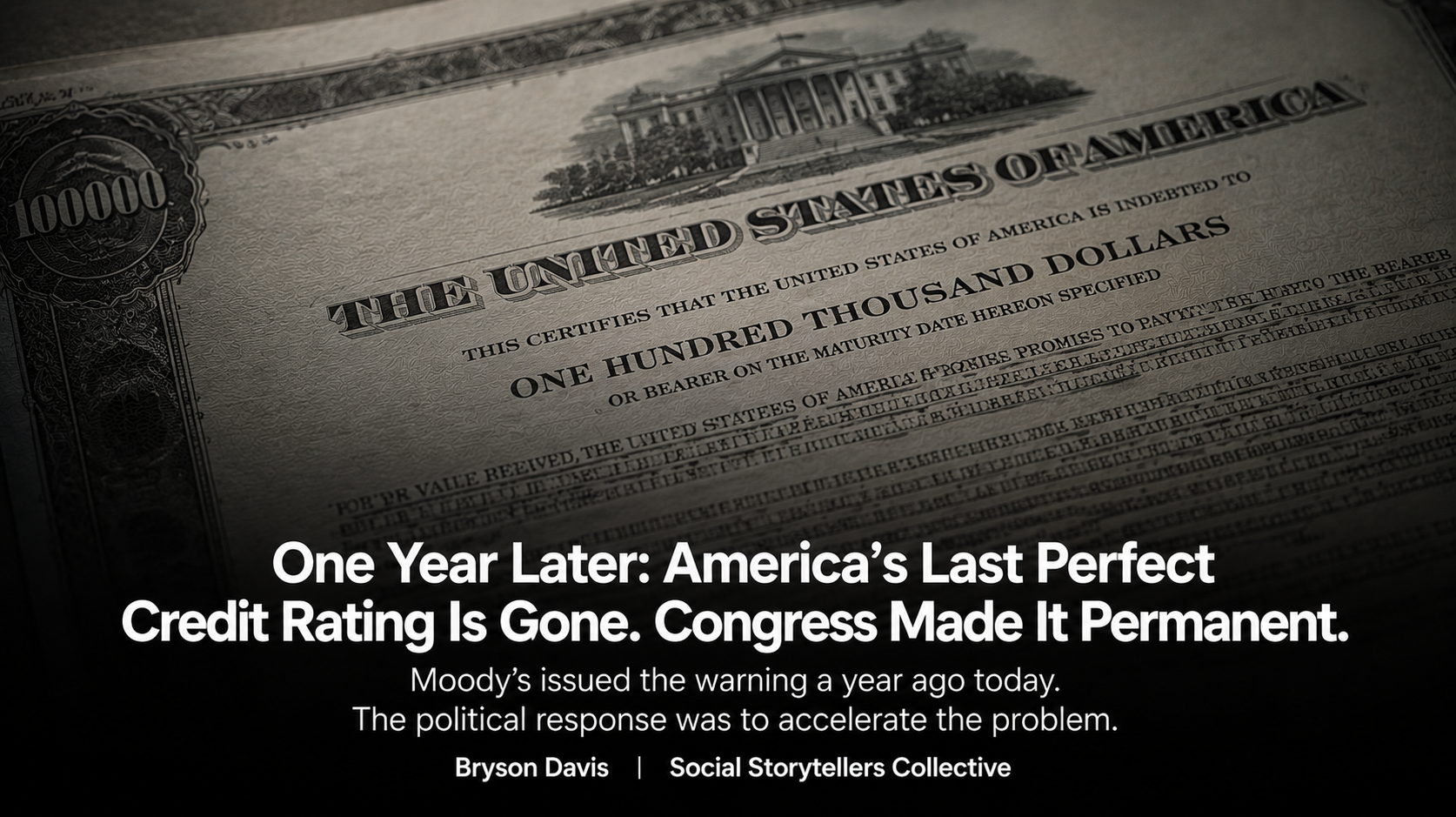
One year ago today, Moody’s Ratings did something that S&P had done in 2011 and Fitch had done in 2023: it looked at the United States‘ fiscal trajectory and decided it no longer warranted a perfect credit rating. On May 16, 2025, Moody’sdowngraded U.S. sovereign debt from Aaa to Aa1 — making it the third and final major ratings agency to strip America of its top-tier status. The national debt stood at $36 trillion. Interest payments had surpassed defense spending. More than a decade of growing deficits had accumulated across administrations of both parties, and no meaningful course correction had emerged. Moody’s called it clearly: the trajectory was unsustainable.
The White House called the downgrade “a lagging indicator.” Congress responded by passing the One Big Beautiful Bill.
The OBBB — a sweeping reconciliation package that extended the 2017 Tax Cuts and Jobs Act, expanded defense spending, restructured Medicaid, and cut food assistance — passed the House 215-214 and was signed into law. The Congressional Budget Office estimated it would add approximately $4 trillion to the national deficit over the next decade. Moody’s had specifically cited the extension of the 2017 tax cuts as a core driver of its downgrade, projecting that if extended — which it called its base case — the result could be a debt-to-GDP ratio of 134% by 2035, potentially reaching 156% by 2055.
Congress passed the bill anyway.
A year later, those projections are no longer a warning. They are the operating condition. Today, markets closed down across the board — S&P 500 off 0.67%, Dow down 0.65%, Nasdaq down 0.84%. 113,863 tech workers have been laid off so far in 2026. Medicaid recipients in states that accepted the restructuring are navigating new eligibility requirements. A student loan borrower is opening a tax bill for debt that was supposed to disappear. The fiscal floor that Moody’swarned about is no longer an abstract projection. It is the ground people are standing on.
The anniversary matters not because the downgrade was a market crisis — it largely wasn’t. Investors absorbed it within days. It matters because of what the political response revealed. A ratings agency — one of the most conservative, institutionally cautious voices in global finance — issued a formal warning about the direction of U.S. fiscal policy. The response from the people with the actual power to change that direction was to accelerate it. To add $4 trillion more. To call the warning a lagging indicator and keep moving.
The people who most need the government to function — the ones whose healthcare, housing, nutrition assistance, and student debt relief depend on federal fiscal capacity — didn’t get a vote on that response. They got the consequences of it.
Moody’s was right. It was a lagging indicator. The question worth sitting with today, one year later, is what exactly it’s lagging behind now.