
There is a specific kind of exhaustion that has settled across the American professional class over the last several years. It is not the exhaustion of failure. It is the exhaustion of doing everything right and watching the distance between effort and stability continue to grow anyway. The degree earned. The network built. The hours logged. The boxes checked. And at the end of it — not arrival, but the creeping realization that arrival may have been the wrong word for what was ever on offer.
A 2024 Pew Research Center survey put a number on that realization: 41% of Americans now say the American Dream was once possible but is no longer attainable for most people. Among younger Americans, the skepticism runs deeper. They are not pessimistic because they gave up. They are pessimistic because they are paying attention.
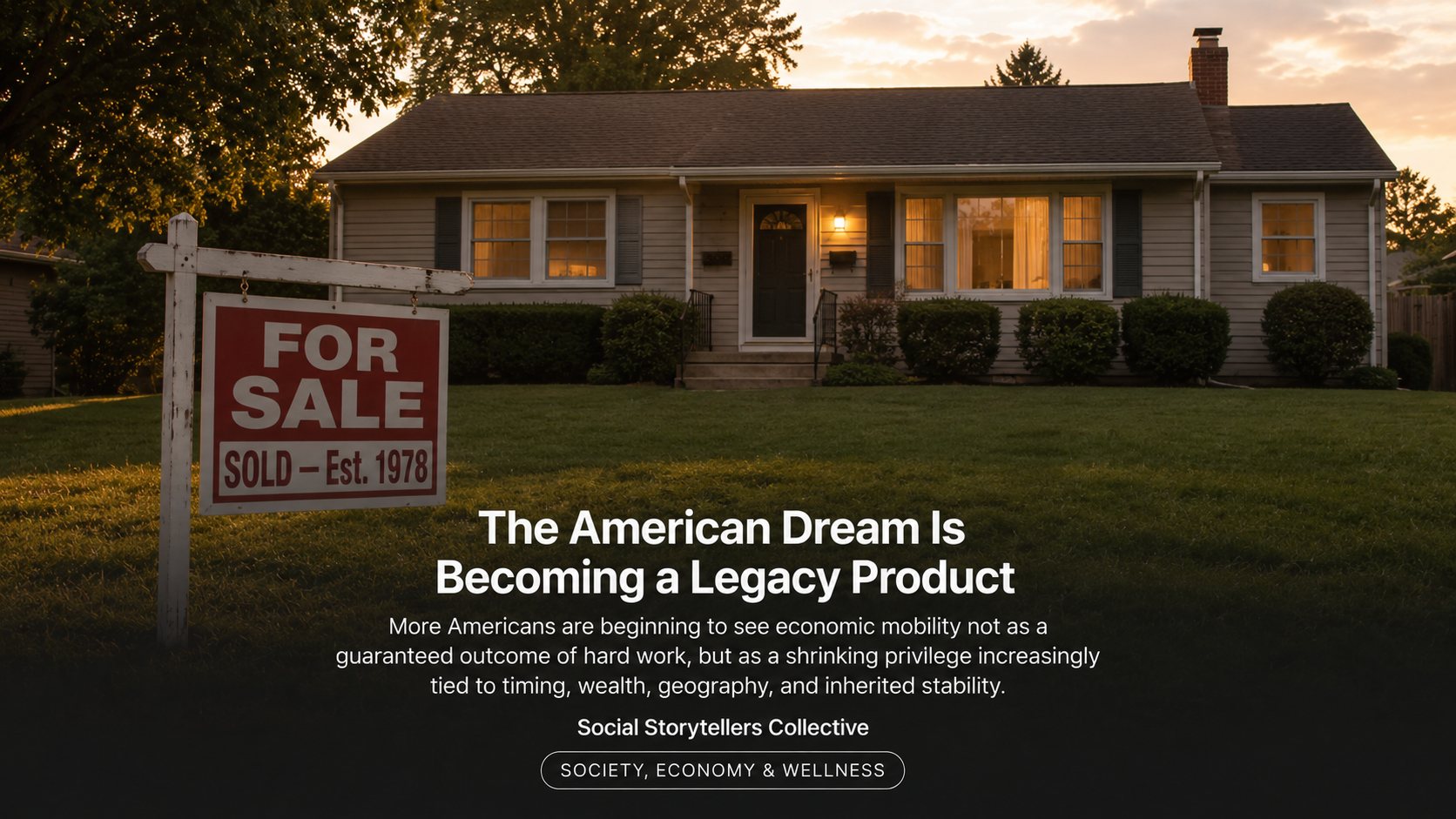
Housing is where the arithmetic breaks down most visibly.
A generation ago, middle-class salaries could support homeownership within commuting distance of economic opportunity. That relationship — between what work pays and what stability costs — has come apart in ways that no amount of individual effort can fully bridge. In cities like New York, Miami, Los Angeles, Boston, and increasingly Houston, even high earners are finding themselves priced out of the ownership economy entirely. The result is not simply that housing is expensive. It is that one of the primary mechanisms through which previous generations built intergenerational wealth — buying a home, holding it, passing it forward — is becoming inaccessible to the people who were told it was the next step.
Rent costs remain elevated across most urban markets. The down payment that once represented two or three years of disciplined saving now represents a decade for many workers — if the target isn’t moving faster than the savings rate. For the generation that was told homeownership was the foundation of the American Dream, the foundation has been repriced out of reach while the advice to save harder remains unchanged.
The labor market has restructured underneath the language of opportunity.
White-collar layoffs have continued across technology, media, finance, consulting, and nonprofit sectors even while headline unemployment numbers remain relatively stable. Entire career tracks that once represented upward mobility — the stable mid-level professional role, the corporate ladder with predictable rungs, the government position with reliable benefits — now function more like temporary positioning inside a permanently volatile economy. Workers are increasingly discovering that prestige industries no longer guarantee long-term security. The credential that was supposed to open the door is now a ticket to a room where the walls keep moving.
The emotional dissonance is severe. People are doing everything they were told to do. The outcomes are no longer following the script. That gap — between the instructions and the results — is where a generation’s optimism has been quietly eroding.
The comparison economy is making it worse.
Social media exposes people daily to accelerated wealth creation through investing, influencing, entrepreneurship, real estate speculation, and viral attention economies — while simultaneously surfacing how difficult traditional pathways have become. The contrast is not merely psychological. It reflects a structural shift in how money is actually accumulated in the modern economy. Wealth increasingly comes from asset ownership, timing, and inherited access — not from labor participation alone.
What that comparison produces is not simply envy. It produces a specific kind of cognitive dissonance: the simultaneous awareness that enormous wealth is being created around you and that the mechanisms creating it are not the mechanisms you were given access to. You were told to work. The people getting rich are holding assets. The instructions and the architecture are no longer the same document.
The deeper shift may be that the broad middle-class expansion of the 20th century was historically unusual rather than permanent.
Postwar economic growth, lower housing costs, stronger unions, accessible education, and expanding industrial employment created conditions that allowed millions of households to experience upward mobility simultaneously. Those conditions do not exist in the same form. The economy still produces immense wealth. The distribution mechanisms increasingly reward capital ownership, scale, and existing access over labor participation alone. The Dream was always partly a product of specific historical conditions. Those conditions have changed. The Dream has not been updated to reflect it.
This is why so much contemporary anxiety centers around exhaustion rather than aspiration. Many workers no longer feel they are climbing toward something. They feel they are running to avoid falling behind. When a society loses confidence that effort can materially improve life outcomes, trust in institutions erodes alongside economic optimism. Housing debates become emotional. Student debt becomes existential. Layoffs become identity crises. Even basic milestones — buying a home, raising children, building savings — begin to feel less like expectations and more like privileges reserved for people who got there first.
The American Dream has not disappeared. It has stratified.
Opportunity still exists — but it has become geographically concentrated, financially expensive to access, and increasingly dependent on the stability you started with rather than the work you’re willing to put in. Americans are still being told the system rewards hard work. What a growing number of them are beginning to name, out loud, in survey data and comment sections and kitchen table conversations, is that hard work alone may no longer be enough to cross the distance between survival and stability.
That is not a crisis of motivation. It is a crisis of the promise.