
Apple has spent more than a decade making privacy the centerpiece of its brand identity. Not as a feature. As a philosophy. The company that refused to unlock a terrorist’s iPhone for the FBI. The company that built App Tracking Transparency and watched the advertising industry scramble to adjust. The company whose billboards read “What happens on your iPhone, stays on your iPhone.” Privacy was not a selling point at Apple. It was the selling point — the reason millions of premium-paying consumers chose the ecosystem and stayed in it.
iOS 27’s revamped Siri arrives this fall with auto-deleting chats, tighter memory controls, and a redesigned interface built around the premise that your conversations with AI should belong to you and disappear when you want them to. At this year’s Worldwide Developers Conference, Apple will position the new Siri as the privacy-forward alternative in an AI race that has largely moved in the opposite direction — toward data accumulation, behavioral modeling, and the kind of persistent memory that makes AI assistants more useful and more surveilled simultaneously.
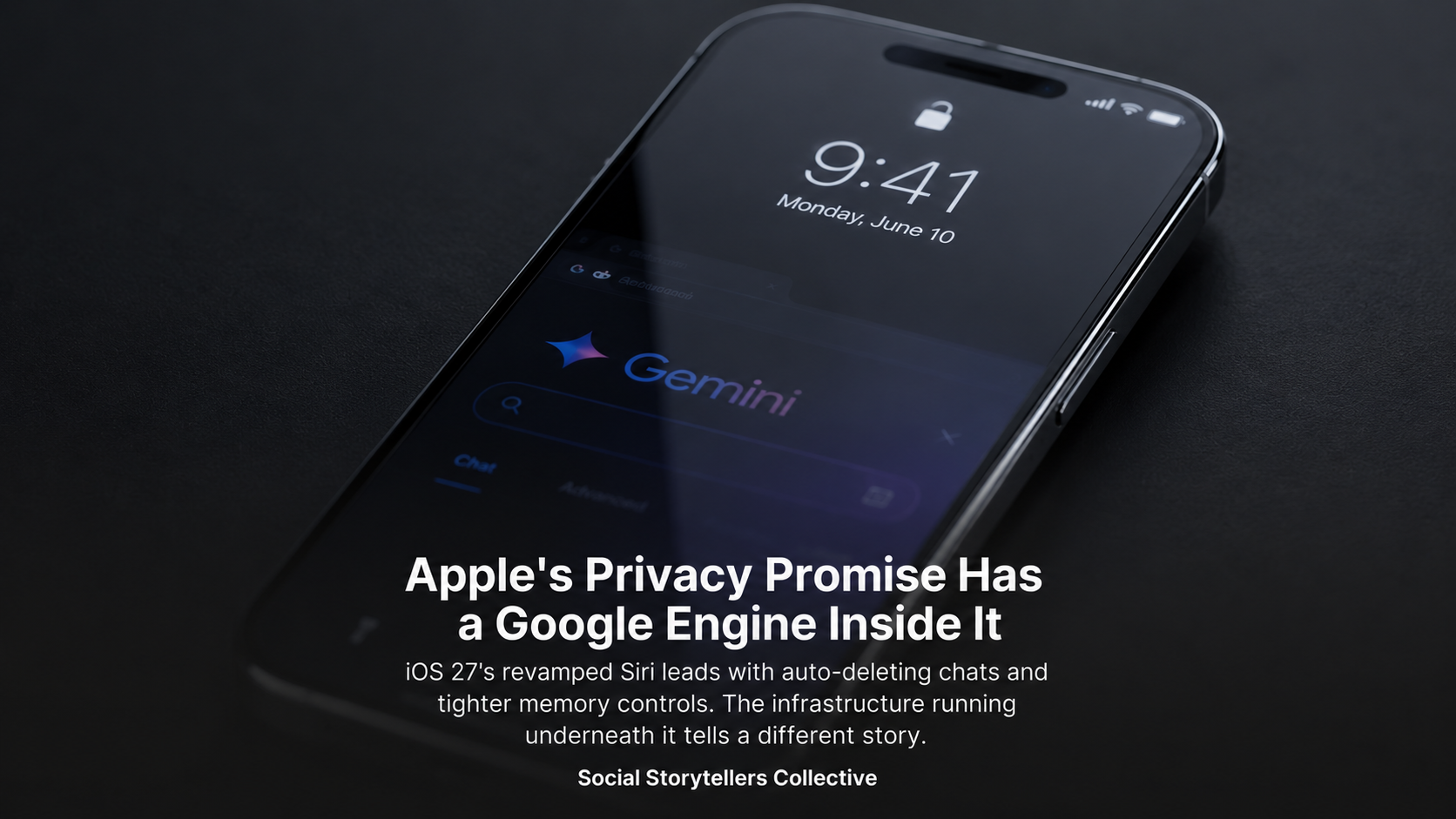
The new Siri is running on Google’s Gemini underneath it.
Apple confirmed the arrangement last year: the company is using Google’s 1.2 trillion parameter Gemini model to power key Siri capabilities. The partnership is, in the language of the industry, entirely standard. Large language model infrastructure is expensive, technically complex, and dominated by a small number of players. Apple is not unique in building on top of someone else’s model. Microsoft built Copilot on OpenAI. Amazon’s Alexa has relied on external model partnerships. Infrastructure sharing is the architecture of the modern AI economy.
But Apple is unique in having built its entire brand premium around the argument that what happens inside its ecosystem stays inside its ecosystem. That promise is the reason its customers pay more. It is the reason they trust it with their health data, their financial information, their location history, and now their AI conversations. The promise has a specific weight at Apple that it does not carry the same way at other companies.
The question the Gemini partnership raises is not whether Apple has done something wrong. It is whether the promise travels through the partnership intact — and whether the customers who specifically chose Apple because of that promise will want to know the difference between privacy as a product feature and privacy as an architectural reality.
Those are not always the same thing.
Privacy as a product feature means the interface auto-deletes your chats, limits what gets stored, and gives you controls that feel like ownership. Apple is genuinely delivering that. The UX is designed around the promise, and the design choices are real.
Privacy as an architectural reality means understanding what happens to your data at the infrastructure level — where it goes, who processes it, under what terms, and what the data handling agreement between Apple and Google actually says about the conversations Siri is routing through Gemini’s model. That information is considerably harder to find in the marketing materials.
The gap between those two versions of privacy is not unique to Apple. It is the defining tension of the AI consumer moment. Every major AI assistant is making promises about data handling while operating on infrastructure whose complexity most consumers cannot evaluate. The difference is that Apple has built a decade of brand equity — and a meaningful price premium — on the argument that it can be trusted to bridge that gap better than anyone else.
At WWDC, Apple will present the new Siri to a room full of developers and a global audience of consumers who have already decided to trust it. The presentation will be polished, the privacy language will be precise, and the auto-delete features will be real. What it probably will not include is a detailed explanation of what Google’s Gemini model processes, retains, or learns from the conversations Apple is routing through it.
That explanation is the fine print. And in 2026, fine print is becoming the story.