
The Degree Economy is a Social Storytellers Collective series examining what happens when the credentialing system that previous generations used to build economic stability is stress-tested from every direction at once. MBA tuition is being slashed at schools that can afford to discount. AI is eliminating the entry-level jobs the degree was designed to access. The workers who most need a credential upgrade to survive the restructuring are the least positioned to use a sale that still costs tens of thousands of dollars and requires time away from an income they cannot afford to lose. And the institutions built specifically to serve those workers are absorbing funding cuts while a discount war plays out around them. This is not a story about business schools adjusting their pricing. It is a story about who the credential was always designed to serve — and what happens when the system that sustained that promise stops working.
There is a fire sale happening in American higher education, and most people are treating it like good news.
Purdue’s Mitch Daniels School of Business just cut its MBA tuition 40% — from $60,000 to $36,000. UC Irvine slashed its Flex and Executive MBA programs by as much as 38%, dropping the Flex MBA from $129,000 to $99,000. Johns Hopkins is offering 50% scholarships across cohorts. Washington University and Boston University are following with their own versions of the same move. The headlines are framing this as accessibility. As a gift to working professionals priced out of graduate education.
It is not a gift. It is a distress signal.
When a product goes on a fire sale, one of two things has happened. Either the seller got generous — or the market decided the product isn’t worth what it used to cost. Business schools are not getting generous. They are responding to a collapse in demand so significant that it is rewriting the economics of graduate education in real time.
U.S. MBA applications have dropped 20% to 30% at many programs this cycle. International applications — historically a critical enrollment buffer — are down more than 40% at some schools. And the explanation most institutions are reaching for — that professionals prefer to stay employed during economic uncertainty — understates what is actually happening.
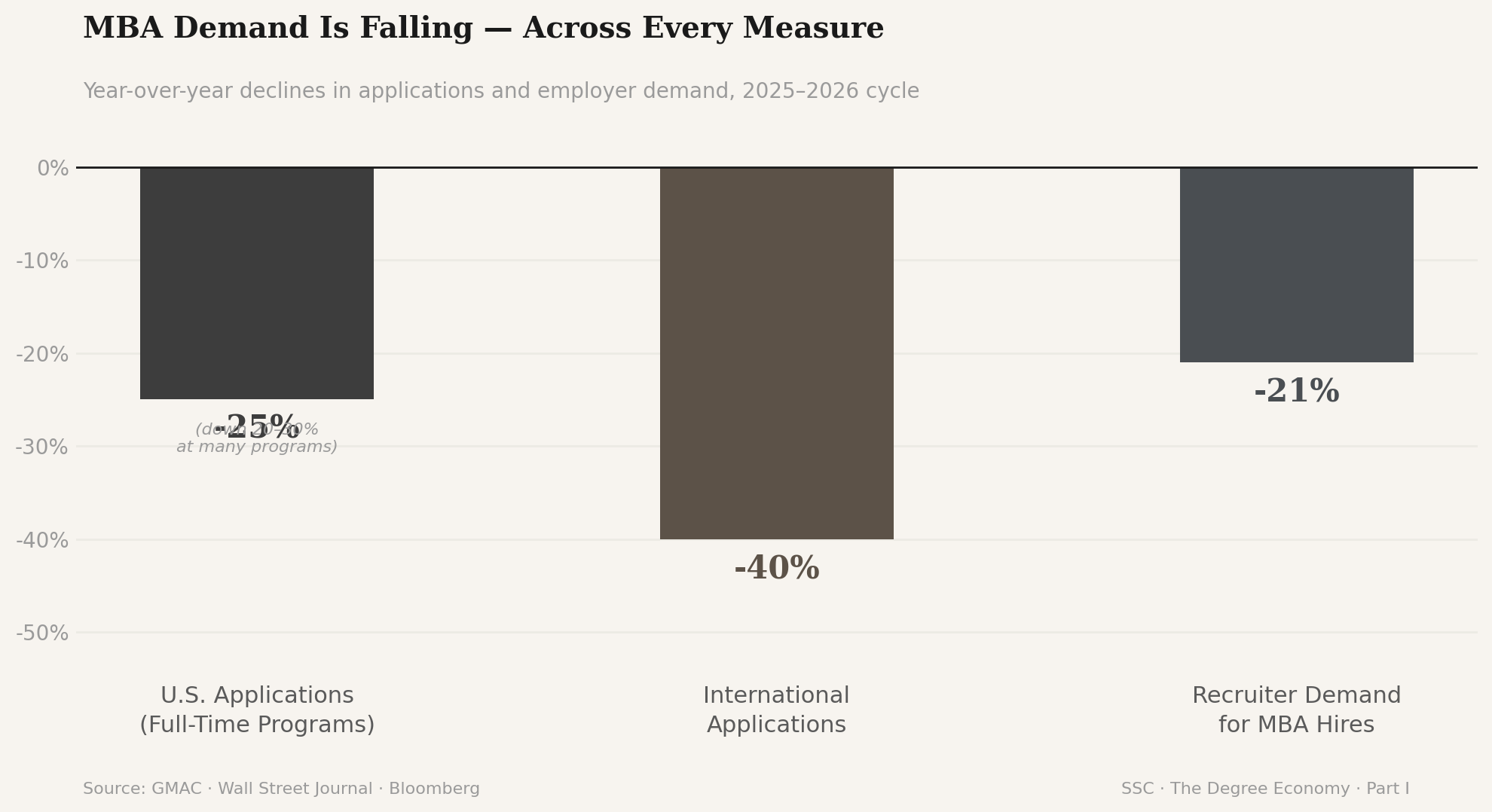
The MBA was not simply a degree. It was a pipeline. A guaranteed on-ramp to a specific class of professional opportunity: consulting, finance, operations, strategy, corporate leadership. McKinsey, Goldman Sachs, and Bain quietly cut their MBA-hire classes 20% to 40% over the last two years. The entry-level analyst and associate roles those firms used to fill with business school graduates are the first jobs AI is eliminating. The pipeline did not slow down. The destination contracted.
What business schools are discounting is not the education. It is the promise attached to it. And you cannot put that on sale.
Here is the part the press releases are not saying out loud: not a single top-20 MBA program has cut tuition. Harvard, Wharton, Chicago Booth, MIT Sloan, Kellogg — all of them are holding their rates or raising them. The schools discounting are Purdue, UC Irvine, Johns Hopkins, Washington University — respected institutions, but not the programs whose graduates walk directly into the rooms where resource allocation decisions get made.
What that tells you is that the credential is not deflating uniformly. It is bifurcating. The prestige premium is holding — for now — at the very top of the market, where the degree still functions as a social signal as much as an educational one. Below that tier, the repricing has already begun. The degree is being marked down to compete with alternatives the market is creating faster than schools can adapt to them.
A 57% of American workers now describe themselves as “job huggers” — clinging to current positions rather than stepping away to pursue a credential upgrade. That number was 45% just nine months ago. The speed of that shift is remarkable. It means that in less than a year, the psychology of professional risk has fundamentally changed. The MBA was always a calculated bet on future earning potential. Workers are no longer confident they can calculate it.
There is a structural twist embedded in the UC Irvine cut that reveals how deep this goes. The school repriced its Flex MBA from $129,000 to $99,000 — specifically to slip below the new $100,000 federal graduate borrowing cap taking effect July 2026 under the Working Families Tax Cuts Act. The school’s own pitch described it as pricing the degree “within reach of government loan limits.”
Read that sentence again. A business school repriced a graduate degree — by $30,000 — not because the education changed, not because the market research suggested that was the right number, but because a federal lending cap forced it to confront what the degree was actually worth to a borrower who needed to pay it back.
The irony is not subtle. If $99,000 is what the school now considers accessible, what was the prior $129,000 based on? The answer, if we are being direct, is that it was based on the assumption that loan availability and employer demand would make the math work for enough students to sustain the model. That assumption is now under pressure from every direction simultaneously.
What comes next is not a recovery. It is a reckoning.
The schools that can absorb tuition cuts — the ones with large endowments, diversified revenue streams, and strong regional donor bases — will weather the repricing. The schools operating on tighter margins, in more vulnerable regional markets, with less capacity to discount without destabilizing their finances, will not.
And the workers who might have used a discounted MBA to reenter a restructuring labor market will soon discover what Part II of this series examines: the jobs the degree was supposed to unlock are not simply paying less. In many cases, they are not there anymore at all.
The credential is deflating. The question is not whether that matters. It is who absorbs the cost when it does.
This is Part I of The Degree Economy, a Social Storytellers Collective series examining what happens when the credentialing system that previous generations used to build economic stability is stress-tested from every direction at once.
Part II — AI Ate the ROI — publishes tomorrow.