
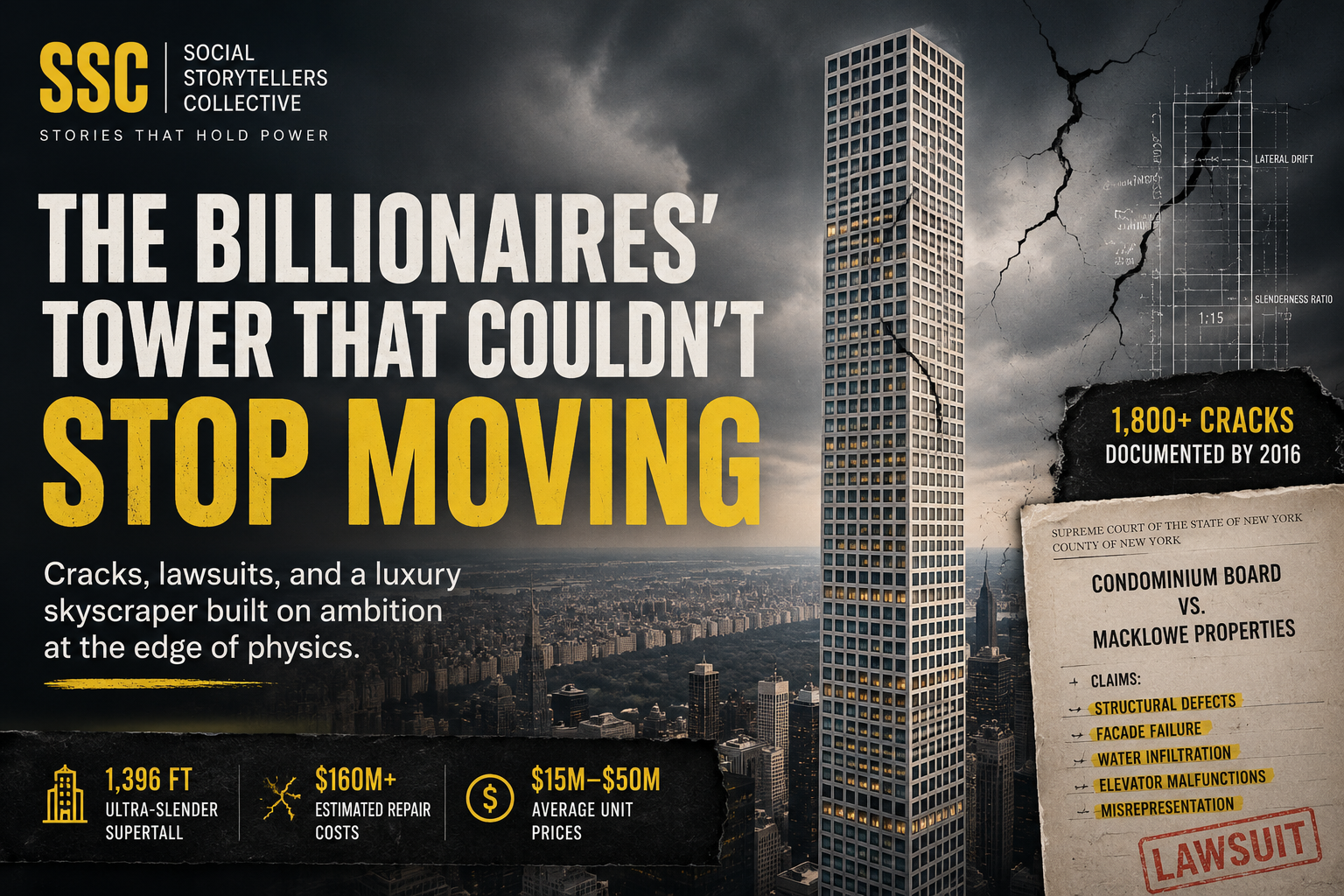
At 1,396 feet tall, 432 Park Avenue was never designed to disappear into the Manhattan skyline. It was built to dominate it. When the building opened in 2015, it announced a new era of luxury real estate: private elevators, multimillion-dollar residences suspended above Central Park, and minimalist architecture so mathematically pure it resembled a vertical grid floating over Midtown. Nearly a decade later, it is known for something else entirely — lawsuits, swaying complaints, water leaks, elevator failures, and a façade reportedly developing thousands of cracks. Residents and engineers are now fighting over whether one of New York’s most recognizable skyscrapers represents architectural ambition or a cautionary tale about chasing financial spectacle past the edge of sound engineering.
The controversy sharpened after a 2025 lawsuit filed by the condominium board alleged that developers and contractors concealed serious structural and façade defects dating back to the construction phase. The complaint claims engineers flagged problems with the all-white concrete mixture years before completion, but that developers continued anyway to avoid delays and protect the building’s aesthetic identity. Court filings cited by multiple outlets state that more than 1,800 cracks had been documented by 2016, including issues described as potential “life safety items.” Residents also alleged recurring flooding, violent noises, excessive vibration, power outages, and mechanical failures throughout the tower. Developers have denied the allegations and maintain the building is structurally safe.
What makes this larger than one troubled luxury address is that 432 Park became the global emblem of a specific real estate philosophy: ultra-slender supertalls built around prestige economics rather than urban necessity. The tower’s narrow width-to-height ratio maximized Central Park views while minimizing the footprint on some of the most expensive land on earth. But those proportions created serious engineering challenges — wind movement, structural flexibility, vibration, pressure loads — that compound the taller and thinner a building gets. Residents have described creaking during high winds and elevator disruptions from building sway, complaints that structural engineers say are growing more common among supertalls globally.
The building is often described publicly as “sinking,” though that framing undersells the actual concern. Some settling after construction is expected in any skyscraper — the issue raised in the lawsuits is whether the concrete façade is deteriorating faster than it should, cracking and absorbing water in ways that compound over time rather than stabilize. Engineers cited in reports point to spalling concrete and expanding fissures as problems that don’t fix themselves. Some remediation estimates attached to legal filings now approach $160 million — not the cost of a building in crisis, but enough to suggest that whatever is happening inside the walls is not minor.
The symbolism of the cracks cuts deep because 432 Park was sold as permanence. Units traded for tens of millions partly because buyers believed the tower represented engineered certainty — an elevated escape from the instability of the city below. But the building’s problems expose how modern luxury real estate often behaves like speculative financial architecture dressed as permanence. Many units function primarily as investment vehicles. Some reportedly sat empty for years while values fluctuated alongside the lawsuits. The deterioration feels psychologically disruptive precisely because it punctures the illusion that enough money can engineer away physical vulnerability.
The legal battles also expose a contradiction inside luxury urban development more broadly. Cities reward spectacle architecture because iconic skylines attract global capital, tourism, and prestige investment. But the race toward taller, thinner, more visually distinctive towers creates incentives that can prioritize aesthetics and speed over long-term durability. Filings tied to 432 Park repeatedly reference disputes over the exact concrete mixture — developers allegedly wanted a brighter white finish even if certain additives might have improved resilience. Whether those allegations hold up legally, the underlying tension is revealing: the building’s identity may have contributed directly to the crisis now surrounding it.
That is probably why 432 Park Avenue continues to fascinate well beyond the world of luxury real estate. The tower was built to project mastery — over land scarcity, engineering limits, wealth, and urban visibility itself. The lawsuits have turned it into something more unsettling: evidence that systems optimized purely for prestige and financial performance can quietly develop fractures long before anyone outside the building understands what is happening inside.