
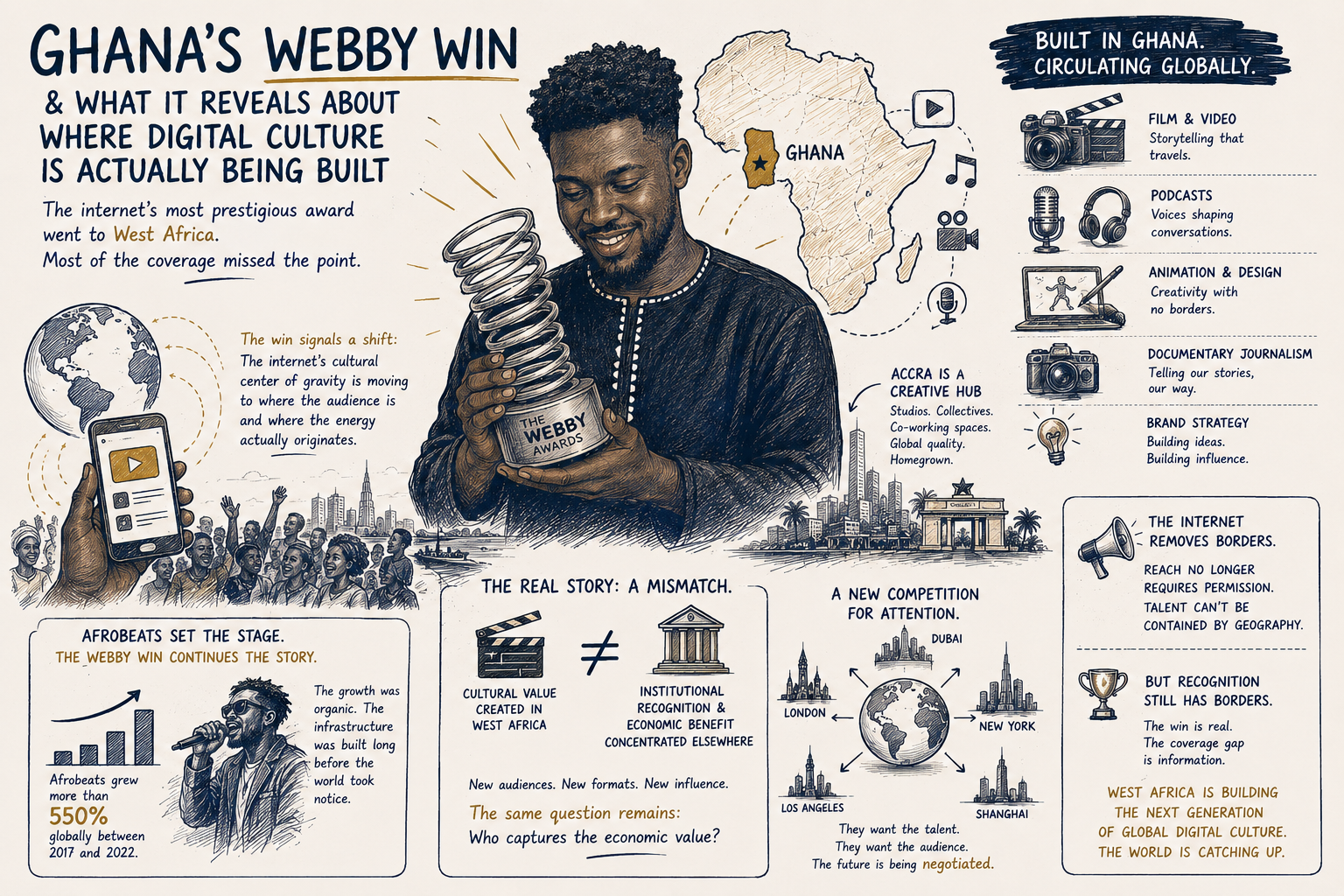
A Ghanaian creator won one of the internet’s highest honors at this year’s Webby Awards — the recognition widely regarded as the most prestigious in digital media, now in its 30th year. The win received modest international coverage. In the creator economy newsletters, it appeared briefly. In mainstream technology and culture press, it registered as a footnote, if at all. That gap between the significance of the moment and the attention it received is itself the story.
The Webby Awards have historically functioned as a barometer for where the internet’s center of gravity sits. Past winners and honorees have included the organizations, platforms, and individuals shaping how digital culture is defined, circulated, and legitimized. When the award travels to West Africa — not as a regional consolation category but in competitive recognition — it signals something the industry has been slow to formally acknowledge: the internet’s cultural production is no longer organized around the institutions and geographies that built the early web. It is being reorganized around where the audience actually is and where the energy actually originates.
Ghana’s creative economy has been building toward this kind of recognition for years, though the international press rarely covered the infrastructure underneath it. Accra has emerged as one of the most active production hubs on the continent — home to an expanding network of podcasters, filmmakers, animators, documentary journalists, brand strategists, and digital storytellers operating at global quality levels with minimal institutional support. The country’s Year of Return in 2019 reoriented diaspora investment in ways that went beyond tourism. Creative infrastructure followed: co-working spaces, production studios, creator collectives, and digital media companies whose output circulates globally even when the origin story is invisible to Western audiences.
The Afrobeats crossover economy made that invisible infrastructure briefly visible in music. Streaming platforms reported that Afrobeats grew more than 550 percent globally between 2017 and 2022. That growth was not manufactured by a label, a campaign, or a platform algorithm. It emerged from a creative ecosystem that had been building audience, refining craft, and developing distribution networks for years before global institutions arrived to monetize the attention. The Webby win belongs to the same continuum — a recognition that caught up to a reality that was already operational.
What makes the moment structurally significant is not simply the award. It is what the award reveals about the mismatch between where cultural value is being produced and where institutional recognition, investment, and economic benefit are being concentrated. West African creators are building audiences that rival Western digital media brands. They are developing formats, aesthetics, and narrative conventions that are migrating outward — into global music, fashion, film, and now digital media — in the same pattern Afrobeats established. The question that follows is the same one the music industry is still working through: when a creative ecosystem generates cultural influence at scale, who captures the economic value of that influence?
The Webby win sits inside a larger competition for narrative authority that is rarely discussed directly. International organizations, Gulf states, Western tech platforms, and global media companies are all actively recruiting African creative talent — not simply as an act of cultural inclusion but because that talent is producing content with demonstrably large, loyal, and influential audiences. Dubai’s creator programs are recruiting from the diaspora. Spotify and Apple Music restructured their African market strategies after growth numbers became impossible to ignore. International media companies have launched African editions and African editorial teams, often staffed with local talent trained to produce content within editorial frameworks designed elsewhere. The opportunity is real. The power dynamic embedded inside many of those arrangements is worth examining.
The creator who won at the Webbys did not win because a Western platform discovered them or because an international label packaged their work for global consumption. The win arrived through the work — and through an internet that, whatever its structural problems, has made it progressively harder to contain talent behind geography. That is not a small thing. It is the operating condition that makes the current moment genuinely different from what came before it. Reach no longer requires permission from legacy gatekeepers in the same way it once did.
What it still requires, too often, is institutional validation before the broader press treats the achievement as news. The Webby win is real whether or not the coverage arrives. But the gap between the win and the coverage is information — about which stories the industry considers self-evidently important and which ones require an argument to be treated as significant at all. West Africa is building the next generation of global digital culture. The mainstream media’s coverage calendar has not caught up to that fact. The Webbys, at least, have.
SSC | Culture & Society — May 18, 2026 — Social Storytellers Collective News Desk