
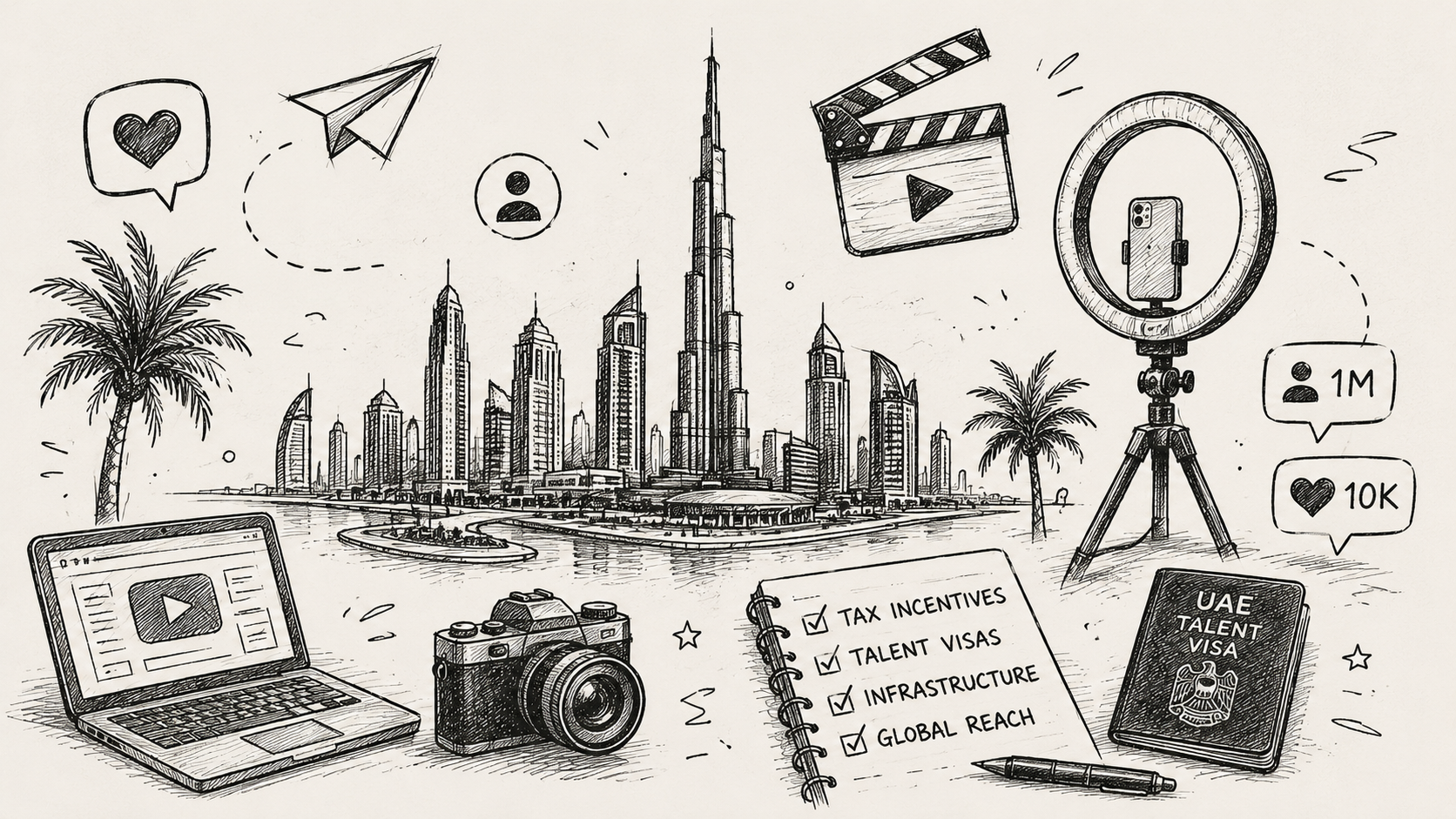
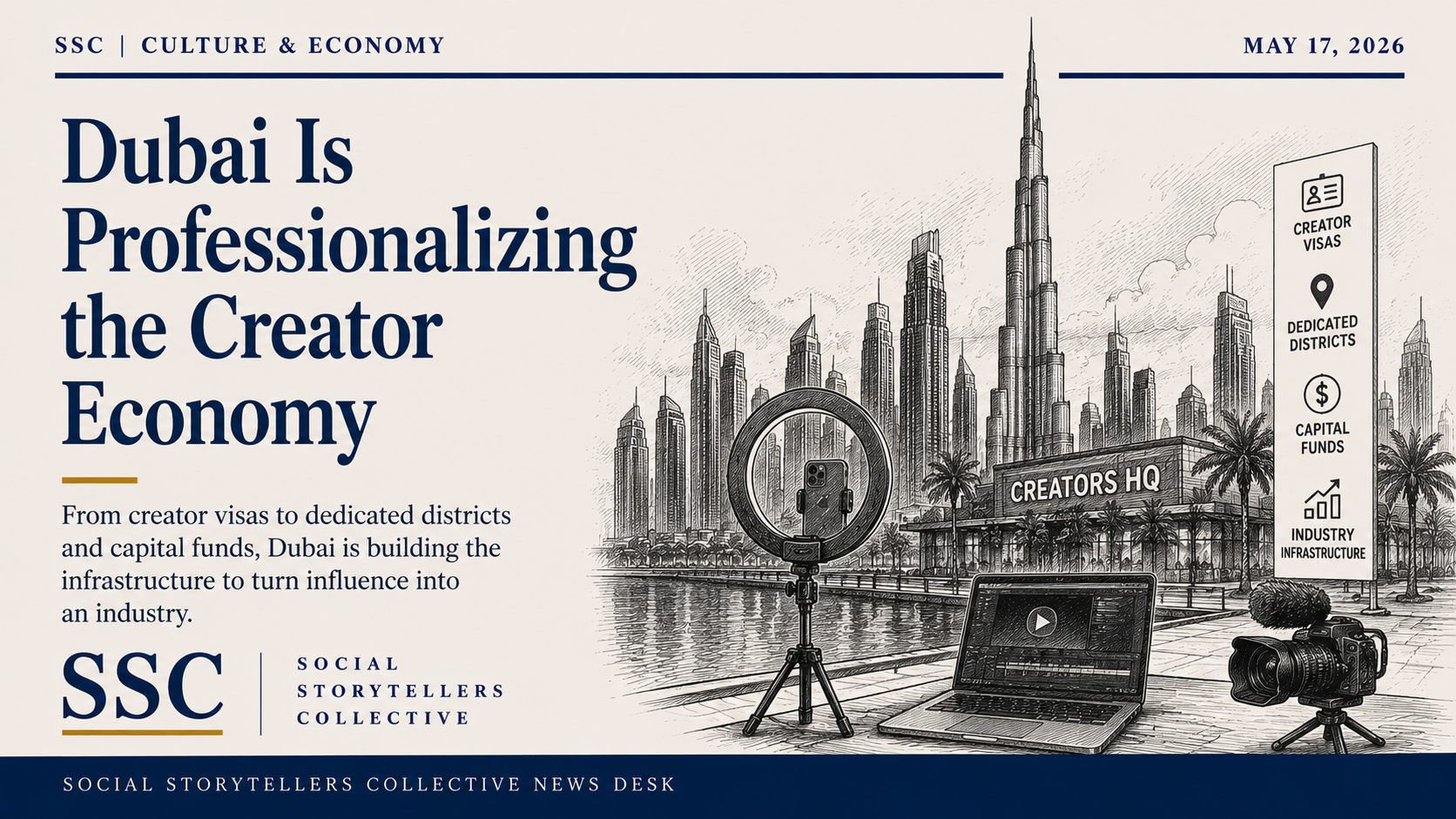
Dubai Press Club and Dubai Culture announced the third edition of the Dubai Content Creators Program this week — a two-week initiative offering roughly 40 hours of workshops on digital storytelling, audience engagement, AI-assisted production, visual strategy, and platform growth. The program brings creators, media professionals, and emerging digital talent together beginning June 8 as part of the emirate’s broader push to position itself as a global creative and media hub. On the surface, it resembles a professional development program for influencers and content creators. Operationally, it reflects something larger: governments increasingly treat digital storytelling as economic infrastructure.
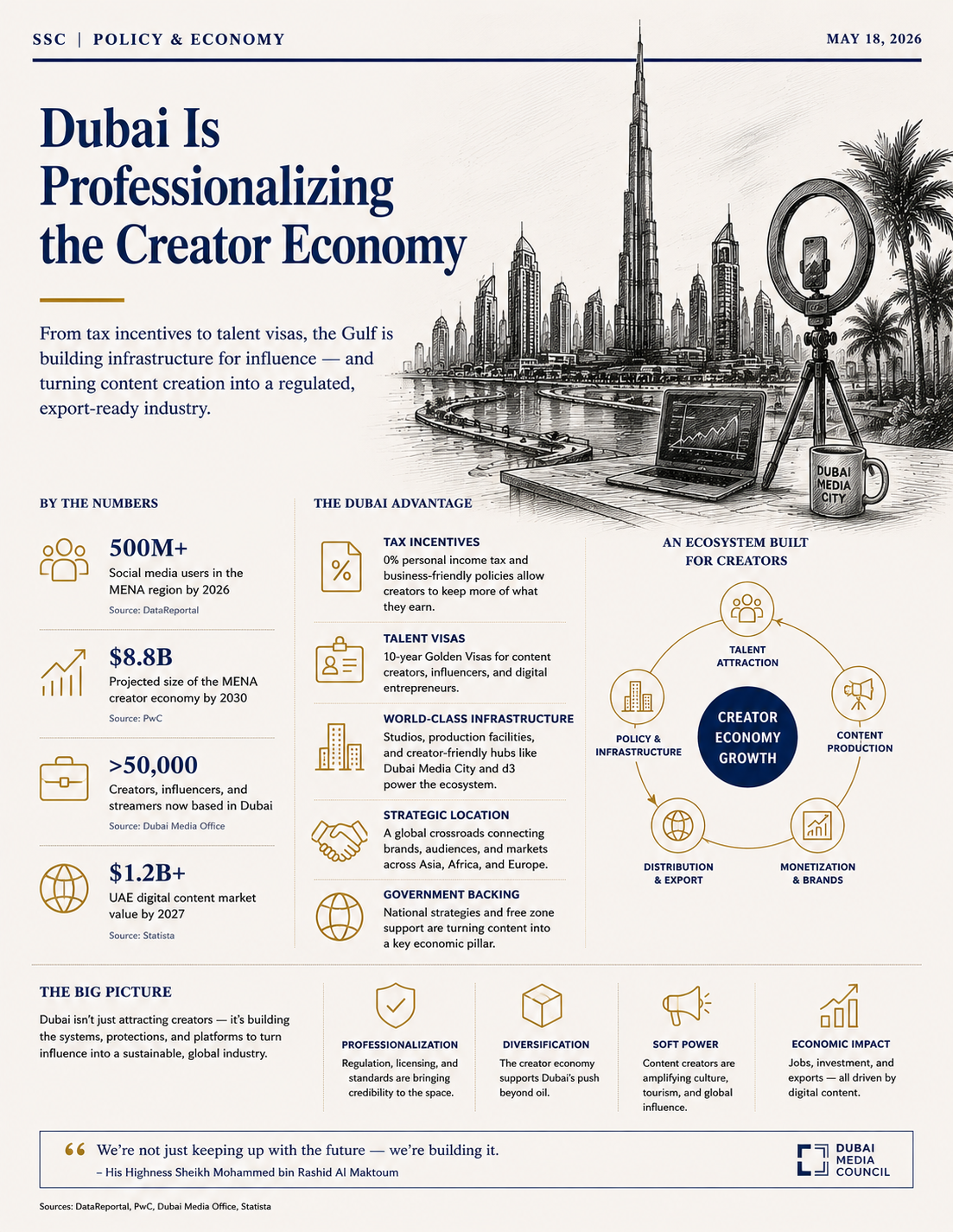
The shift aligns with Dubai’s diversification strategy as Gulf economies work to reduce long-term dependence on oil revenues by investing in tourism, finance, technology, logistics, hospitality, and media. Saudi Arabia, the UAE, and Qatar have all dramatically increased spending on sports, entertainment, film production, creator partnerships, and cultural tourism over the last decade. Dubai alone welcomed more than 17 million international overnight visitors in 2023. Attention itself has become an economic asset — one that requires active cultivation and institutional investment.
What makes the creator economy valuable to governments extends beyond advertising revenue or platform visibility. Narrative now moves investment flows, shapes tourism demand, accelerates talent migration, and shifts international perception faster than traditional institutional messaging. Cities compete through digital reputation, lifestyle branding, and algorithmic circulation as much as through infrastructure projects or tax incentives. A viral creator video can reach more potential travelers in 24 hours than many legacy tourism campaigns reached in months. Gulf governments have absorbed that shift clearly and are funding accordingly.
The inclusion of AI-focused training inside the program is especially significant. It reveals how rapidly content production expectations are changing globally — and how much pressure that creates for the people doing the work. Creators are now expected to operate simultaneously as editors, marketers, videographers, strategists, analysts, and platform managers. AI tools accelerate output, but they also intensify the expectation of constant visibility and competitive presence. The creator economy increasingly resembles high-frequency labor disguised as flexible independence. The freedom narrative frequently obscures what algorithmic systems actually reward: relentless consistency and perpetual availability.
Dubai’s program also reflects a larger geopolitical repositioning. Gulf states are aggressively competing to become global crossroads for finance, tourism, sports, luxury consumption, and media production at the same time many Western institutions face polarization and economic uncertainty. The region’s investment in creators, festivals, entertainment districts, and digital infrastructure is partly about economic diversification — and partly about narrative ownership. The goal is not simply to host global conversations. It is to shape them from a position of architectural advantage.
Governments increasingly see creators not as entertainers but as distributed media infrastructure capable of influencing consumer behavior, migration patterns, investment confidence, and cultural prestige. That reframes how public institutions approach storytelling altogether. Content creation is no longer peripheral to economic planning. It is being embedded within it — funded, trained, and directed through programs that look like cultural investment and function like strategic communication.
The question that the program’s marketing does not address is who benefits from the infrastructure once it’s built. SSC reported earlier this year on Dubai’s creative economy and the African diaspora professionals arriving there in significant numbers — drawn by tax advantages, functioning infrastructure, and immigration stability that the UK and US are increasingly withdrawing. The opportunity is real. But as SSC documented, the legal structure governing those professionals has a character the creative economy branding consistently omits. In June 2021, UAE authorities conducted mass overnight raids on African migrant workers across Dubai — people living and working legally in the country. Amnesty International, drawing on more than 100 testimonies, documented racial targeting, detention without legal representation, confiscation of documents, and mass deportation. The UAE government has never publicly addressed the findings. No accountability followed. The Kafala sponsorship system, which ties a worker’s legal residency to their employer and leaves them precarious when that relationship ends, remains operative. There is no citizenship pathway in the UAE regardless of tenure, contribution, or economic output. The creative economy is being constructed as a destination — a place to produce and generate value — not as a community to belong to permanently.
That distinction matters especially now because of who the programs are attracting. African creators, entrepreneurs, and media professionals are among the most active participants in Dubai’s creative economy expansion. As SSC has previously documented in coverage of the japa movement and the Afrobeats crossover economy, Black creative labor moving into systems not designed for long-term Black belonging consistently raises the same structural question: who captures the value that labor produces? In music, the answer appears in publishing rights and masters. In Dubai’s creator economy, it appears in visa frameworks, ownership structures, and whether the professionals generating the city’s cultural output are building equity for themselves or producing value for infrastructure they will never fully own.
The Dubai initiative ultimately reflects a transition unfolding across multiple governments simultaneously. Cities and nations are reorganizing around visibility because visibility increasingly precedes access: access to capital, tourism, talent, partnerships, and influence. The creator economy stops being about entertainment or internet fame. It becomes part of how modern economies compete for relevance in a permanently networked world. Dubai is positioning itself near the center of that competition. The professionals it is recruiting to build that position deserve to know exactly what the fine print says about what they are building — and for whom.
SSC | Culture & Society — May 18, 2026 — Social Storytellers Collective News Desk