
FIFA released “Dai Dai” this week as the official anthem for the 2026 World Cup, pairing Shakira with Nigerian superstar Burna Boy and attaching the song to the FIFA Global Citizen Education Fund. FIFA also confirmed a halftime show for the tournament final featuring Madonna, Shakira, and BTS — a lineup engineered less like a concert and more like a demographic map of the modern internet. The 2026 tournament will span the United States, Canada, and Mexico, becoming the largest World Cup ever staged. Long before the first kickoff, the infrastructure surrounding the event is already revealing what global sports has become: a permanent culture platform designed to monetize attention across language, geography, and identity simultaneously.
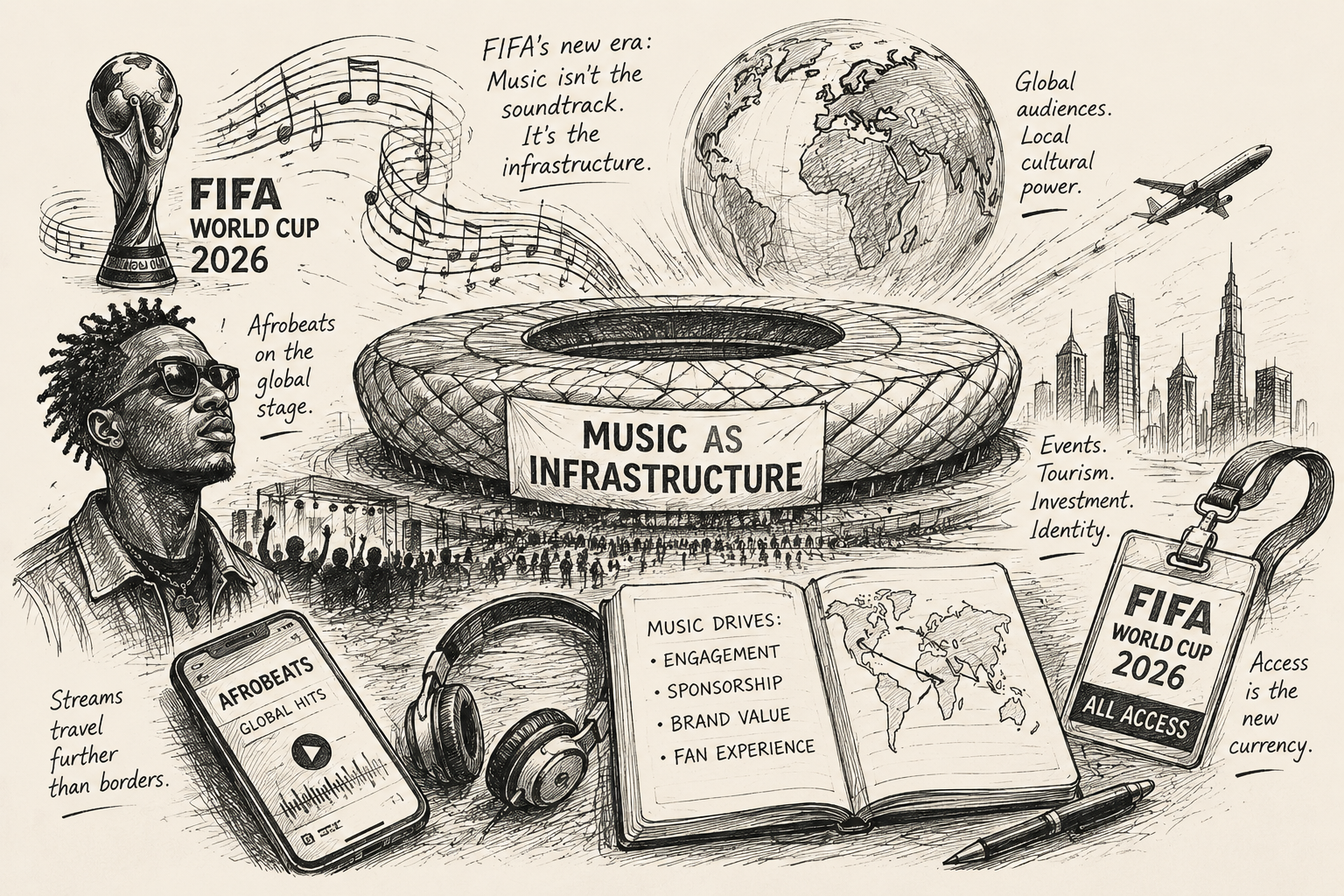
The shift matters because the World Cup no longer operates as a sports tournament that happens to include entertainment. Entertainment is now part of the tournament’s core architecture. FIFA understands that music compresses geography faster than sport alone. Burna Boy’s inclusion is not simply artistic collaboration — it reflects the economic ascent of Afrobeats as a global export category. Spotify reported Afrobeats streams increased more than 550 percent globally between 2017 and 2022. Goldman Sachs projects the global music industry could surpass $130 billion in annual revenue by 2030. FIFA is building around that momentum because cultural scale now determines commercial scale.
The deeper transformation is that international sporting events are beginning to resemble streaming platforms. The old model centered on live attendance and television ratings. The new model prioritizes year-round cultural circulation: clips, collaborations, soundtrack licensing, creator content, influencer partnerships, branded fashion drops, and algorithmic visibility. FIFA is treating the World Cup as a multi-continent engagement funnel. The song is not promotion for the event. The song is part of the product. That distinction matters because it changes how institutions measure value — audience retention now carries as much weight as competition results.
There is also a labor dimension embedded beneath the spectacle. Global tournaments increasingly depend on cultural workers — musicians, creators, producers, stylists, videographers, choreographers — to sustain emotional investment before and after matches. The sports economy is quietly absorbing the creator economy into its operational model. Formula One expanded this logic through Netflix’s Drive to Survive. The NBA built it through player-driven fashion and podcast ecosystems. FIFA is now scaling the same approach globally, and the workers sustaining that apparatus rarely appear in the revenue figures.
The contradiction is that institutions still present these collaborations as organic celebrations of diversity while operating through highly centralized commercial incentives. FIFA generated roughly $7.6 billion from the 2022 World Cup cycle. The expanded 2026 tournament is expected to push revenues higher through larger sponsorship inventories, more matches, and broader digital reach. Burna Boy, BTS, and Shakira reflect genuine global influence — and they also reflect the economic reality that audience growth now depends on regions historically treated as secondary entertainment markets. The global South is no longer simply consuming culture. It is driving the economics of it.
The mainstream framing reduces announcements like these to celebrity spectacle or “international unity.” The more significant story is that major institutions now treat cultural participation as a logistics system. Music lowers the friction of global engagement. It creates emotional continuity across borders before policies, products, or brands can. FIFA is not selling tickets to matches in 2026. It is building an emotional operating system capable of keeping billions of people engaged for months before the first game is played. The anthem is not the opening act. It is the product launch.
SSC | Culture & Society — May 18, 2026 — Social Storytellers Collective News Desk