
SSC first covered this story with The 8% Is No Longer Quiet — a piece tracking the viral moment that fueled Black men with master’s degrees to post their credentials online en masse, turning a statistic into a movement. What followed was harder to predict.
On May 8, one post on X cut through the platform’s usual churn of outrage, celebrity updates, layoffs, and political warfare with unusual force. “Can we shift focus to the sheer volume of black people GRADUATING COLLEGE TODAY???” user @SolRadiant7 wrote. “I ain’t seen nothing but caps, gowns, degrees, and TEETH.” Within days, the post crossed more than 1.1 million views and became less a single viral tweet than a temporary digital corridor. Every scroll revealed another graduate: master’s degrees, law degrees, first-generation graduates, fourth-generation graduates, doctoral robes, cords, stoles, ceremonies, family photos, acceptance letters, and declarations of generational advancement. The scale mattered — not because Black graduation is new, but because social media briefly behaved as if Black academic achievement was culturally central instead of statistically incidental.
What made the moment notable was not simply celebration. Black graduation content appears online every spring. What changed was the density. The timeline stopped functioning like a stream of isolated personal updates and started behaving like collective visibility. Users were not encountering one successful graduate; they were encountering hundreds in rapid succession. That repetition altered perception. It disrupted the long-standing imbalance between how Black life circulates algorithmically and how Black achievement circulates institutionally. For years, platform economies have disproportionately rewarded trauma, conflict, spectacle, criminalization, and ideological confrontation when Black audiences become highly visible online. But this particular cycle forced another reality into view: an enormous volume of Black students are still moving through higher education despite rising tuition, mounting student debt, attacks on DEI infrastructure, housing instability, and deepening uncertainty about what a degree actually guarantees in the economy waiting on the other side.
That context matters because these graduation posts emerged during one of the most politically hostile periods toward diversity initiatives in the recent history of American higher education. Just days after the viral graduation wave, Reuters reported that the American Bar Association voted to eliminate a longstanding DEI accreditation requirement for law schools, bowing to pressure from the Trump administration and Republican-led states. The ABA’s move was not an isolated act. It arrived alongside a cascade of institutional retreats: executive orders stripping diversity requirements from federal contractors, the Department of Education threatening to withhold funding from universities that maintained race-conscious programs, and the downstream effects of the Supreme Court’s 2023 ruling ending affirmative action in college admissions still reshaping enrollment pipelines. The coordinated nature of these rollbacks matters. This was not a series of independent policy decisions but a sustained attempt to dismantle the structural scaffolding that, however imperfectly, had supported broader access to elite and professional education over the previous half century. The symbolism became difficult to ignore. At the exact moment institutions were publicly abandoning diversity commitments, Black users were flooding the internet with visible evidence of educational persistence. The contradiction exposed something deeper about this moment: institutional support for inclusion may be shrinking, but the pursuit of educational mobility inside Black communities has not disappeared with it. If anything, the external pressure appears to be intensifying the symbolic weight of achievement itself.
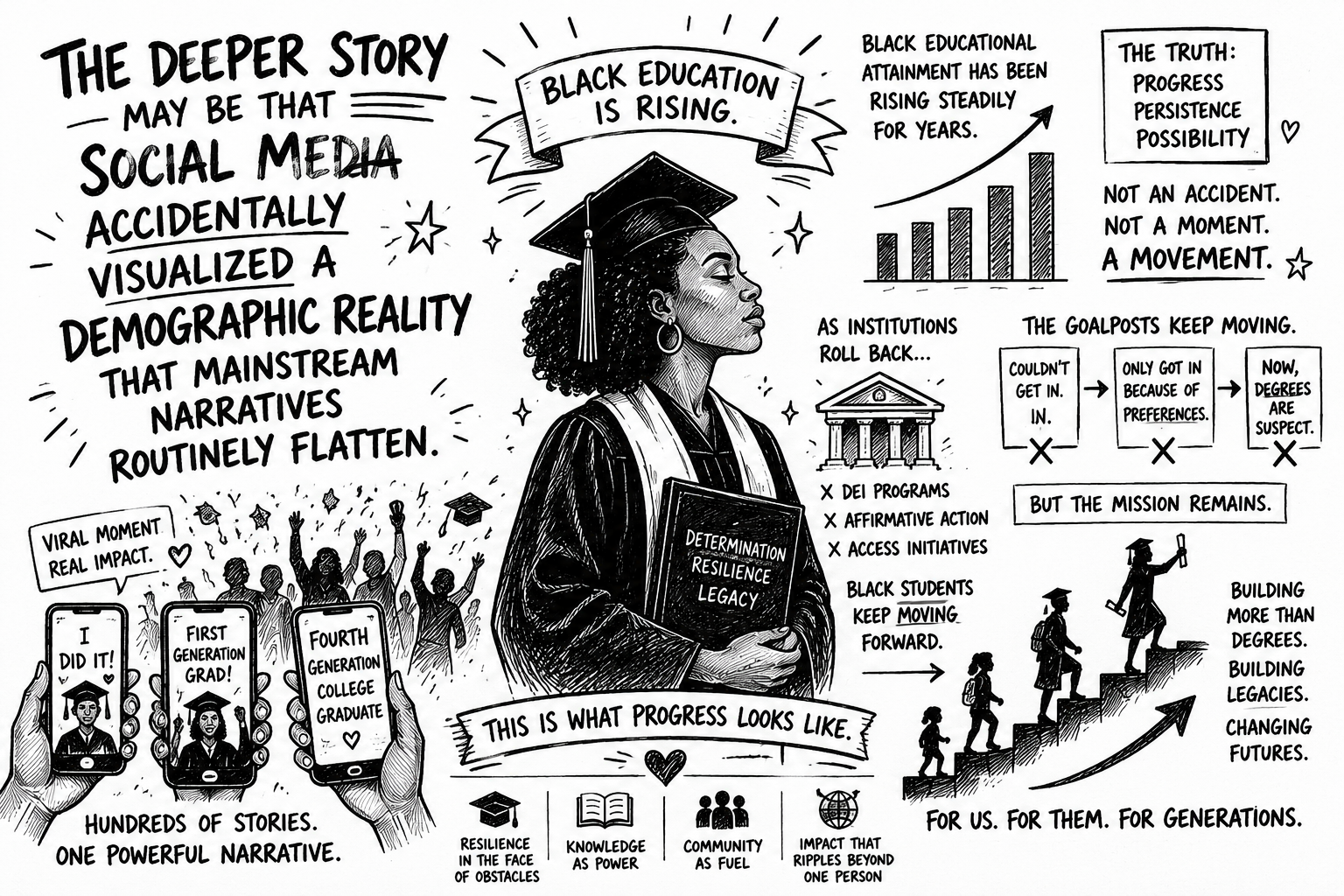
The responses underneath many graduation posts revealed another layer of the story. Alongside celebration came backlash, arriving almost immediately. Some users attributed the visible graduation wave to “DEI passes.” Others questioned academic legitimacy outright. The speed of the hostility mattered because it revealed how educational visibility itself has become a political flashpoint — but it also revealed something about how the terms of that hostility keep shifting. For decades, the dominant argument was that Black students could not gain access to elite institutions. After affirmative action expanded that access, the argument migrated: they got in, but only because of preferences. Now, as Black graduation rates rise and DEI infrastructure erodes, the argument has shifted again — degrees themselves are suspect, credentials are questioned, achievement is reframed as accommodation. The goalposts do not move randomly. They move in whatever direction keeps Black educational accomplishment from registering as simply that. What this means is that Black success online now increasingly triggers the same ideological reactions once reserved primarily for corporate hiring debates or admissions policy fights. In earlier generations, educational attainment functioned as one of the few universally affirmed symbols of upward mobility — a metric that transcended political lines. Online, that consensus is collapsing. Achievement is no longer simply viewed as achievement. It is filtered through algorithmic tribalism, political grievance, and demographic anxiety. The existence of visible Black excellence now regularly becomes raw material for someone else’s ideological argument.
But the posts themselves also revealed something the backlash could not fully contain: collective aspiration still exists at scale. Many of the graduation photos were not framed as individual triumph alone. Users repeatedly referenced parents, grandparents, lineage, and generational movement. One graduate celebrated becoming a fourth-generation college graduate. Another referenced becoming the second attorney in the family. Another described “building generational wealth.” Those phrases matter because they signal that higher education within many Black communities still functions not merely as personal fulfillment but as infrastructure. And that framing persists even as the economic logic underlying it becomes more complicated. The wage premium attached to a college degree has narrowed in some fields. Student loan burdens fall unevenly across racial lines, with Black borrowers statistically more likely to carry debt longer and into lower-wealth households. The return on a degree is not guaranteed in the way it once appeared to be. Yet for many Black families, the calculus has not changed — because the alternative is worse. Degrees are still treated as stabilization tools, as floors against the most precarious economic outcomes, in an era where wages, housing access, healthcare affordability, and long-term security feel increasingly unreliable for anyone without credentials. The emotional intensity surrounding the posts reflected more than pride. It reflected relief. Survival. Proof of continuity.
The deeper story may be that social media accidentally visualized a demographic reality that mainstream narratives routinely flatten. Black educational attainment has been rising steadily for years. The share of Black Americans holding at least a bachelor’s degree has grown significantly over the past two decades, and Black enrollment in graduate and professional programs has climbed alongside it, including in law, medicine, and doctoral fields historically resistant to integration. These are not marginal gains. But they rarely dominate cultural perception because visibility online is not neutral. Algorithms tend to prioritize conflict over continuity and spectacle over accumulation. The result is a persistent gap between what is actually happening demographically and what the internet reflects back as the story of Black life. What happened during that viral graduation cycle was effectively a temporary narrative override. The platform could no longer reduce Black visibility to outrage cycles because too many users were posting evidence of disciplined, long-term achievement simultaneously. The timeline briefly became archival instead of reactive. It documented accumulation instead of collapse.
That may ultimately be why the moment resonated so deeply. “The 8% Is No Longer Quiet” argued that demographic visibility shifts once numbers become culturally undeniable. This second phase reveals something even more important: visibility changes the emotional architecture of the internet itself. For a few days, Black users were not primarily responding to crisis. They were documenting momentum. And in a digital ecosystem engineered to amplify instability, that alone felt like an act of disruption.