
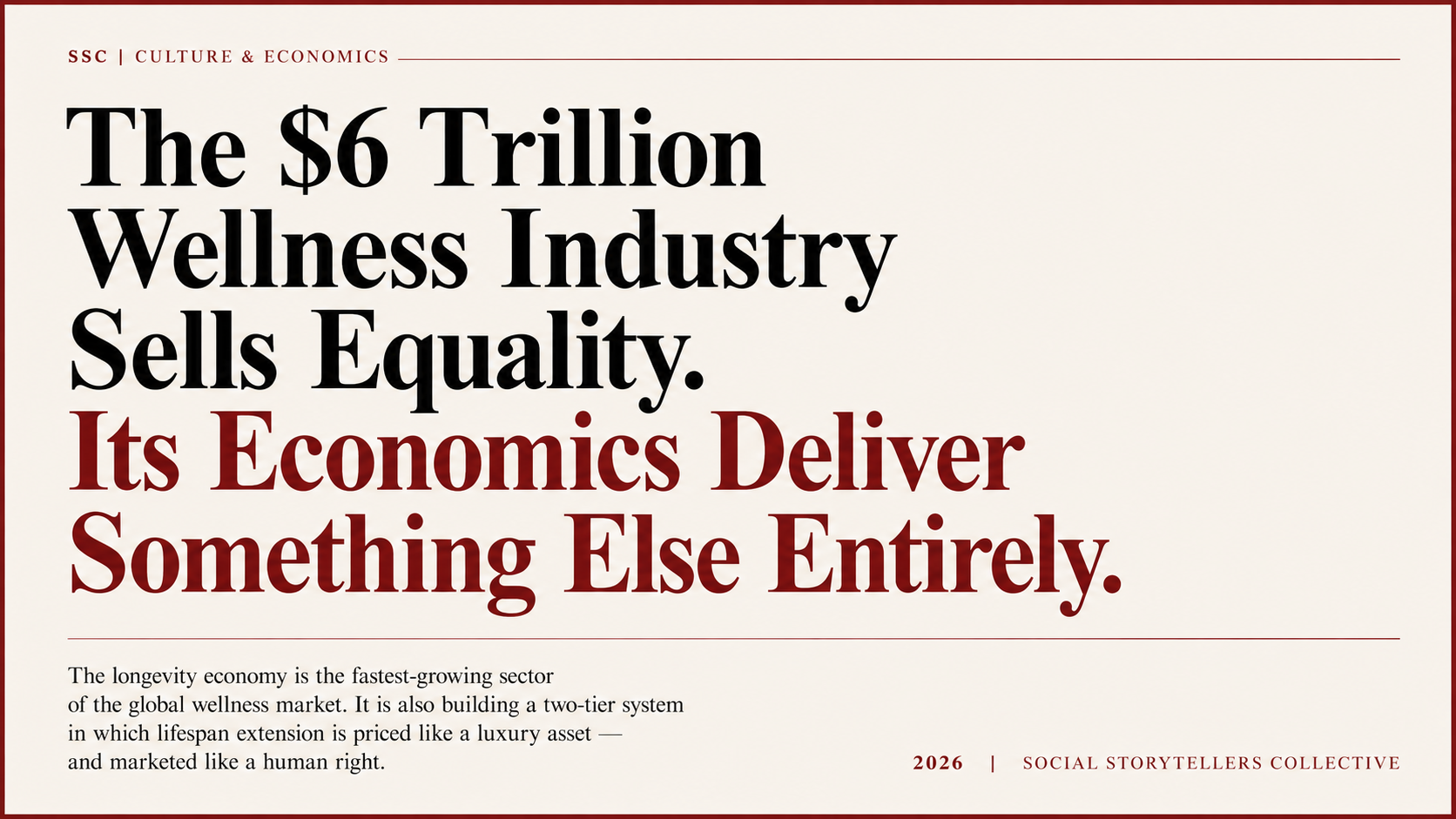
It is also building a two-tier system in which lifespan extension is priced like a luxury asset — and marketed like a human right.
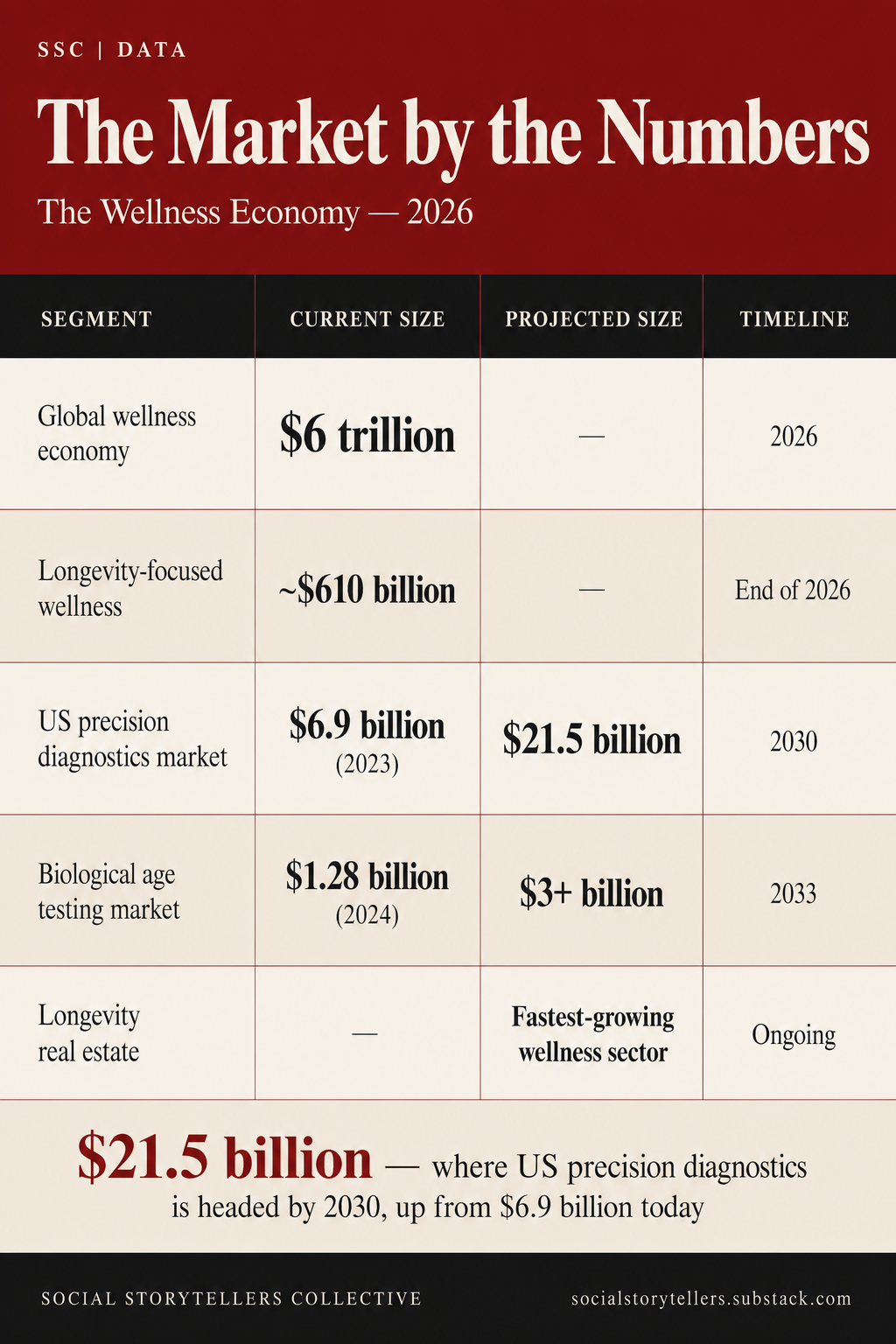
The global wellness economy crossed $6 trillion in 2026. The longevity-focused segment within it — biological age testing, precision diagnostics, CGM-guided coaching, longevity residences, peptide protocols, and bio-optimization services — is projected to reach $610 billion by year’s end. The marketing language across this industry is almost uniformly democratic: treat your health like hygiene, make longevity accessible, your body, your data, your choices. The economic architecture underneath that language is building the most sophisticated tiered-access health system the world has ever seen — one that is not organized around diagnosis and treatment, but around optimization and prevention, and that prices accordingly.
This is not a story about whether longevity science works. Most of it does, in degrees, for the people who can access it. It is a story about who that population is, how it is being constructed, and what the rest of the market gets sold while the infrastructure of extended healthy life is being built for someone else.
The Two Tiers
The bifurcation of the wellness industry is real and measurable, though rarely named as such by the industry itself. At the accessible tier: apps, supplements, fitness content, wearable devices, and preventive health messaging that is widely distributed, heavily marketed, and genuinely useful at the margin. At the elite tier: biological age testing, continuous glucose monitoring with clinical coaching, precision diagnostics panels, peptide and hormone optimization protocols, longevity residences designed around life extension, and concierge preventive medicine practices that operate entirely outside insurance billing.
The accessible tier costs tens to hundreds of dollars. The elite tier costs thousands to hundreds of thousands. A comprehensive biological age panel runs $300–$3,000 depending on the provider and the markers tested. A full-body MRI longevity scan from Prenuvo runs approximately $2,500 out of pocket, with no insurance coverage. A year in an emerging “longevity residence” — communities designed around healthy aging with integrated medical monitoring — costs at the scale of luxury real estate. Peptide protocols, when administered through concierge medicine, can run $500–$2,000 per month.
None of this is covered by standard health insurance. All of it is positioned as the frontier of preventive care. The market for it is growing at double-digit rates annually, concentrated among high-income consumers who already have access to the best conventional healthcare in the world and are now purchasing the next layer above it.
What the Mass Market Gets Instead
The mass market wellness industry — the $6 trillion — runs on a different product: the performance of optimization, rather than its substance. Supplement stacks with limited clinical evidence. Fitness content optimized for engagement rather than outcome. Sleep tracking that generates data without changing the structural conditions — work schedules, financial stress, housing quality — that produce poor sleep. Mindfulness apps that address the symptom of anxiety without touching the labor and economic conditions producing it.
This is not fraud, exactly. Supplements can be genuinely useful. Exercise content can change behavior. Sleep data can produce useful insights. But the wellness industry’s marketing consistently overstates the relationship between consumer products and health outcomes — and the gap between what is marketed and what is demonstrated is largest at the affordable end of the market, and smallest at the expensive end. The people paying $2,500 for a precision scan are getting precision data. The people paying $30 for a supplement stack are getting marketing copy backed by limited evidence.
The industry knows this. The research base on most consumer supplements is thin, contested, or actively misleading. The US precision diagnostics market is growing because high-income consumers are spending real money on real tests that produce real data. The supplement market is growing because a much larger population is spending smaller amounts of money on products whose primary function is making people feel like they are doing something about their health.
The Access Architecture
The longevity economy is building its infrastructure in places and through mechanisms that are structurally inaccessible to most Americans. Longevity residences — a new category of wellness real estate — are emerging in high-cost metros and resort markets. Concierge preventive medicine practices operate on annual retainer models that range from $1,500 to $10,000+ per year, entirely outside insurance. Direct-to-consumer diagnostic platforms require credit cards and an internet connection, and while that is not the highest access barrier, it is not nothing — and the follow-up clinical interpretation of the data those platforms produce requires a physician relationship that lower-income patients often do not have.
The public health consequence of this bifurcation is not hypothetical. If the people with the most access to advanced preventive care are also the people who already have the best health outcomes — because of income, education, nutrition, housing, and reduced chronic stress — then the longevity economy is not closing health equity gaps. It is widening them with better data.
What the Tech Bros Got Wrong (And What They Got Right)
A CNN piece published in April 2026 examined what the tech-bro longevity movement — epitomized by figures like Bryan Johnson, who reportedly spends $2 million per year on his own biological optimization — gets right and wrong. The piece, drawing on commentary from journalist Kara Swisher and longevity researchers, argued that the fundamentals of longevity science are more accessible than the influencer economy suggests: sleep quality, consistent movement, strength training, social connection, and reduced chronic stress account for the majority of measurable longevity benefit. The expensive interventions — exosome infusions, plasma exchange, pharmaceutical stacks — operate at the margin of a margin, in populations that have already optimized everything else.
That argument is important, and largely correct, as far as it goes. The problem is structural: the conditions that produce good sleep, consistent movement, and reduced chronic stress are not equally distributed. A person working two jobs in a shift economy, living in a food desert, commuting 90 minutes each way in a city with limited public transit, does not have equal access to the lifestyle variables that longevity science identifies as most important. The fundamentals are free in theory. In practice, they are purchased by time, income, housing quality, and neighborhood infrastructure that are not equally available.
The Real Stakes
The wellness industry’s two-tier architecture matters beyond individual consumer decisions because health is the most consequential form of access inequality. Income inequality produces financial precarity. Educational inequality shapes professional trajectory. Health inequality determines length and quality of life itself. A system in which the most advanced preventive care is being built for and marketed to the people who need it least — who already have the best health outcomes, the most physician access, and the most resources to act on health information — is a system that compounds every other form of inequality over time.
The $6 trillion number is not evidence that wellness has been democratized. It is evidence that the market for the performance of health has become very large. Those are not the same thing. And the distance between them — between what the industry sells and what it delivers, between who can access the science and who gets sold the supplement — is where the real public health story of the next decade lives.