
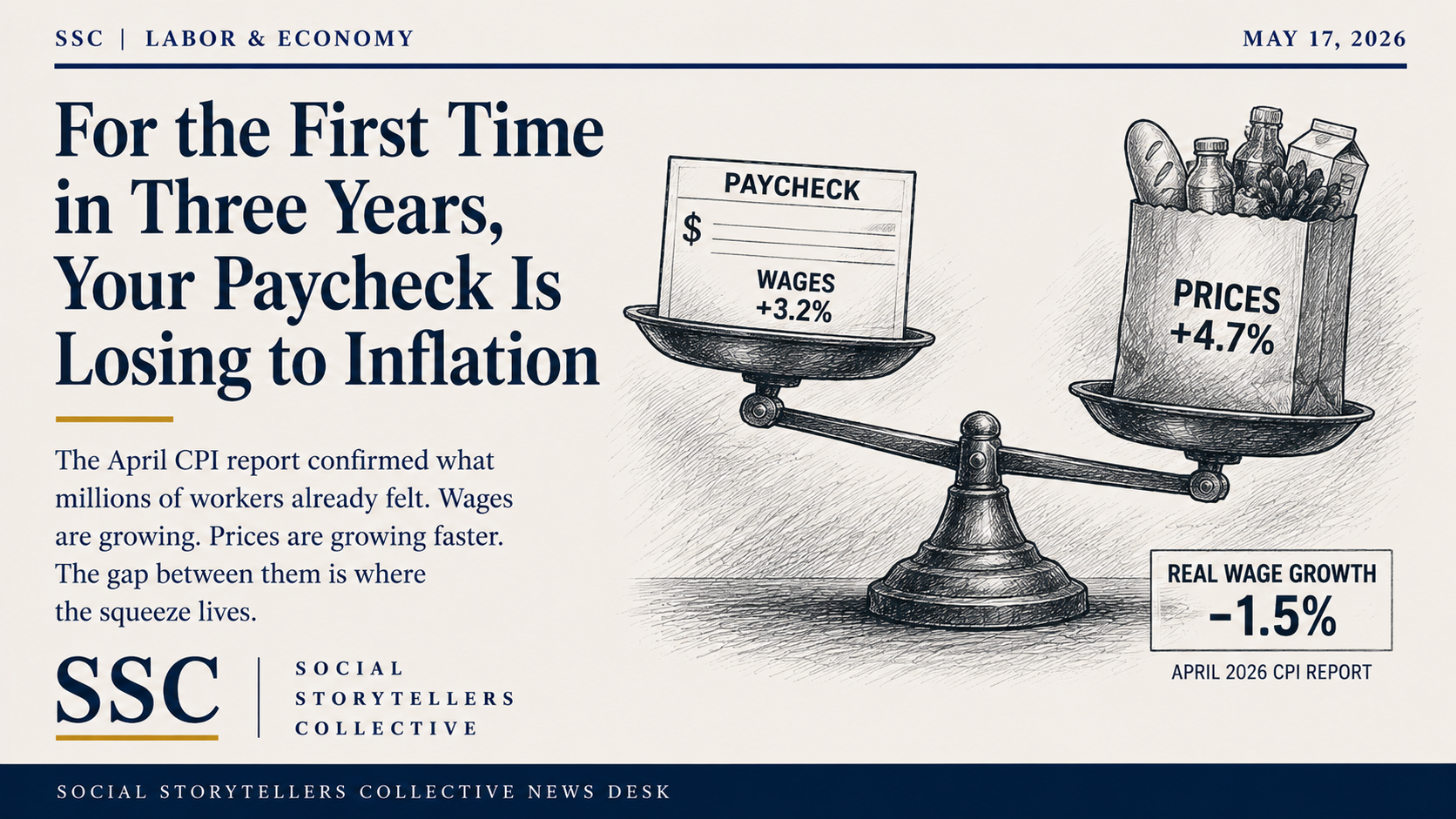
The April 2026 Consumer Price Index report arrived this week with a number that reframes the economic story the White House has been telling. Inflation came in at 3.8 percent year-over-year — the highest annual rate since May 2023 — driven primarily by an energy spike that accounted for more than 40 percent of the monthly increase. Wages, meanwhile, grew at 3.6 percent over the same period. The math is simple and the conclusion is direct: for the first time in three years, American workers are losing ground.
Real average hourly wages fell 0.3 percent annually and slipped 0.5 percent in April alone. Real average weekly earnings fell 0.2 percent between April 2025 and April 2026. These are not rounding errors or statistical noise. They are the measurable distance between what a paycheck covers this month and what it covered last year — a distance that households absorb through reduced savings, accumulated debt, deferred purchases, and the quiet recalculation of what they can afford to do.
The official unemployment rate is 4.3 percent. The White House has pointed to job creation numbers as evidence of economic strength. Both of those things can be true, and the real wage data can also be true. Employment and purchasing power are not the same measure. A person can have a job and be falling behind simultaneously. The April report documents exactly that condition — a labor market where people are working but where the value of that work, denominated in what it actually buys, is declining.
The energy component deserves specific attention because it is not a domestic policy variable the administration can easily manage. Oil prices are responding to geopolitical pressures in the Middle East that are outside the direct control of any single government’s economic policy. Energy costs shape inflation in ways that are fast and regressive — they hit lower-income households, who spend a larger share of their income on gasoline and utilities, harder than higher-income households with more discretionary flexibility. An inflation spike driven by energy is not evenly distributed across the income spectrum. It is concentrated at the bottom.
This is also the context in which the Federal Reserve is transitioning leadership. Powell’s term ended on May 15. Kevin Warsh was confirmed as chair two days prior. The mandate Warsh inherits — bring inflation back toward the 2 percent target without triggering a recession — has not become simpler. The policy tools available to him are the same blunt instruments his predecessor navigated: rate adjustments that slow the economy broadly, without the precision to target the specific inputs, like energy prices, driving the current spike. Raising rates reduces demand. It does not reduce the cost of a barrel of oil affected by a conflict on the other side of the world.
What the April data reveals, underneath the headline numbers, is the texture of an economy in which the aggregate statistics and the lived experience are increasingly divergent. GDP continues to register growth. Corporate earnings in the most recent quarter were strong in several sectors. The S&P 500 has recovered from earlier volatility. These measures capture activity at the top of the income distribution — in investment portfolios, in executive compensation, in sectors where AI-driven productivity gains are being banked as profit rather than redistributed as wages. They do not capture what is happening at the kitchen table when a family recalculates whether they can afford the same grocery run they made last April.
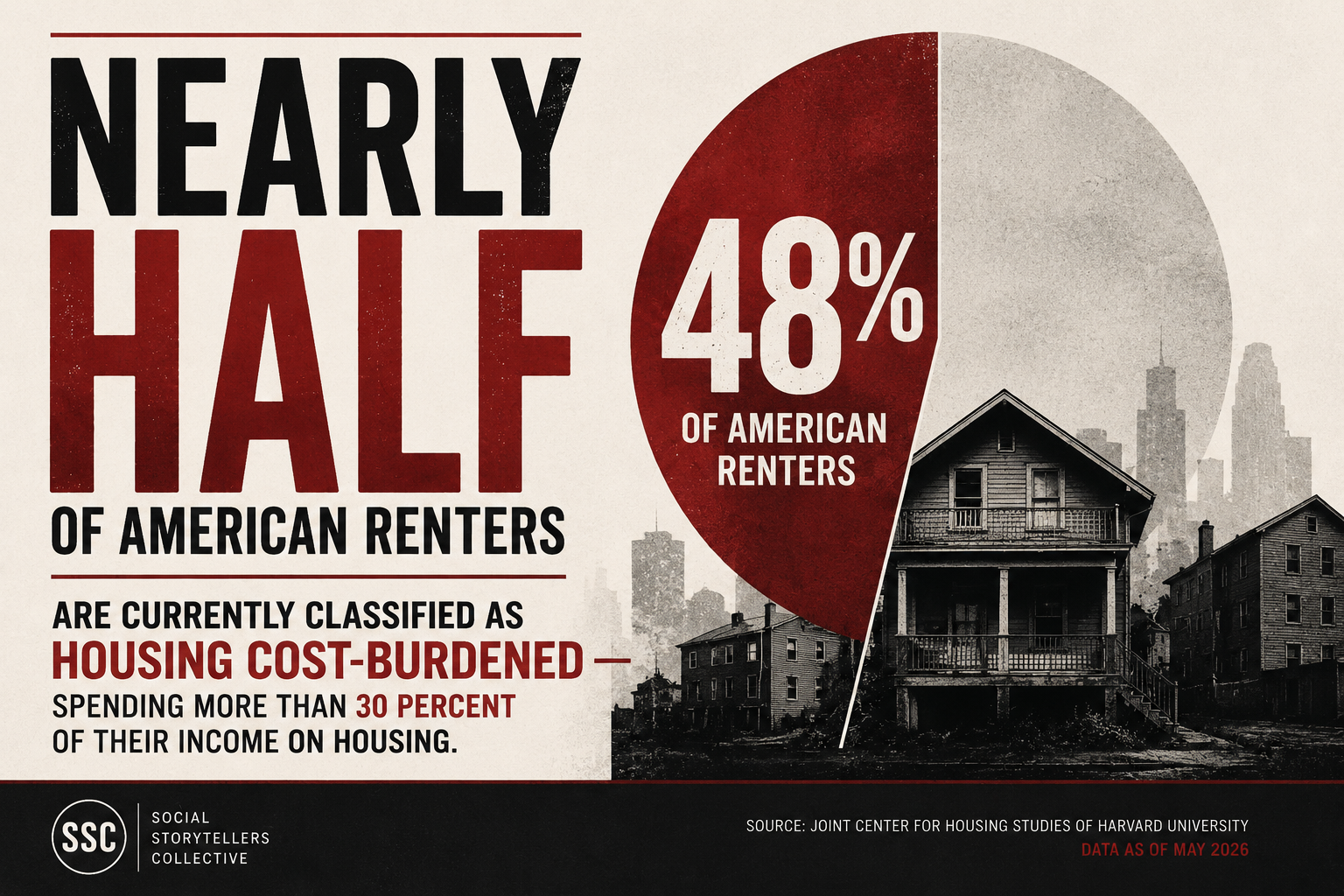
Nearly half of American renters are already classified as housing cost-burdened — spending more than 30 percent of their income on shelter. For those households, an inflation spike driven by energy on top of existing housing pressure is not an abstract economic data point. It is a reduction in the number of things they can pay for. The political vocabulary around inflation tends toward the aggregate — the rate, the index, the trend. The economic experience of inflation tends toward the specific: the thing you used to be able to afford that you now cannot.
For three years, wage growth outpaced inflation by enough to produce modest real gains for workers. That period appears to have ended in April. Whether it ends for a month or for a sustained stretch depends on energy prices, Fed policy, and global conditions that are genuinely difficult to forecast. What is not difficult to understand is what real wage decline means for the households already navigating the thinnest margins in the economy. They do not need a CPI report to feel it. They felt it at the gas station. They will feel it again at checkout. The data is simply confirmation of something that arrived before the numbers did.